
Tokyo in January is the coldest, clearest and one of the two driest months of the year: highs around 10°C, about 60 mm of rain spread over roughly five days, and the best odds you will get of seeing Mount Fuji from the middle of the city. It is also the month Tokyo closes for three days and then holds the largest gathering in Japan. Plan the first week carefully and the rest of the month is one of the best-value trips in Asia.
The New Year shutdown, and why the dates matter
From roughly 29 December to 3 January a large part of everyday Tokyo stops. Independent restaurants, small shops, many clinics, some museums and most offices close for the oshogatsu holiday, and they do it without much warning online. What stays open: convenience stores, chain restaurants, most department stores from 2 January, the trains, and the major temples and shrines – which are the busiest places in the country.
This is not a reason to avoid early January. It is a reason to know which trip you are taking. If you arrive on 30 December you are visiting a city in holiday mode, with an extraordinary religious festival running through it. If you arrive on 5 January you are visiting a normal Tokyo at its cheapest and clearest.
Hatsumode: the first shrine visit of the year
Hatsumode – the year’s first visit to a shrine or temple – runs from just after midnight on 1 January through the first few days. Meiji Jingu in Shibuya draws around three million people over the first three days, which makes it the single busiest place in Japan; Senso-ji in Asakusa and Kanda Myojin are close behind.
Three practical rules. Go at dawn on 2 or 3 January rather than at midnight on the 1st, when the queue at Meiji Jingu can take two hours to move. Or pick a neighbourhood shrine instead – the ritual is identical and you will be one of thirty people rather than thirty thousand. And note that many train lines run all night on New Year’s Eve, which is the one night of the year Tokyo’s last-train rule is suspended.
Weather: dry, bright, and genuinely cold
January averages a high near 10°C and a low around 0–2°C, with frost on the coldest mornings, and it is one of the two driest months of the year – around 60 mm of rain across about five days. Humidity is low, the sun is out most days, and the combination of cold dry air and low cloud makes it the clearest month for long views.
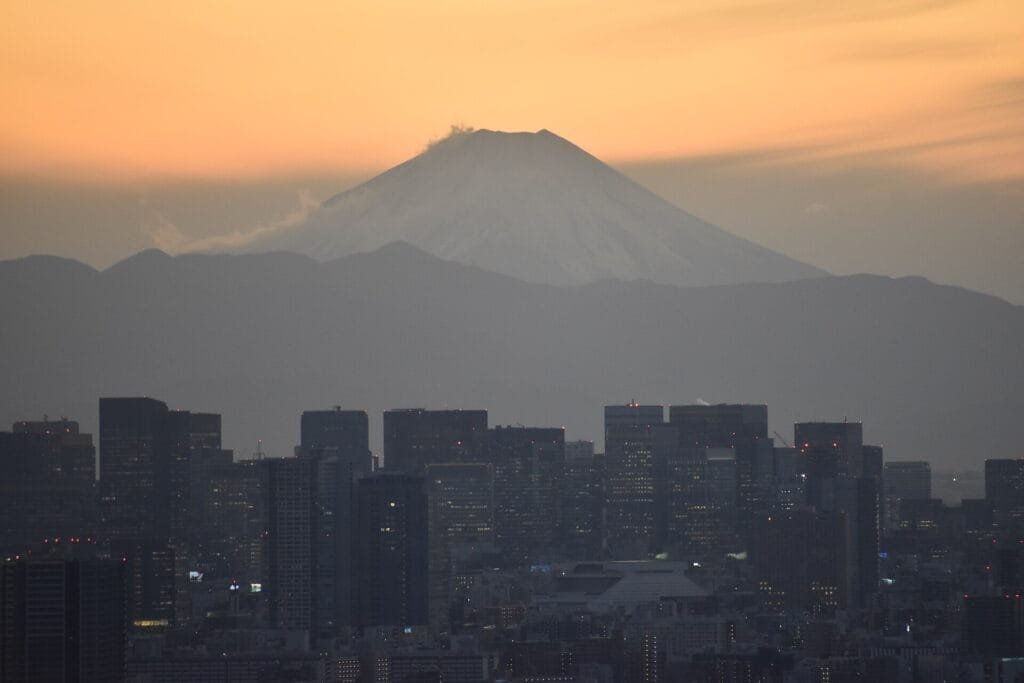
The Fuji point is the one worth planning around. From roughly December to February the mountain is visible from central Tokyo far more often than in summer, when haze hides it for weeks at a time. Two free vantage points: the observatories of the Tokyo Metropolitan Government Building in Shinjuku, and the Sky View lounge at the Bunkyo Civic Center. Both are free, both look west, and both are best in the first hour after opening, before the air warms and thickens.
Snow: Tokyo gets measurable snow on a handful of days in most winters. A few centimetres is enough to slow the trains and cancel flights, because the city is not equipped for it. If snow is forecast, build slack into the day rather than assuming the network will absorb it.
The January sumo tournament: 10–24 January 2027
The Hatsu Basho, the year’s first grand sumo tournament, runs 10 to 24 January 2027 at the Ryogoku Kokugikan – fifteen consecutive days, as every tournament is, opening and closing on a Sunday.
It is the most accessible major cultural event in the Tokyo winter. Advance tickets go on sale around a month ahead and the weekend days and the final week sell out first; a limited number of same-day standing-room tickets are sold at the venue from early morning, which means queueing before dawn. Weekday afternoons early in the tournament are the easy way in. Sessions run all day, but the top-division bouts – the reason to be there – are from about 16:00.
Fukubukuro, and the January sales
On 1 and 2 January the department stores sell fukubukuro, sealed “lucky bags” of stock worth considerably more than the price, and people queue from before dawn for the ones from popular brands. The winter sales run through the rest of the month.
Whether this is a highlight or a crowd to avoid depends entirely on you, but it explains why Shinjuku and Ginza are far busier on 2 January than on 1 January – and why the city feels closed on the 1st and open on the 2nd.
Coming of Age Day: Monday 11 January 2027
Seijin no Hi falls on the second Monday of January, which in 2027 is 11 January. It is a public holiday, so it creates a three-day weekend, and twenty-year-olds attend ceremonies at ward offices and shrines in formal dress – the women in furisode, long-sleeved kimono, often with fur collars against the cold. Meiji Jingu and the big ward halls in the late morning are the places to see it. It is one of the few days in the year when a great deal of Tokyo is dressed formally in public.
Prices: the sharpest split of the year
Tokyo’s January has two price regimes. Through the New Year period – roughly 28 December to 4 January – flights and hotels are at their annual peak, because the whole country is travelling. From about 6 January they fall hard, and the middle two weeks of January are among the cheapest of the year to fly to and sleep in Tokyo.
If you can shift your dates by a week, shifting them later is worth more here than in almost any other month. The Tokyo travel budget sets out what a realistic day costs once you are on the ground.
Winter food, and where the warmth is
January is the best eating month of the Tokyo year and it costs nothing extra. Nabe – the shared hotpot – is in season, as are oysters and crab. Oden simmers in a tray by the till of every convenience store from December. Ramen tastes better at 4°C than at 34°C, and the queues at the famous shops are shorter than in spring.
For warmth between things: the department-store basement food halls, the kissaten coffee shops, and a sento or onsen. Tokyo has real hot-spring water inside the city limits, and a January afternoon in an outdoor bath with cold air on your face is the correct use of the month.
What to wear
Dry cold rather than damp cold, but the wind off Tokyo Bay is sharper than the numbers suggest. A proper coat, a layer under it, and something for your hands: you will be outside for long stretches between stations. Indoors is heated to the point of discomfort and so are the trains, so you want layers you can shed rather than one thick thing. Shoes you can slip off easily matter more in Japan than anywhere else – you will be taking them off in restaurants, temples and ryokan.
Day trips that work better in January
- Hakone – the combination of a clear Fuji view and an outdoor onsen is a January speciality. Cloud cover is lower and the mountain shows itself far more often than in summer.
- Nikko – cold, sometimes snowy, and dramatically quieter than in autumn. Check which roads and the Lake Chuzenji area are open before committing.
- Kamakura – dry, bright, and walkable without the summer humidity.
One thing January does not offer: climbing Mount Fuji. The official season is July to early September and the mountain is closed, unstaffed and genuinely dangerous outside it. In January you look at Fuji, you do not go up it. Day trips from Tokyo has the full list with travel times.
The January 2027 calendar
- 29 December – 3 January – the New Year shutdown: independent restaurants and small shops closed, trains and chains running.
- Friday 1 January – New Year’s Day, a public holiday; hatsumode at every shrine and temple.
- 1–2 January – fukubukuro lucky bags at the department stores; winter sales begin.
- Sunday 10 – Sunday 24 January – the Hatsu Basho grand sumo tournament at Ryogoku Kokugikan.
- Monday 11 January – Coming of Age Day, a public holiday and a three-day weekend.
- From about 6 January – flights and hotels drop to their annual low.
Read alongside
- Tokyo in December – the illuminations, and the run-up to the shutdown.
- Tokyo in March – the cherry blossom gamble.
- Best time to visit Tokyo – all twelve months compared.
- Tokyo travel budget – what a day actually costs.
- Where to stay in Tokyo – choosing a base.
- Getting around Tokyo – the train system, explained properly.
- What to pack for Japan – the winter list.
Frequently asked
Is January a good time to visit Tokyo?
Yes, from about 6 January onwards. It is the clearest month and among the driest, the crowds are thin, prices fall to their annual low after the New Year holiday, and the Fuji views from the city are the best of the year. The catch is the cold – highs around 10°C, lows near freezing – and the shutdown over the first few days of the month.
How cold is Tokyo in January?
Highs average about 10°C and lows around 0–2°C, with frost on the coldest mornings. It is dry cold with a lot of sunshine, not the damp grey of a European winter, but the wind off the bay makes it feel sharper than the numbers.
What is closed in Tokyo over New Year?
Roughly 29 December to 3 January, most independent restaurants, small shops, many museums and all offices close. Convenience stores, chain restaurants, trains and the major shrines stay open, and department stores generally reopen on 2 January.
Does it snow in Tokyo in January?
On a handful of days most winters, and rarely more than a few centimetres. It is enough to disrupt trains and flights, because the city is not built for it, but it is not a reason to avoid the month.
Can you see Mount Fuji from Tokyo in January?
More often than in any other month. Cold, dry winter air gives the clearest sightlines of the year. The free observatories at the Tokyo Metropolitan Government Building and the Bunkyo Civic Center both face west; go in the first hour after opening.
When is the January sumo tournament in 2027?
The Hatsu Basho runs 10–24 January 2027 at the Ryogoku Kokugikan – fifteen days, Sunday to Sunday. Advance tickets go on sale about a month ahead; a small number of same-day standing tickets are sold at the venue each morning.
Is Tokyo cheap in January?
After the first week, yes. The New Year period is the most expensive of the year for flights and hotels; from around 6 January prices fall to among their lowest, and the middle of the month is one of the cheapest windows to visit.
Can you climb Mount Fuji in January?
No. The official climbing season runs from July to early September. Outside it the trails are closed, the mountain huts are shut and the conditions are genuinely dangerous.
You Might Also Love


Written by
John Morrison is the founder and lead travel writer at Packzup. Over the past decade he has explored destinations across Africa, the Americas, Asia, Europe, the Middle East, and Oceania — always self-funded, never on a press trip.
