
February is the month Iceland gets its light back, faster than any other. Reykjavik opens the month with seven hours of daylight and closes it with nearly ten – a gain of about seven minutes a day – while keeping everything January had: aurora season, natural ice caves, and low-season prices. If you want the winter Iceland without the four-hour day, February is the answer.
The light returns at seven minutes a day
- 1 February 2027 – sunrise 10:11, sunset 17:14. 7 hours 3 minutes.
- 15 February – sunrise 09:26, sunset 18:00. 8 hours 34 minutes.
- 28 February – a little over ten hours.
That is three hours gained across a single month, and it changes what is possible. A February day gives you time for the Golden Circle and a stop on the way back; a January day does not. The nights are still long enough for the aurora, so February is the only month that gives you both halves properly.
Iceland stays on UTC all year and does not use daylight saving, which is why sunrise stays late by the clock even as the days lengthen.
Still peak season for the two winter things
Northern lights. The aurora season runs roughly September to April and February sits comfortably inside it. Use the Icelandic Met Office forecast at en.vedur.is for both activity and – more importantly – cloud cover, because cloud is what actually costs you the aurora. Give yourself at least three nights.
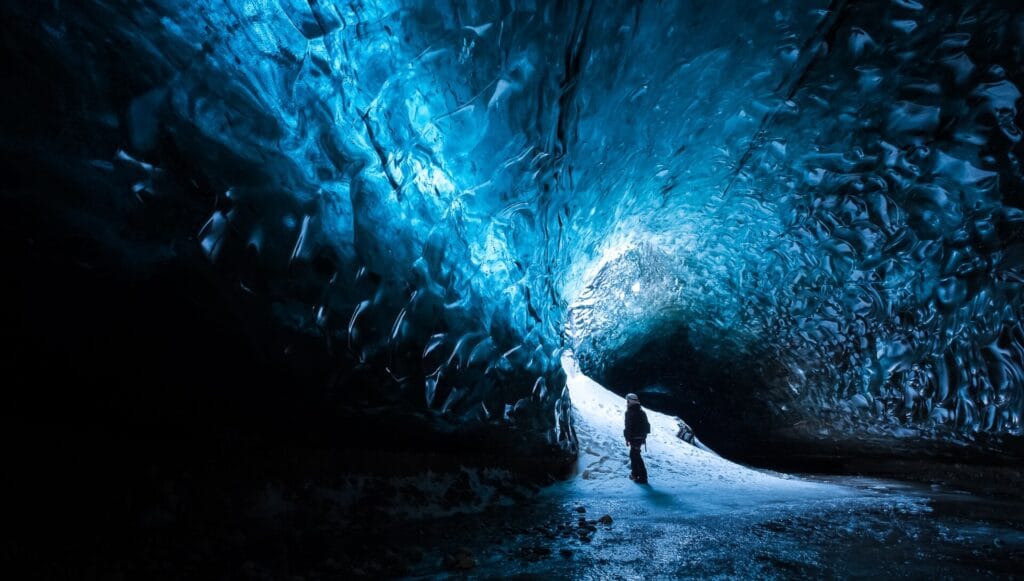
Ice caves. The natural caves under Vatnajokull are accessible roughly November to March and are re-surveyed every winter – they are never the same caves twice. February is prime. They can only be visited with a guide, and the year-round alternative is the ash-insulated Katla cave on the south coast.
Weather and driving
Reykjavik averages a high near 2–3°C and a low near -2°C, with precipitation on around 15 days. February is statistically one of the snowier months in the north and east, and storms are frequent.
The three sites to check every single morning before driving: road.is for live road status, safetravel.is for alerts and to leave a travel plan, and vedur.is for wind warnings. Wind is the real hazard in Iceland, not cold – and car-hire policies exclude wind damage to doors because it happens so often.
Studded tyres are legal in Iceland from 1 November to 15 April, so a February hire car will be properly shod. Highland F-roads remain closed and will not open until June.
The Winter Lights Festival
Reykjavik’s Vetrarhatid runs over several days in early February: buildings and landmarks lit up, museums open late and free on Museum Night, and the city pools open through the night for Pool Night, which is a more Icelandic idea than it sounds. It is free, it is genuinely local, and it exists precisely to mark the return of the light. Dates are announced by the city in the autumn.
Thorrablot, and eating in February
The midwinter Thorrablot feast season runs from late January through February: fermented shark, singed sheep’s head, soured ram’s testicles, rye bread and brennivin. It is an exercise in national memory rather than gastronomy, and several Reykjavik restaurants serve a sampler platter during the season. Try it once.
February also contains two small domestic occasions worth knowing: Bondadagur, husband’s day, which opens the old month of Thorri in late January, and Konudagur, women’s day, which opens Goa in late February. Both mean flowers in every shop window.
Prices
February is a low-season month and prices reflect it – flights, hotels and tours are all well below the summer, and close to January’s floor. Iceland remains expensive in absolute terms; how much a trip to Iceland costs and is Iceland expensive have the real numbers.
What is realistic in a February week
Reykjavik, the Golden Circle, the South Coast to Jokulsarlon and a glacier or ice cave tour, with two or three aurora nights built in. The Snaefellsnes peninsula is a stretch but doable in settled weather. The full Ring Road is still not sensible in February – the north and east get serious winter weather and the daylight, while better, is not enough to absorb a closure.
Volcanic activity
Iceland’s Reykjanes peninsula has seen repeated eruptions in recent years, at times affecting the Grindavik area and the Blue Lagoon. The position changes month to month and no article should be trusted for the current state. Check safetravel.is and the Icelandic Met Office before and during your trip, and follow the authorities on the ground.
What to wear
Waterproof and windproof shell, insulating mid-layer, thermal base, and boots with real grip – Reykjavik pavements ice over and microspikes are sold everywhere for a few thousand krona. Hat, gloves, and a swimsuit: the geothermal pools are the best thing about an Icelandic winter. See what to pack for Iceland.
The February 2027 calendar
- Early February – Reykjavik Winter Lights Festival, with Museum Night and Pool Night; dates announced in autumn.
- Through February – aurora season and natural ice caves both at their best.
- Late January into February – Thorrablot feast season.
- Late February – Konudagur, women’s day, opening the old month of Goa.
- All month – studded tyres legal; highland F-roads closed; daylight rising about seven minutes a day.
Read alongside
- Iceland in January – the darkest month, and the deepest discounts.
- Iceland in March – the last of the ice caves and the equinox aurora.
- Best time to visit Iceland – all twelve months compared.
- How much a trip to Iceland costs – the numbers.
- What to pack for Iceland – the winter list.
- Where to stay in Reykjavik – choosing a base.
- Things to know before visiting Iceland – driving and weather rules.
Frequently asked
How much daylight does Iceland get in February?
Seven hours at the start of the month – sunrise 10:11, sunset 17:14 in Reykjavik on 1 February 2027 – rising to nearly ten hours by the 28th, a gain of about seven minutes a day.
Can you see the northern lights in February?
Yes. February is inside the September-to-April aurora season and still has long nights. Cloud decides it more than activity does, so use the Icelandic Met Office cloud and aurora forecast and allow at least three nights.
Are ice caves open in February?
Yes – February is in the middle of the natural ice cave season under Vatnajokull, which runs roughly November to March. Guided tours only. The Katla ice cave on the south coast is open all year.
How cold is Iceland in February?
Reykjavik averages about 2–3°C by day and -2°C at night, with precipitation on roughly fifteen days. Wind and storms, not temperature, are what disrupt a February trip.
Is February better than January in Iceland?
For most visitors, yes. You keep the aurora and the ice caves but gain three hours of daylight across the month, which materially changes how much you can see, at almost the same price.
Do I need studded tyres in February?
Studded tyres are legal in Iceland from 1 November to 15 April and hire cars are fitted accordingly in February. Using them outside that window carries a fine per tyre.
Can you drive the Ring Road in February?
It is not sensible for most visitors. The north and east get serious winter weather and a single closure can strand an itinerary. Reykjavik, the Golden Circle and the South Coast are the realistic February route.
What is the Winter Lights Festival?
Reykjavik’s Vetrarhatid, held over several days in early February: illuminated buildings, a free Museum Night and a Pool Night when the city’s geothermal pools stay open late. Dates are announced by the city in the autumn.
You Might Also Love

Written by
John Morrison is the founder and lead travel writer at Packzup. Over the past decade he has explored destinations across Africa, the Americas, Asia, Europe, the Middle East, and Oceania — always self-funded, never on a press trip.
