
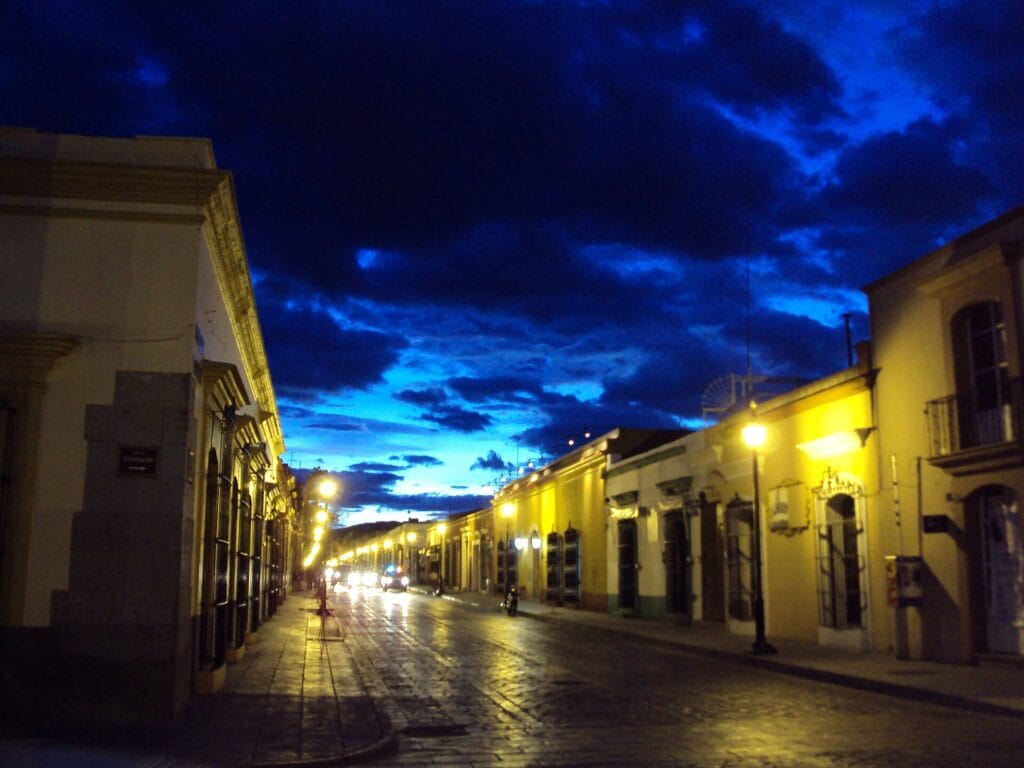
January is Oaxaca’s driest month and one of its best. The valley is clear, the light is hard and bright, and the city is busy without being overwhelmed. The thing nobody warns you about is the cold: Oaxaca City sits at about 1,555 m, so nights drop to around 8°C in rooms that were built to stay cool.
The numbers
Why the altitude matters more than the latitude
Oaxaca is at 17 degrees north, which sounds tropical, and the daytime temperature is a comfortable 28°C. But at 1,555 m the air is thin and dry and it loses its heat fast after sunset. The gap between a 28°C afternoon and an 8°C night is the single most underpacked-for fact about the city.
- Colonial buildings have thick stone walls and no heating. They are built for the dry-season afternoon, not the night.
- Bring a proper jacket, not a light layer. Courtyard restaurants get cold from about 7pm.
- The sun is strong even at 28°C, because of the altitude. Sunburn in January is normal.
- The air is very dry. Drink more than you think and expect dust on the valley roads.
The weekly market circuit
Oaxaca’s valley villages each hold a market on a fixed weekday, and the dry season is the easiest time to do them. This is the single best-value day out in the state.
- Sunday – Tlacolula, the biggest and the most Zapotec, with livestock, barbacoa and traders speaking Zapotec rather than Spanish.
- Wednesday – Etla, known for cheese.
- Thursday – Zaachila.
- Friday – Ocotlan, with the Rodolfo Morales museum alongside it.
- Daily in the city – Mercado 20 de Noviembre for the smoke hall, and Benito Juarez next door.
What January is good for
- Monte Alban in clear air, with the whole valley visible from the platforms.
- Hierve el Agua, the mineral terraces, at their best in dry weather when the road is easy.
- Mezcal palenques around Santiago Matatlan and the Ocotlan road, which run year-round.
- Whale watching from Puerto Escondido and Huatulco, where the humpback season runs roughly December to March.
- The coast – Zipolite, Mazunte and Puerto Escondido are dry, hot and at their peak season.
- Textile villages – Teotitlan del Valle for rugs, San Bartolo Coyotepec for black pottery, San Martin Tilcajete for alebrijes.
Where to go in January
- Oaxaca City centro – Santo Domingo, the zocalo, the markets and the mezcalerias.
- The Tlacolula valley – Mitla, the Tule tree, Teotitlan and Hierve el Agua on one road.
- Puerto Escondido for the dry-season coast, though January swell at Zicatela is for experienced surfers only.
- Mazunte and Zipolite for the quieter end of the coast.
- The Sierra Norte – the Pueblos Mancomunados community tourism network, cool, pine-forested and very cold at night.
Prices and crowds
High season, but the calm part of it. The Christmas and New Year peak ends in the first week, and from about 7 January the city settles into busy-but-pleasant until Semana Santa. Coastal prices stay high all month. See what a trip to Mexico costs.
What to pack
A warm jacket and long trousers for evenings – the single most common packing mistake here. Strong sunscreen, a hat and sunglasses for the daytime. Comfortable shoes for cobbles. A light rain layer is unnecessary in January. Lip balm and moisturiser, because the dry-season air is harsh at altitude.
The January 2027 calendar
- Friday 1 January – New Year’s Day, a federal public holiday across Mexico.
- Wednesday 6 January – Dia de Reyes, when the rosca de reyes is eaten and children traditionally receive gifts. Not a public holiday, but widely observed.
- From about 7 January – the Christmas peak ends and prices ease.
- Through January – the driest month of the year, at roughly 3 mm of rain.
- Through January – humpback whale season off the Oaxaca coast, running to about March.
- Every Sunday – the Tlacolula market, the largest in the valley.
Read alongside
- Oaxaca in February – carnival and Candelaria.
- Oaxaca in March – Semana Santa and the heat building.
- Oaxaca in November – the best all-round month.
- Best time to visit Oaxaca – all twelve months compared.
- Oaxaca travel guide – the city, the valley and the coast.
- Oaxaca itinerary – how to put a trip together.
- Things to do in Oaxaca – the year-round list.
- Oaxaca food guide – moles, tlayudas and the markets.
Frequently asked
Is January a good time to visit Oaxaca?
One of the best. It is the driest month, the air is clear, and after the first week the Christmas crowds have gone. The only real drawback is cold nights.
How cold does Oaxaca get at night in January?
Around 8°C. The city sits at about 1,555 m and colonial buildings have no heating, so evenings feel colder indoors than the number suggests. Bring a proper jacket.
Does it rain in Oaxaca in January?
Almost never. January averages about 3 mm, against roughly 175 mm in September.
Which Oaxaca village market is on which day?
Tlacolula on Sunday, Etla on Wednesday, Zaachila on Thursday and Ocotlan on Friday. Tlacolula is the biggest and the most traditional.
Can you see whales in Oaxaca in January?
Yes. Humpbacks pass the Oaxaca coast from about December to March, and trips run from Puerto Escondido and Huatulco.
Is the Oaxaca coast busy in January?
Yes, it is peak season – dry, hot and fully booked over the New Year period. Prices stay high through the month.
What is Dia de Reyes?
6 January, when families share a ring-shaped rosca de reyes and children traditionally receive their gifts. It is not a public holiday but bakeries and plazas are busy.
Do I need altitude precautions in Oaxaca?
Not really. At about 1,555 m it is far below the level where altitude sickness is a concern, but the thin dry air does make the sun stronger and dehydration easier.
Oaxaca month by month
- January – dry, bright days and genuinely cold nights (this page).
- February – carnival, Candelaria and perfect dry-season weather.
- March – Semana Santa, jacarandas and the heat building.
- April – the hottest and driest month, just before the rains.
- May – the rains arrive and the valley turns green.
- June – clear mornings, afternoon storms, and no crowds.
- July – Guelaguetza, the biggest festival of the year.
- August – deep green season and the quietest city of the year.
- September – Independence, the wettest month and the hurricane peak.
- October – Dia de Muertos and the end of the rains.
- November – dry, clear and arguably the best month of all.
- December – Noche de Rabanos, posadas and the Christmas peak.
You Might Also Love



Written by
John Morrison is the founder and lead travel writer at Packzup. Over the past decade he has explored destinations across Africa, the Americas, Asia, Europe, the Middle East, and Oceania — always self-funded, never on a press trip.
