
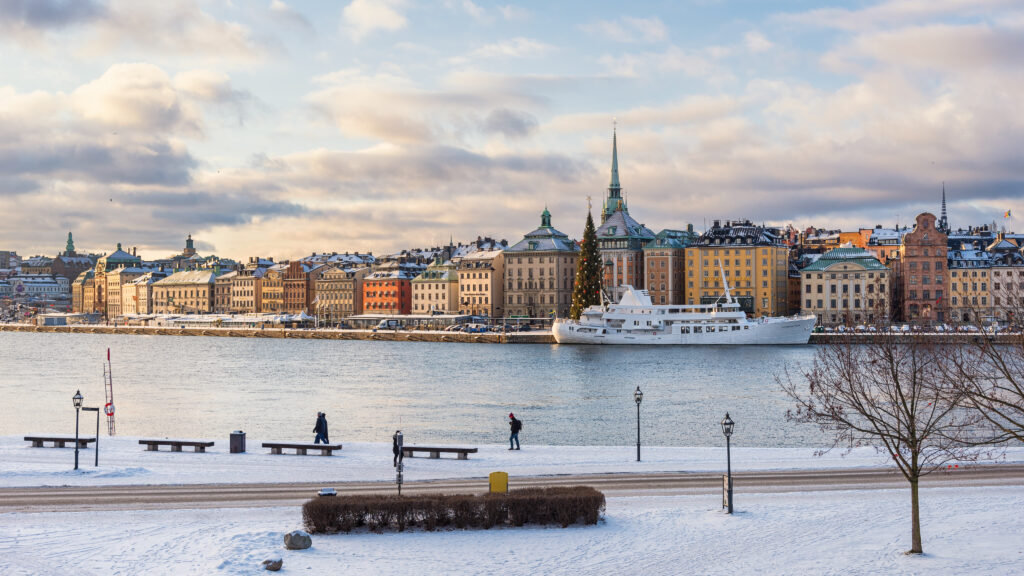
January is Stockholm at its quietest, cheapest and darkest. Expect about 0°C by day and −4°C at night, roughly six hours and fifty minutes of daylight in the middle of the month, and a city that responds by making indoors extremely good. It is a museum, café and design trip, not a sightseeing one.
How dark is it actually?
This is the question worth answering precisely, because Stockholm is often described as if it were the Arctic. It is not. Stockholm sits at 59.3°N, well south of the Arctic Circle, so there is no polar night – the sun rises every day of the year. In mid-January it comes up around 08:30 and sets around 15:20.
What you actually get is a long, low, blue-grey light for most of the short day, and a very long twilight at each end. Swedes have a word for the particular blue of it – and photographers come for it.
If you want genuine polar night, that is Kiruna and Abisko, about 1,250 km north and a separate trip.
Weather and what it means
- Temperature – averages around 0°C by day and −4°C at night. Cold snaps reach −15°C or lower; mild spells sit above freezing and turn everything to slush.
- Snow – likely but not guaranteed. Recent Stockholm winters have swung between deep snow and grey, wet streets, sometimes in the same week. Plan for both.
- Ice – the lakes and the sheltered inner archipelago can freeze hard enough for long-distance skating, which is a genuine Stockholm speciality. It depends entirely on the winter and is never a given; go with an organised group, who read the ice.
- Underfoot – the real hazard is not cold but ice on pavements. Boots with actual grip, or clip-on studs, change the trip.
What January is good for
- The museums, properly. The Vasa Museum, the Nationalmuseum, Moderna Museet, Fotografiska and the Historiska are all indoor, all excellent, and all far less crowded than in July. Several of Sweden’s state museums have free entry to their permanent collections – worth checking before you pay.
- The metro as an art gallery. Around ninety of the hundred stations are decorated, and a single transport ticket lets you ride the blue line and walk the platforms. It is the best-value hour in the city, and it is warm.
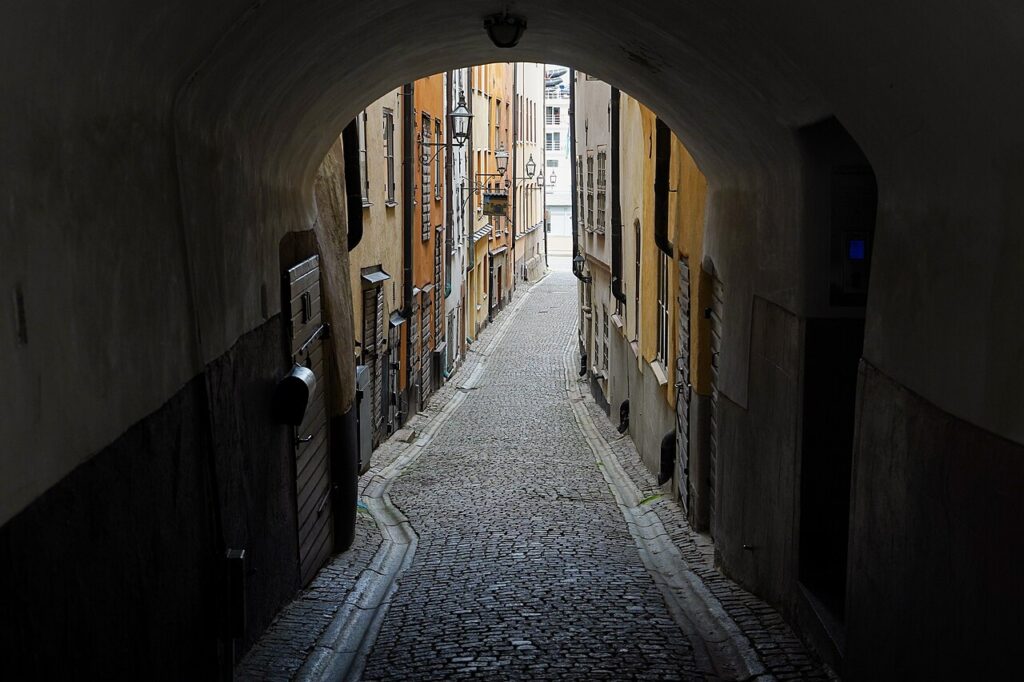
- Cafés and fika. January is when the institution makes sense rather than being a novelty. Gamla Stan, Södermalm and Vasastan all reward an afternoon of it.
- Design and interiors. The January sales run through the month and Swedish design shops are at their most interesting when the light outside is at its worst.
- Prices. After the first week, Stockholm hotel rates fall to their annual floor. It is the cheapest month to stay well in an expensive city.
Tjugondag Knut, 13 January
Swedish Christmas does not end on Twelfth Night. It ends on Tjugondag Knut – St Knut’s Day, the twentieth day of Christmas, 13 January – when trees are stripped, the last sweets are eaten and the tree goes out. You will see discarded Christmas trees appear on Stockholm pavements overnight. Decorations and lights largely come down with them, so the city looks noticeably plainer after the middle of the month.
What to pack
A proper insulated coat, a hat that covers the ears, gloves, and above all boots with real grip – ice on pavements is the thing that spoils January trips. Layers for indoors, because Swedish buildings are warm. A power bank, since cold drains phone batteries fast. See the Sweden itinerary for how a winter trip fits together.
The January 2027 calendar
- Friday 1 January – New Year’s Day, a public holiday; almost everything closed.
- First week – the tail of the holiday season; hotel rates still high, then they drop sharply.
- Wednesday 6 January – Epiphany (trettondedag jul), a public holiday; shops and many restaurants closed or on Sunday hours.
- Wednesday 13 January – Tjugondag Knut; Christmas officially ends and the decorations come down.
- Mid-January – about 6h 50m of daylight; sunrise near 08:30, sunset near 15:20.
- Through January – the rea sales run; hotel rates at their annual floor.
- January and February – the window for long-distance lake skating, when the ice allows.
Read alongside
- Stockholm in February – colder, brighter, and the better skating month.
- Stockholm in December – Lucia, the markets and the darkest weeks.
- Stockholm itinerary – how to structure the days.
- Is Stockholm expensive? – what things actually cost.
- Things to do in Stockholm – the indoor-heavy list.
- Trip to Sweden cost – budgeting the whole trip.
- Sweden in 10 days – going beyond the capital.
Frequently asked
How many hours of daylight does Stockholm get in January?
About 6 hours 50 minutes in the middle of the month, with sunrise near 08:30 and sunset near 15:20. It grows quickly – Stockholm gains roughly two and a half hours of daylight across January.
Does Stockholm have polar night?
No. Stockholm is at 59.3°N, south of the Arctic Circle, so the sun rises every day of the year. Polar night is a Kiruna and Abisko phenomenon, about 1,250 km further north.
How cold is Stockholm in January?
Around 0°C by day and −4°C at night on average, with cold snaps to −15°C or below and mild spells above freezing. It is the coldest month alongside February.
Is there snow in Stockholm in January?
Usually some, but it is not guaranteed. Recent winters have alternated between deep snow and wet grey streets. Pack for both, and prioritise boots with grip over extra warmth.
Is January a cheap time to visit Stockholm?
It is the cheapest month. After the first week, hotel rates fall to their annual floor, and the rea sales run through the month.
Can you ice skate in Stockholm in January?
Often, yes. Long-distance skating on the lakes and sheltered archipelago is a Stockholm speciality in January and February, but it depends entirely on the winter. Go with an organised group who can read the ice rather than alone.
What is Tjugondag Knut?
St Knut’s Day on 13 January, the twentieth day of Christmas and the official Swedish end of it. Trees are stripped and thrown out – you will see them on the pavements – and the city’s lights come down.
What is there to do in Stockholm in the dark?
The museums are world-class and indoor, the metro is a decorated art gallery you can ride on a normal ticket, and the café culture exists precisely for this month. It is a strong city break and a poor sightseeing trip.
You Might Also Love


Written by
John Morrison is the founder and lead travel writer at Packzup. Over the past decade he has explored destinations across Africa, the Americas, Asia, Europe, the Middle East, and Oceania — always self-funded, never on a press trip.
