
Last updated September 6, 2026 · Editorial policy
Based on the Packzup Cost Index (Moderate tier), typical on-the-ground totals per person, excluding international flights:
| Travel style | 7 days | 14 days |
|---|---|---|
| Budget | $210 - $385 | $420 - $770 |
| Mid-range | $700 - $1,260 | $1,400 - $2,520 |
| Luxury | $2,100 - $3,500 | $4,200 - $7,000 |
- Chile trip cost: daily budget at a glance
- Cost Breakdown
- Plan Your Budget
- Two-Tier Daily Budget for Chile, Plus the Costs Travelers Forget
- FAQs
- What Does a Trip to Chile Actually Cost?
- How to Save Money in Chile
- When Is Chile Cheapest to Visit?
- Related Articles
- Frequently Asked Questions
- Why moving around Chile costs more than being in Chile
- How CONAF prices Torres del Paine since 1 May 2026
- The 19 per cent Chilean tax foreign visitors do not have to pay on a hotel room
- When Chile gets expensive: the summer squeeze and the low-season timetable
- What you pay to enter Chile, and the paper you must not lose
- At a glance
- Frequently asked questions
Quick answer: A mid-range trip to Chile costs $100-180/day.
Trip costs to Chile depend on travel style, season, and length. Here’s the breakdown.
Chile trip cost: daily budget at a glance
Short answer: budget on roughly $110–210 per person per day mid-range (excluding international flights).
| Travel style | Per day (per person) | What it covers |
|---|---|---|
| Budget | $50–85 | Hostels/guesthouses, street food, public transport |
| Mid-range | $110–210 | 3-star hotels, restaurants, the odd tour or taxi |
| Luxury | $350+ | 4–5★ hotels, fine dining, private guides & transfers |
Cost Breakdown
- Budget: $40-90/day
- Mid-range: $100-180/day
- Luxury: $400+/day
Plan Your Budget
Two-Tier Daily Budget for Chile, Plus the Costs Travelers Forget
Here is the honest split. A disciplined shoestring traveler lands around $45-60/day: a Santiago or Valparaiso dorm bed near $12-23, self-catered and lunch-menu meals, local metro and bus hops, and one paid sight. A comfortable mid-tier sits around $120-160/day, covering a private double (a decent mid-range room averages roughly $90-150/night), a mix of local and sit-down dining, taxis when convenient, and daily activities. Over a typical 10-day trip that works out to about $500-650 shoestring or $1,300-1,700 comfortable, before international flights.
The costs people underestimate are not the headline ones. Most Western passport holders pay no entry or reciprocity fee and get 90 days visa-free, so that line is $0 - but ATM withdrawals quietly bleed you: most Chilean banks charge around CLP 5,000-10,000 (about $5-10) per withdrawal and cap each pull near CLP 200,000. Restaurants commonly add a 10% propina marked 'sugerida' on the bill, so you are tipping whether you notice or not.
- Use Scotiabank or Banco Security ATMs (fee-free for foreign cards) and withdraw the max - saves about $5-10 each visit.
- Take the Centropuerto or TurBus airport bus into Santiago for about CLP 1,900 (~$2) instead of a taxi, saving roughly $25-30.
- Book a 'salon cama' intercity bus - Santiago to Valparaiso runs near CLP 5,600 and Santiago to La Serena from about CLP 9,200, far below domestic flights.
FAQs
How expensive is Chile?
Mid-range: $100-180/day.
Cheapest way?
Travel in off-season.
When to book flights?
60-90 days ahead.
What Does a Trip to Chile Actually Cost?
Chile uses the Chilean Peso (CLP). A cheap local meal runs $5-8, while a mid-range restaurant dinner costs $12-20. Taxis charge roughly $1-2 per kilometer, a beer averages $2-4, and a coffee is typically $2-3.
More expensive than neighbors Peru or Bolivia, but Torres del Paine and the Atacama Desert justify the premium. Wine from the Maipo Valley is incredibly cheap by global standards.
How to Save Money in Chile
Eat where locals eat. Skip tourist-facing restaurants near major sights and walk a few blocks to where the prices drop. Lunch specials and set menus are almost always cheaper than dinner ? la carte.
Travel in shoulder season. Visiting just before or after peak season can cut accommodation costs by 30-50% while still offering good weather. Flights drop too ? use flexible date searches to find the sweet spot.
Use public transport. Taxis and ride-shares add up fast. Most popular destinations have reliable public transit that costs a fraction of what you would spend on private transfers. Research transit passes or tourist cards that bundle transport with attraction entry.
Book accommodation with a kitchen. Even making breakfast and the occasional dinner yourself saves hundreds over a week-long trip. Markets and grocery stores are also a great way to experience local food culture.
When Is Chile Cheapest to Visit?
Like most destinations, Chile is cheapest in the low season when fewer tourists compete for hotel rooms and flight seats. Shoulder months typically offer the best balance of price and experience ? decent weather without peak-season markups. Booking flights 6-10 weeks in advance and accommodation 4-8 weeks out generally yields the best rates.
Related Articles
Frequently Asked Questions
How much does a trip to Chile cost?
A budget trip runs $30-60 per day including accommodation, food, and local transport. Mid-range travelers spend $80-150 per day, while luxury travel starts at $200+ daily.
Is Chile expensive for tourists?
Cost depends on your travel style. Chile can be affordable with budget accommodation and local food, or expensive if you opt for luxury hotels and fine dining.
How can I save money in Chile?
Stay in locally-owned guesthouses, eat at local restaurants instead of tourist spots, use public transport, travel in shoulder season, and book flights early for the best deals.
What currency is used in Chile?
Check the local currency before you go. ATMs are widely available in most destinations, and credit cards are accepted at larger establishments. Always carry some local cash for markets and small vendors.
Why moving around Chile costs more than being in Chile
Chile's budget problem is not the price of a meal, it is the shape of the country. The distance between the north and the far south is measured in thousands of kilometres, and one stretch of it has no Chilean road at all.
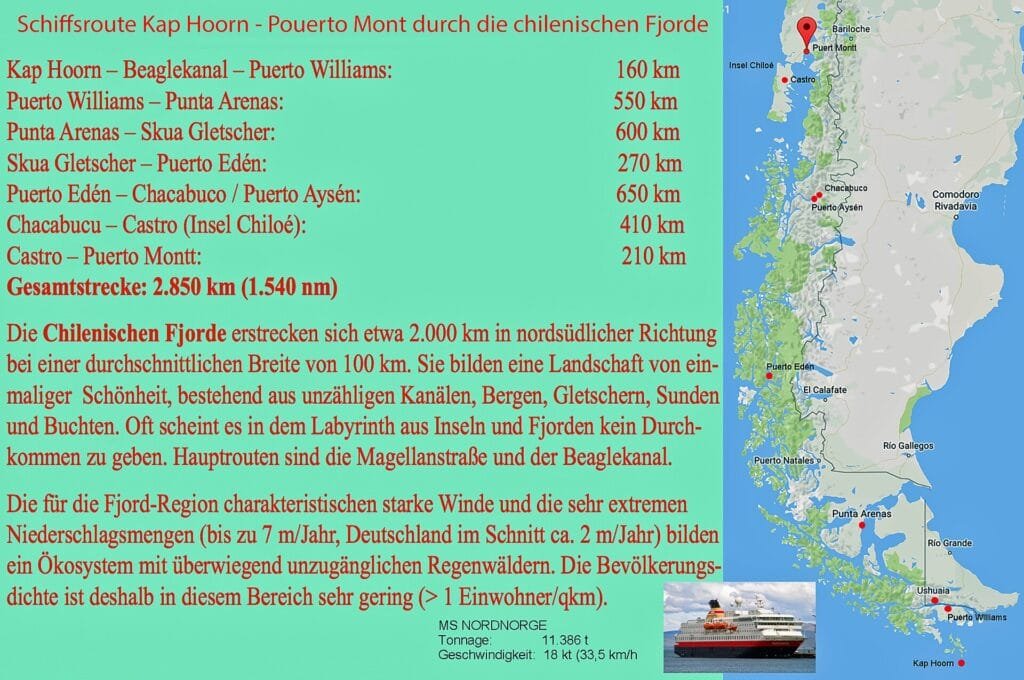
There is no continuous overland route through Chilean territory between the Aysen and Magallanes regions. SERNATUR, the national tourism service, made the point plainly when a maritime link opened, describing it as a route that connects Chile by Chile and removing the need to go around through Argentina, because land connectivity between the two regions had previously existed only across Argentine territory. That is why almost every visitor heading for Torres del Paine flies rather than drives.
The Chilean alternative to flying is a ferry, and its numbers explain why it is a choice of experience rather than a way to save time. SERNATUR describes the service as connecting Puerto Natales in Magallanes with the Aysen region, calling at Puerto Eden, Caleta Tortel and Puerto Yungay, covering 770 km in 41 hours of sailing plus port time, operated by the ferry Crux Australis with capacity for about 142 passengers and 50 vehicles, running once a week in high season and, in SERNATUR's phrase, two and a half sailings a month in low season.
Three consequences for a budget.
- Long-distance buses are excellent value inside a region and useless between the far ends of the country. Chilean intercity coaches are comfortable and cheap by international standards, and they are the right answer for Santiago to Valparaiso, La Serena or the Lake District. They are the wrong answer for Santiago to Punta Arenas.
- Domestic flights are the structural cost of a north-and-south itinerary. Price them before you fix the route, not after. A trip that touches the Atacama and Patagonia in the same fortnight buys at least two internal flights, and those often cost more than the entire ground portion.
- Driving south means leaving Chile. Taking a hire car through Argentina requires the rental company's cross-border permit and insurance, arranged in advance and charged for, plus border formalities in both directions. Ask about it at the booking stage or you will be turned back at the frontier.
How CONAF prices Torres del Paine since 1 May 2026
Torres del Paine is priced separately from the rest of the Chilean park system, and its charging model changed in 2026. CONAF replaced the old structure, which split tickets into stays of under and over three days, with a system it set out in Resolucion N° 514/2025.
The timeline matters, because plenty of secondary pages still describe the old one. CONAF announced the new system for 1 January 2026, then postponed it to 1 May 2026. It stated that between 1 January and 30 April 2026 the ticketing arrangement in force to 31 December 2025 continued, with an adjustment of 4.9 per cent based on the accumulated consumer price index to March 2025. The differentiated system took effect on 1 May 2026.
Two things define the new model.
The pass is bought by duration. There is a single-day entry, and an entry for two or more days valid for a continuous period of up to ten days. That second option is what the trekking routes need, and it replaces the older three-day threshold.
The pass is bought by route. CONAF's announcement describes differentiated purchase for specified routes: Full day, Base Torres, the W circuit and the Macizo Paine circuit. In practice you are declaring what you intend to walk, not simply buying entry to a gate.
Tariffs are differentiated by category, covering Chilean nationals, foreign visitors, children, older adults, people with disabilities and their companions. CONAF directs buyers to its official pass platform, pasesparques.cl, and no other site is the official seller. Prices there are set by resolution and adjusted, so take the current figure from that platform on the day you book rather than from any article, including this one. Position as of 5 September 2026.
For scale, CONAF reports that Torres del Paine received 367,426 visitors in 2024, of whom 201,731 were foreigners. That is the demand behind both the differentiated pricing and the need to book ahead.
The 19 per cent Chilean tax foreign visitors do not have to pay on a hotel room
Chile exempts accommodation supplied to foreign tourists from IVA, the value added tax whose rate the Servicio de Impuestos Internos gives as 19 per cent, fixed by article 14 of the Ley sobre Impuesto a las Ventas y Servicios, and a great many visitors pay it anyway because they never ask. The exemption sits in article 12, letter E, number 17 of the Ley sobre Impuesto a las Ventas y Servicios (Decreto Ley 825), and the Servicio de Impuestos Internos sets out what has to be true for it to apply.
The SII's requirements are three, and all of them must hold:
- the accommodation provider is entered in the register the SII maintains for this exemption
- the guest is a foreign tourist with neither domicile nor residence in Chile
- the accommodation is paid for in foreign currency
The paperwork is where the exemption is won or lost, and the SII's administrative jurisprudence on Circular N° 56 of 3 December 1991 spells it out. The exempt service is documented in an export invoice expressed in dollars, and the guest's status as a foreign tourist is evidenced by a passport or foreign identity document together with the international police record of entry as a tourist. The circular treats the covered services as accommodation plus the things a hotel commonly supplies alongside it, food and beverage service, laundry, telephone and the like. Note one currency caveat before you quote the circular at anyone: parts I and II of Circular N° 56 of 1991 were superseded on the entry into force of Decreto N° 222 of 2011 of the Ministry of Economy, so read the SII's current guidance rather than the 1991 text alone.
What to do with that:
Ask before you book, not at checkout. The question is whether the property is registered with the SII for the exemption and whether it can invoice you in US dollars. Smaller guesthouses often are not registered, and cannot apply it however you pay.
Keep the tarjeta de turismo you were given at immigration. It is the document that evidences your status as a tourist without residence in Chile, and hotels ask to see it along with your passport.
Compare the exempt rate with the peso rate. Paying in dollars to obtain the exemption exposes you to the property's own conversion. On a room quoted at a fair rate the 19 per cent saving is decisive, but check the arithmetic rather than assuming it.
On the currency itself, Chile's reference rate is the dolar observado, which the Banco Central de Chile calculates as a weighted average of operations carried out in the local market on the previous business day and publishes each business day in the Diario Oficial. It is a backward-looking average, not a live market price, so it is a benchmark to judge an exchange office against rather than a rate you can transact at.
When Chile gets expensive: the summer squeeze and the low-season timetable
The costly months in Chile are January and February, and the reason is supply rather than any published surcharge. They fall in the southern summer and coincide with the Chilean holiday period, so domestic and international demand land on the same beds, the same seats and the same park permits at once.
The clearest official signal of what the calendar does is not a price at all, it is a timetable. SERNATUR's description of the Aysen to Magallanes ferry has it running once a week in high season and two and a half sailings a month in low season. That is close to a fourfold difference in supply on a single link, and the same pattern repeats across Patagonian transport and accommodation: out of season the constraint stops being what things cost and becomes whether they run at all.
How to use that:
- If your dates are January or February, book first and price second. Torres del Paine received 367,426 visitors in 2024 on CONAF's own count, and the summer share of that lands in a short window. Permits, refuges and internal flights are the items that sell out, and paying more later is often not an available option.
- Late spring and early autumn, meaning November and March, are the compromise. Services are still running, the summer peak has not closed the calendar, and Patagonian weather is no less variable in January than it is in March.
- Deep winter in Patagonia is cheap because much of it is shut. Reduced ferry frequency, closed sectors and shortened daylight are the trade you are making. Confirm every leg is actually operating on your dates with the operator or CONAF before you commit to a low-season saving.
North of Santiago the seasonality inverts in usefulness. The Atacama is a year-round destination with far less summer dependence, which is one argument for putting the desert in the shoulder months and reserving the scarce summer dates for the far south.
What you pay to enter Chile, and the paper you must not lose
Nothing, for most tourist visits, and there is no arrival fee to budget for. The FCDO's advice for British nationals is that you can visit Chile for up to 90 days without a visa, and that your passport must be valid after your intended departure date from Chile. Longer stays, or travel for work, study or business, require meeting the Chilean government's separate requirements.
The administrative catch is a piece of paper. On arrival, immigration issues a tarjeta de turismo, described by the FCDO as an A5-sized white form. You keep it for the whole trip and surrender it when you leave. If you lose it, a replacement can be requested through the PDI online system or at a local PDI office, which costs you time rather than money, but it is time at the wrong end of a trip. It is also the document a hotel will want to see if you are claiming the IVA exemption, so it earns its keep.
Rapa Nui, Easter Island, is administered as a separate entry for these purposes. The FCDO states that visiting it requires completing an online entry form and providing documentation including a return ticket and either an accommodation reservation registered through SERNATUR or an invitation letter. Budget the flight and the paperwork together: the form is not something you can complete at the gate.
What about the old reciprocity fee? Chile used to charge some nationalities a one-off administrative charge on arrival at Santiago airport, matched to what their own country charged Chileans, and it is still described as current on a great many secondary pages. For Australian passport holders it is not. The Chilean government's own diplomatic site for Australia states that from 16 December 2019 the USD 117 reciprocity charge on arrival at Santiago airport was eliminated, and that from 9 May 2020 Australian passport holders instead need an electronic visa obtained before travel. That is a swap of an arrival fee for an advance formality, not a saving you can ignore.
For everyone else, work from the authority rather than from a list. Chile's Servicio Nacional de Migraciones states that the transitory stay permit for tourism is limited to 90 days, and that for qualified reasons of national interest or of international reciprocity a prior authorisation or a visa granted by a Chilean consulate abroad may be required of nationals of certain countries. Its published schedule of immigration fees covers extensions, work authorisation, temporary and permanent residence and citizenship, and lists no charge levied on a tourist at the border. So the question to answer for your own passport is not whether there is a fee at the airport, it is whether you need a consular authorisation before you fly.
Entry rules change and they differ by nationality. Confirm your own position with Chile's Servicio Nacional de Migraciones and with your own government's travel advice close to departure rather than relying on any summary, including this one. Position stated as of 5 September 2026.
At a glance
| Chilean cost or rule | Position as of 5 September 2026 | Authority |
|---|---|---|
| Tourist entry for British nationals | Up to 90 days without a visa; passport valid beyond the departure date; no arrival fee stated | FCDO travel advice for Chile |
| Tarjeta de turismo | A5-sized white form issued at immigration, kept and surrendered on departure; replacement via the PDI online system or a PDI office | FCDO travel advice for Chile |
| Rapa Nui (Easter Island) entry | Online entry form plus a return ticket and either a SERNATUR-registered accommodation reservation or an invitation letter | FCDO travel advice for Chile |
| IVA (VAT) standard rate | 19 per cent, fixed by article 14 of the Ley sobre Impuesto a las Ventas y Servicios | Servicio de Impuestos Internos |
| IVA exemption on accommodation for foreign tourists | Available where the provider is on the SII register, the guest is a foreign tourist with no domicile or residence in Chile, and the accommodation is paid in foreign currency | Article 12 letter E number 17, Ley sobre Impuesto a las Ventas y Servicios (DL 825); SII guidance |
| Documenting the exemption | Export invoice expressed in dollars; tourist status evidenced by passport or foreign identity document plus the international police record of entry as a tourist; parts I and II of the circular were superseded on the entry into force of Decreto N° 222 of 2011 | SII administrative jurisprudence on Circular N° 56 of 3 December 1991 |
| Torres del Paine charging system | Route-based and duration-based passes under Resolucion N° 514/2025, in force from 1 May 2026 after postponement from 1 January 2026 | CONAF |
| Torres del Paine pass durations | Single-day entry, or an entry for two or more days valid for a continuous period of up to 10 days | CONAF |
| Torres del Paine routes priced separately | Full day, Base Torres, Circuito W, Circuito Macizo Paine | CONAF |
| Where to buy park passes | pasesparques.cl, the official platform | CONAF |
| Torres del Paine visitors, 2024 | 367,426 total, of whom 201,731 were foreigners | CONAF |
| Aysen to Magallanes ferry | 770 km in 41 hours of sailing plus port time; once a week in high season, two and a half sailings a month in low season; about 142 passengers and 50 vehicles on the Crux Australis | SERNATUR |
| Reciprocity charge on arrival | Eliminated for Australian passport holders from 16 December 2019, the charge having been USD 117 at Santiago airport; Australian passport holders instead need an electronic visa from 9 May 2020 | Government of Chile, diplomatic site for Australia |
| Tourist stay permit | Transitory stay for tourism limited to 90 days; a prior authorisation or consular visa may be required of nationals of certain countries for reasons of national interest or international reciprocity | Servicio Nacional de Migraciones |
| Reference exchange rate | Dolar observado, a weighted average of local market operations on the previous business day, published each business day in the Diario Oficial | Banco Central de Chile |
Frequently asked questions
Do foreign tourists have to pay VAT on hotels in Chile?
No, if three conditions are met. Article 12, letter E, number 17 of the Ley sobre Impuesto a las Ventas y Servicios exempts accommodation supplied to foreign tourists from the 19 per cent IVA, and the Servicio de Impuestos Internos requires that the provider is entered in the register it keeps for the exemption, that the guest is a foreign tourist with neither domicile nor residence in Chile, and that the accommodation is paid for in foreign currency. The SII treats services normally supplied with a room, such as meals, drinks, laundry and telephone, as covered when they are supplied together with the accommodation. Ask whether a property is registered before you book, because many are not.
Can I pay by card and still get the Chilean VAT exemption?
Ask the property, in writing, before you arrive. The exemption turns on the hotel actually receiving foreign currency rather than converting a peso price at the till, so what matters is whether that property is set up to charge you and be paid in US dollars. No official source reachable on 6 September 2026 states a rule on card payment specifically, so treat any claim that cards always qualify, or never do, as unverified and get the property's answer in writing. Keep your tarjeta de turismo either way, since that is what evidences you are a tourist without residence in Chile.
How much does it cost to enter Torres del Paine?
For most tourist visits there is no charge at the border. Chile's Servicio Nacional de Migraciones publishes fees for extensions, work authorisation, residence and citizenship, and lists no charge levied on a tourist at entry, and it gives the transitory stay permit for tourism as limited to 90 days. The old reciprocity charge is the thing to check by nationality: the Chilean government's own diplomatic site for Australia states that the USD 117 reciprocity charge on arrival at Santiago airport was eliminated from 16 December 2019, and that Australian passport holders instead need an electronic visa from 9 May 2020. Migraciones also notes that for reasons of national interest or international reciprocity a prior authorisation or a consular visa may be required of nationals of certain countries, so confirm your own passport's position with Migraciones before you fly. Position as of 5 September 2026.
Why did Torres del Paine change its ticket prices in 2026?
CONAF replaced a structure that split tickets into stays of under and over three days with a more flexible model of a single-day pass and a two-or-more-day pass valid for up to ten continuous days, differentiated by route. The change was announced for 1 January 2026 and then postponed to 1 May 2026. CONAF stated that between 1 January and 30 April 2026 the arrangement in force to 31 December 2025 continued, with a 4.9 per cent adjustment based on the accumulated consumer price index to March 2025.
Can you travel overland from Santiago to Patagonia without leaving Chile?
Not on a continuous Chilean road. SERNATUR has stated that land connectivity between the Aysen and Magallanes regions previously existed only through Argentine territory, which is why a maritime link between them was described as connecting Chile by Chile. The Chilean-only alternative is that ferry, which SERNATUR describes as covering around 770 km in about 41 hours of sailing between Puerto Natales and Puerto Yungay with calls at Puerto Eden and Caleta Tortel, running weekly in high season and about twice a month in low season. If you plan to drive south instead, you will cross into Argentina and need your hire company's cross-border permit and insurance arranged in advance.
When is the most expensive time to visit Chile?
January and February, the southern summer and the Chilean holiday season, when domestic and international demand hit the same beds, seats and permits. The scarcity shows up in official timetables as well as prices: SERNATUR describes the Aysen to Magallanes ferry as running once a week in high season and around twice a month in low season. November and March are the usual compromise, with services still operating and the calendar not yet closed. In deep winter the risk is not cost, it is that the leg you have planned is not running, so confirm each one with the operator or CONAF.
Is there a fee to enter Chile as a tourist?
For most tourist visits there is no charge at the border. Chile's Servicio Nacional de Migraciones publishes fees for extensions, work authorisation, residence and citizenship, and lists no charge levied on a tourist at entry, and it gives the transitory stay permit for tourism as limited to 90 days. The old reciprocity charge is the thing to check by nationality: the Chilean government's own diplomatic site for Australia states that the USD 117 reciprocity charge on arrival at Santiago airport was eliminated from 16 December 2019, and that Australian passport holders instead need an electronic visa from 9 May 2020. Migraciones also notes that for reasons of national interest or international reciprocity a prior authorisation or a consular visa may be required of nationals of certain countries, so confirm your own passport's position with Migraciones before you fly. Position as of 5 September 2026.
Best time to visit Chile (real climate data)
Best months: January, February, March, April, May, September, October, November, December.
Chile’s warmest month is January (avg 30°C / 85°F), the coolest is July (low 7°C / 44°F). The wettest is June (80 mm) and the driest is January.
Source: Open-Meteo / WMO climate normals (WMO 1991–2020, or ERA5 2019–2023 where unavailable). See the full month-by-month weather →
You Might Also Love



Written by
John Morrison is the founder and lead travel writer at Packzup. Over the past decade he has explored destinations across Africa, the Americas, Asia, Europe, the Middle East, and Oceania — always self-funded, never on a press trip.
Working out the money? Check whether your destination is a cash or card country, how much to bring, and how to dodge ATM fees and the DCC trap.
