
Almost every money mistake visitors make in Vietnam comes from the same source: there are a lot of zeros, and two of the banknotes look alike. Get those two things straight and the rest of the system is genuinely easy to use.
This guide covers the mechanics of paying for things — the notes, the ATMs, the card situation, the fees worth avoiding and the specific ways people lose money by accident. It is not a budget guide; if you want to know what a trip costs, that is how much money to bring to Vietnam and our how much a trip to Vietnam costs breakdown. This page is about how paying actually works once you are there.
More: When to visit Vietnam · Vietnam travel guide
The currency, and the two notes that cause trouble
Vietnam uses the Vietnamese dong, written VND or with the symbol ₫. There is no subdivision in practical use — no cents, no equivalent of small change below the smallest note. Prices are quoted in whole dong, and because the unit is small, ordinary prices run into the hundreds of thousands.
The notes in circulation fall into two families:
- Polymer notes — 10,000, 20,000, 50,000, 100,000, 200,000 and 500,000 VND. Plastic, slightly slippery, hard to tear. These are the notes you will handle almost all the time.
- Paper notes — smaller denominations including 1,000, 2,000 and 5,000 VND. Often soft and well-worn. Useful for tiny purchases and parking.
Now the important part. The 20,000 note and the 500,000 note are both predominantly blue. They are similar in tone and, in poor light or a hurry, easy to confuse. A 500,000 note is twenty-five times the value of a 20,000 note. Handing over the wrong one is the single most common and most expensive money error in Vietnam, and it happens to careful people.
The countermeasures are simple and worth building as habits from your first day:
- Separate the 500,000 notes into a different part of your wallet from everything else. Physically apart, not just mentally.
- Count the zeros, every time. Not the colour. Five zeros after the 5 means 500,000.
- Break large notes early at a supermarket, convenience store or hotel, where the transaction is unhurried and the till has change.
- Pay in daylight where you can, and look at what you are handing over rather than what you think you are handing over.
Handling the zeros without doing constant mental arithmetic
Vietnamese prices look alarming until you build one shortcut and stop thinking about it.
The technique: drop the last three zeros to get the price in thousands, then convert that against the current rate. A 150,000 VND meal becomes “150”, and once you know roughly what 150 thousand dong is worth in your own currency, you can price everything by feel within a day.
Look up the live exchange rate before you travel and again on arrival, and build your shortcut from that day’s number rather than a figure from an old guide. Exchange rates move, and a stale rate quietly distorts every judgement you make for two weeks. This is the one piece of homework on this page.
You will also hear prices spoken in thousands rather than in full. A vendor saying the equivalent of “twenty-five” for a bowl of noodles means 25,000 VND, not 25. This is normal shorthand rather than an attempt to confuse you, and once you expect it, spoken prices become much easier to follow.
ATMs: where the fees hide
ATMs are widespread in Vietnamese cities and towns and generally reliable. Withdrawing cash from one is the normal way visitors get dong, and it usually beats exchanging cash brought from home. But there are three separate charges stacked on a single withdrawal, and most people only notice one of them.
- The local machine’s fee. Vietnamese banks charge foreign cards a fee per withdrawal. It varies meaningfully between banks, and the machine must disclose it on screen before you confirm.
- Your own bank’s foreign withdrawal fee. Charged at home, often a flat amount plus a percentage. Check this before you leave — it is frequently the largest of the three.
- The exchange-rate margin. The least visible and often the most expensive. This is the gap between the real interbank rate and the rate you are given.
Because two of the three are charged per withdrawal rather than per amount, the arithmetic points one way: make fewer, larger withdrawals. Four small withdrawals pay the fixed fees four times.
Which runs into the second thing to know: withdrawal limits vary a lot by bank. Some Vietnamese banks cap foreign-card withdrawals at a low per-transaction amount, which forces exactly the pattern you are trying to avoid. Others allow substantially more per transaction. It is worth a few minutes of searching for current traveller reports on which banks have the higher limits and lower fees, because the difference over a two-week trip is real money. Machines attached to bank branches during opening hours are also the ones to prefer — if a machine retains your card, you want staff on the other side of the wall.
Always decline the conversion offer
This deserves its own section because it is the most reliable way to lose money in Vietnam and it is entirely avoidable.
When you use a card — at an ATM or a card terminal — you may be offered the choice of being charged in Vietnamese dong or in your home currency. Being charged in your own currency sounds helpful and looks reassuring, because you can see a familiar number.
Always choose Vietnamese dong.
This is dynamic currency conversion. Choosing your home currency hands the exchange rate to the local operator, who sets a margin in their favour. Choosing dong sends the transaction to your own card network, which converts at a rate that is very close to the interbank rate. The difference on a single large withdrawal can be several percent for nothing in return. The screen may present the home-currency option as the default or the recommended one. Decline it anyway, every time.
Cards: where they work and where they do not
Vietnam is not a cashless country and it is not a cash-only country either. The split is fairly predictable.
Cards work reliably at hotels, mid-range and upmarket restaurants, supermarkets, convenience-store chains, larger shops, tour operators, airlines and intercity transport booked online. Visa and Mastercard are widely accepted; American Express noticeably less so.
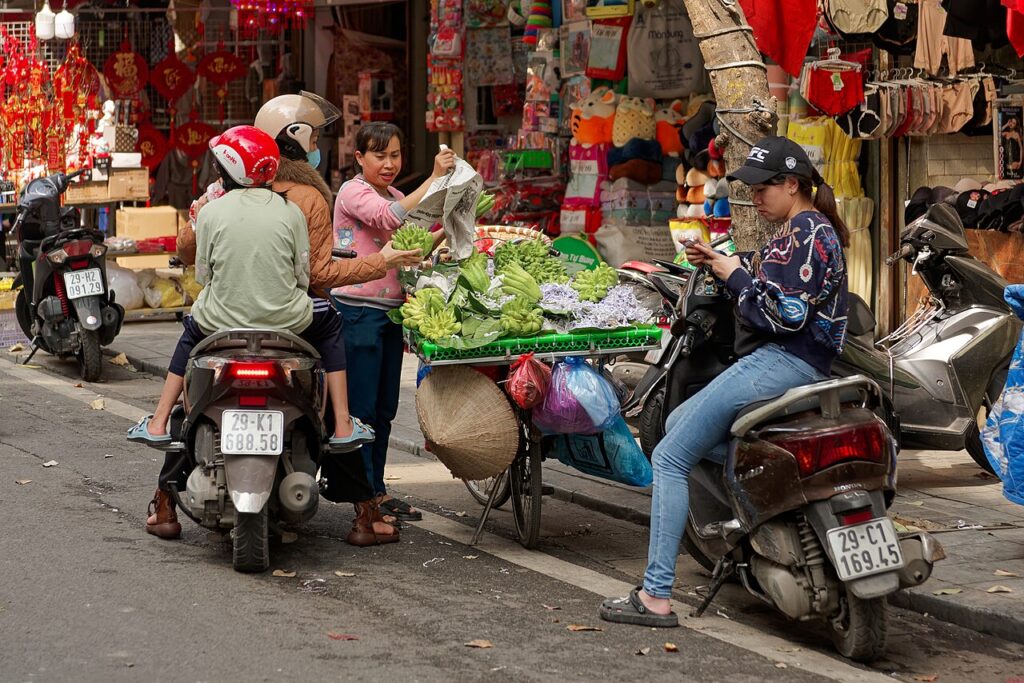
You will need cash for street food, markets, small family-run restaurants, local cafes, motorbike and taxi fares paid directly, motorbike rental, entrance fees at smaller sites, tips, and essentially everything outside cities and tourist centres. Street food is one of the best parts of Vietnam and it is almost entirely a cash economy.
Some smaller vendors who do accept cards add a surcharge, typically a small percentage, to cover their processing cost. This is common and usually disclosed. If you would rather not pay it, pay cash.
Two practical notes. Tell your bank you are travelling, or your first Vietnamese transaction may be declined as suspicious — and if the resulting verification code goes to a phone number you cannot receive SMS on, you have a real problem, which is covered in our Vietnam eSIM and mobile data guide. And carry a second card from a different network, stored separately from the first. Card problems abroad are usually solved by having another card, and almost never solved by anything else.
QR payments: everyone is using them and you probably cannot
You will notice QR codes on every counter in Vietnam, and locals paying for everything by scanning them. This is a domestic bank-transfer system, and it has become the default way Vietnamese people pay for things.
It generally requires a Vietnamese bank account, which in turn requires residency documentation. For a visitor on a short trip, it is usually not accessible, and that is not a failure on your part. Plan on cash and cards. Do not arrive expecting to slot into the QR system just because you can see it working all around you.
Exchanging cash, if you bring it
You do not need to bring a stack of foreign cash to Vietnam, but there is a reasonable case for carrying a modest emergency reserve in a major currency, kept separately from your cards. If you do bring cash, US dollars are the most widely recognised, followed by euros.
Where to change it:
- Banks — the safest option, with fair rates and a receipt. Bring your passport. Hours are limited, which is the main drawback.
- Licensed exchange counters in cities offer competitive rates and longer hours. Rates are posted; compare a couple before committing.
- Airports — convenient and consistently among the worst rates available. Change a small amount for your first taxi and nothing more.
- Hotels — convenient, poor rates, fine for a small top-up.
Bring notes in good condition. This is not a formality. Torn, heavily creased, marked or older-series foreign notes are routinely refused or discounted at exchange counters across the region. Crisp, recent notes exchange without argument.
The same standard applies in reverse to the dong you receive. Vietnamese vendors can and do refuse badly damaged notes. If a machine or a counter hands you something torn or taped, ask for a replacement there and then, while you are still standing in front of the person who gave it to you.
A note on prices quoted in dollars
Some tourist-facing businesses — tour operators, dive shops, certain hotels — quote prices in US dollars. This is legal and normal.
What matters is the rate applied if you pay in dong. It is frequently rounded in the business’s favour, sometimes noticeably. Ask what rate they are using before agreeing, and compare it against the day’s actual rate. It is usually a small difference, and occasionally it is not.
Tipping: the honest position
Tipping is not a traditional part of Vietnamese culture and is not built into wages the way it is in the United States. You are not committing a social offence by not tipping, and nobody will chase you down the street.
That said, it has become common in tourist-facing service, and in some contexts it is genuinely appreciated and reasonable: guides and drivers on multi-day tours, spa and hotel staff, and rounding up a restaurant bill where service was good. Some restaurants add a service charge, in which case an additional tip is entirely optional.
What tipping is not is obligatory, and you should be sceptical of anyone who presents it as such. Give when you want to, in cash, in dong, and in an amount that is proportionate to local prices rather than to what you would tip at home.
Small ways money goes missing
None of these are dramatic, and all of them are avoidable with a little attention.
- The note confusion, in reverse. The 20,000 and 500,000 problem cuts both ways. Check your change as carefully as you check what you hand over.
- “No change.” A genuine constraint for small vendors early in the day, and occasionally a convenient one. Carrying small notes solves it and is simply good practice.
- Unmetered taxis. Either use a metered taxi from a reputable company, or agree the fare before departure, or use a ride-hailing app where the price is fixed in advance. Any of the three is fine; no plan at all is where problems start.
- Rounding on dollar-quoted prices. Covered above — ask the rate.
- The conversion offer at card terminals. Also covered above. Decline it.
- Leftover dong. The dong is difficult and expensive to exchange outside Vietnam, and many foreign banks will not touch it. Spend it down before you fly, or change it back at the airport and accept the loss. Do not plan to deal with it at home.
Bringing money in and out
Vietnam sets declaration thresholds for currency carried across its borders, covering both foreign cash and dong. The commonly cited figures are the equivalent of several thousand US dollars in foreign currency and a set amount in dong, above which you must declare at customs.
Because these thresholds are set by regulation and can change, verify the current numbers against official Vietnamese customs guidance before you travel if you intend to carry a large sum. For an ordinary trip funded by card withdrawals, this will not apply to you at all.
What to actually do
- Check your own bank’s foreign withdrawal fee and daily limit before you leave, and tell them you are travelling.
- Bring two cards on different networks, stored separately.
- Look up today’s exchange rate and build your “drop three zeros” shortcut from it.
- Change a small amount at the airport for your first taxi. No more.
- Withdraw from a bank-branch ATM, in larger amounts, fewer times.
- Decline the home-currency conversion offer every single time.
- Split the 500,000 notes into their own section of your wallet on day one.
- Keep a working supply of small notes for street food, and break big notes at supermarkets.
- Spend your remaining dong before you leave.
Frequently asked questions
Should I bring cash to Vietnam or use ATMs?
ATMs are the normal and usually cheaper route. Bring a modest emergency reserve in good-condition US dollars, kept separately from your cards, and withdraw the rest as you go.
Can I use my credit card in Vietnam?
Yes in hotels, supermarkets, larger restaurants and tour operators. No for street food, markets, small local restaurants and most transport paid directly. Carry cash for those.
Why do the 20,000 and 500,000 notes look the same?
Both are predominantly blue polymer notes of similar tone. Count the zeros rather than reading the colour, and keep the 500,000 notes physically separate in your wallet.
Should I pay in dong or my home currency?
Always dong. Choosing your home currency is dynamic currency conversion, and it hands the exchange rate to the operator at a margin in their favour.
How much cash should I carry day to day?
Enough for a day of food, transport and small purchases, weighted toward smaller notes, with your reserve left in your accommodation. Street food, taxis and market stalls are all cash.
Can I use QR payments as a tourist?
Generally no. Vietnam’s QR system runs on domestic bank accounts that usually require residency documentation. Plan on cash and cards.
Is tipping expected in Vietnam?
Not traditionally, and never obligatory. It is common and appreciated in tourist-facing service — guides, drivers, spa and hotel staff — and best given in cash in dong.
What do I do with leftover dong?
Spend it before you fly. It is difficult and costly to exchange outside Vietnam, and many foreign banks will not accept it at all.
The short version
Vietnam’s money system is easy once two habits are in place: count the zeros instead of reading the colour, and always refuse the home-currency conversion offer. Those two alone prevent the great majority of what goes wrong. Everything else — fewer and larger ATM withdrawals, small notes for street food, two cards on different networks, spending your dong before you leave — is ordinary good practice that happens to matter a little more here because of the zeros.
Next: how much a trip to Vietnam costs covers what things cost, our 10-day Vietnam itinerary covers the route, and Vietnam by train covers getting between the stops on it.
Where the notes get exploited: the 20,000 and 500,000 similarity produces honest mistakes daily, which is exactly what creates an opening. Our guide to scams and overcharging in Vietnam covers the note swap, the taxi patterns, tour bait-and-switch, and why dynamic currency conversion quietly costs travellers more than every street scam combined.
You Might Also Love



Written by
John Morrison is the founder and lead travel writer at Packzup. Over the past decade he has explored destinations across Africa, the Americas, Asia, Europe, the Middle East, and Oceania — always self-funded, never on a press trip.
