
Vietnam’s railway is not the fastest way to cross the country, and anyone telling you otherwise is selling romance. A flight from Hanoi to Ho Chi Minh City takes about two hours. The train takes somewhere between thirty-two and thirty-six. On pure efficiency the argument is over before it starts.
The train wins on different ground. Vietnam is a long, narrow country pressed between mountains and sea, and the railway runs down the seam of it. For long stretches the track sits close enough to the water that there is nothing between your window and the South China Sea but a few metres of sand. You cannot see that from 35,000 feet, and you cannot see it from the highway either, because the highway goes inland where the engineering was easier.
This guide covers how the system actually works: what the trains are called and why the numbering matters, which class is worth paying for, the one segment most travellers should ride even if they fly everything else, and how to book without paying a reseller’s markup. It is a companion to our broader getting around Vietnam guide, which compares trains against buses and internal flights.
More: When to visit Vietnam · Vietnam travel guide
The line, in one paragraph
One main line does almost all the work: the North–South railway between Hanoi and Ho Chi Minh City, roughly 1,726 km of track. It is colloquially called the Reunification Express, a name that comes from the line being reconnected in 1976 after the war — it is a nickname for the route, not the name of a particular luxury train, which is a common misunderstanding.
The important technical detail is the gauge. Vietnam’s main line is metre gauge — 1,000 mm between the rails, narrower than the 1,435 mm standard gauge used across most of Europe, China and North America. Narrow gauge on mountainous terrain means tight curves and modest speeds. Average speed end to end works out around 50 km/h. This is not a neglected railway; it is a railway built to a specification that caps how fast it can ever go.
That single fact explains most of what follows. It is why the full run takes a day and a half, why the train cannot compete with flying over long distances, and why the smart way to use Vietnamese trains is in segments rather than end to end.
Decoding the train numbers
Vietnamese train codes look opaque and are actually simple, and understanding them saves you from booking a service that stops everywhere.
- SE trains are the express services. Newer rolling stock, fewer stops, faster. These are what you want.
- TN and other codes are the slower services, stopping more often, generally older. Cheaper, considerably longer.
- Odd numbers run southbound from Hanoi toward Ho Chi Minh City. Even numbers run northbound. So SE1 heads south and SE2 heads north.
Lower SE numbers generally indicate the faster, better-equipped services on the route, though this is a rule of thumb rather than a guarantee — check the actual timing for the specific train. There are also regional services that do not run the full line, most usefully the Hanoi–Sapa-direction trains to Lao Cai and short-haul services along the central coast.
The classes, and which one to actually book
There are four broad options, and the difference between them is larger than the price gap suggests.
Hard seat. A bench-style upright seat, sometimes without air conditioning on older services. Fine for two or three hours in daylight. Genuinely unpleasant overnight, and worth avoiding for anything longer than a short hop.
Soft seat. A padded reclining seat, air conditioned. Perfectly comfortable for daytime journeys of up to five or six hours. This is the right choice for short scenic segments and the sensible default for a daytime ride.
Hard sleeper. A compartment with six berths, stacked three high on each side. Air conditioned, bedding provided. “Hard” is a translation artefact rather than a description — the mattress is thin but it is a real bed. The middle and top berths have noticeably less headroom, and the top berth is a genuine climb.
Soft sleeper. A compartment with four berths, two on each side, with more space per person and a door that closes. This is the class to book for an overnight journey. On a long overnight leg the extra cost buys you actual sleep, which is the entire reason you chose the train.
One booking detail that matters more than people expect: berth position is not cosmetic. Lower berths cost more and are worth it. You can sit upright on a lower berth, you can reach your luggage, and you do not have to climb over a stranger at three in the morning. Upper berths are cheaper, hotter, and have a shelf-like quality that some people find cosy and others find claustrophobic. In a six-berth hard sleeper the lower berths also double as the compartment’s communal seating during the day, which is either sociable or intrusive depending on your mood.
If you are travelling as a pair and want privacy, book all four berths in a soft sleeper compartment. It is not as extravagant as it sounds relative to a hotel room, and it converts the journey into a private cabin.
The one segment worth riding even if you fly everything else
If you take one piece of advice from this page, take this one. The stretch between Hue and Da Nang is roughly three hours, and it is the single best-value train journey in Vietnam.
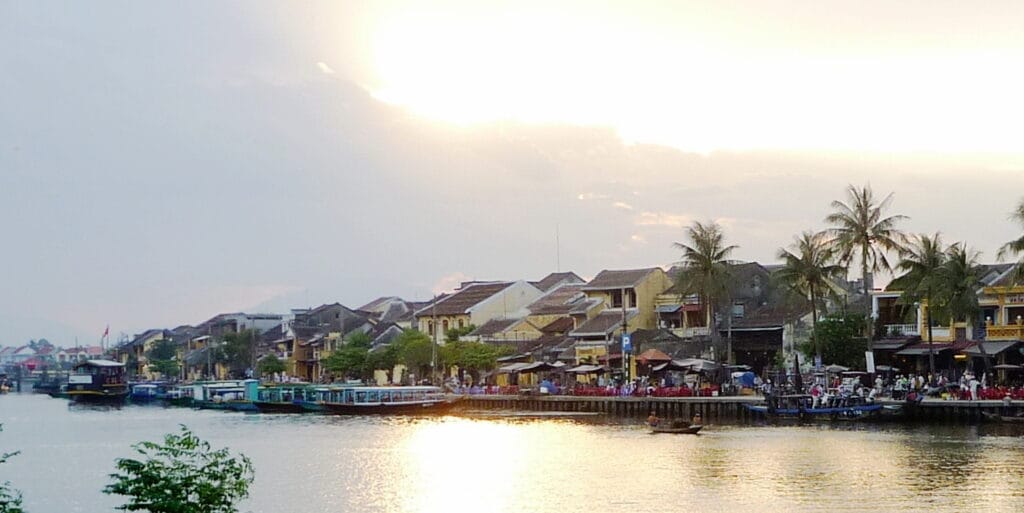
The track climbs away from the Hue plain, works its way over the Hai Van Pass — the mountain spur that forms the historic dividing line between Vietnam’s northern and central climates — and then runs along a cliff-and-beach coastline with the sea directly below. The road route through the same terrain now largely uses a tunnel, which means the train has views the traffic does not. It is short enough that you do not need a sleeper, cheap enough that class barely matters, and it slots naturally into any itinerary that includes both Hue and Hoi An, because Da Nang is the transfer point for Hoi An anyway.
Book a soft seat, sit on the eastern side of the train for the sea — that is the right-hand side heading south from Hue, the left-hand side heading north from Da Nang — and do not spend the journey looking at your phone. Coverage on this stretch is intermittent regardless, as our Vietnam eSIM and mobile data guide covers in more detail.
Which legs make sense, and which do not
The honest framing is that trains are excellent for medium distances and scenery, and a poor use of holiday time over very long ones. Approximate journey times on the express services:
| Leg | Train, approx. | Verdict |
|---|---|---|
| Hue – Da Nang | ~3 hours | Take the train. The best segment on the network. |
| Hanoi – Hue | ~13–14 hours | Good overnight sleeper. Arrives ready to use the day. |
| Hanoi – Da Nang | ~16–17 hours | Workable overnight, but a long one. |
| Da Nang – Ho Chi Minh City | ~17–19 hours | Fly unless you specifically want the ride. |
| Hanoi – Ho Chi Minh City | ~32–36 hours | Only as a deliberate experience. Costs you two days. |
Treat these as planning approximations. Timings vary by service and change with the schedule, so confirm against the official timetable before you build a day around one.
The practical pattern most travellers land on: fly the single longest hop, take an overnight sleeper for one leg to experience it, and ride Hue–Da Nang in daylight for the views. That gets you the railway without donating a day and a half to it.
Booking without paying a markup
Vietnam Railways sells tickets directly through its official site, dsvn.vn. Booking there is the cheapest route because you pay the state operator’s fare with no intermediary.
A large number of third-party resellers also sell Vietnamese train tickets, and they are not scams — they are convenience services. They add a booking fee, and in exchange they offer an English-language interface that is easier to navigate and card payment that is more likely to go through on a foreign card. That is a legitimate trade. Just know that you are paying for it, and roughly how much, before deciding.
Points worth knowing whichever route you choose:
- Book ahead for sleepers, and well ahead around Vietnamese public holidays. Tết, the lunar new year, is the single hardest time to get a berth on the network — the entire country travels at once, and sleepers sell out far in advance.
- Your passport details are required at booking, and the name on the ticket should match your passport.
- You can book specific berths on the official site. Use that. Pick lower berths.
- Keep a copy of the ticket offline — a screenshot as well as the email. Station wi-fi is not something to rely on.
- Arrive at the station with time to spare. Vietnamese stations are straightforward, but platforms are not always obvious and the trains do not wait.
What it is actually like on board
Expectations are the main thing that goes wrong on Vietnamese trains, so here is a level-headed account.
The compartments are clean and basic. Bedding is provided in sleeper class and is generally fresh. Air conditioning works and is often set colder than you would choose, which is the reason experienced travellers pack a layer for an overnight leg.
Toilets are at the end of each carriage and their condition declines predictably over a long journey. Going early in the trip is a reasonable strategy. Bring your own tissue and hand sanitiser as a matter of course rather than as a precaution.
Food comes past on a trolley, and there are usually meals available on longer services. It is inexpensive and perfectly edible. It is also limited, so most people bring their own supplies. Station platforms and the areas around stations sell snacks and fruit before departure, which is where the good stuff is.
Power sockets exist but are not guaranteed per berth. Older carriages may have one or two per compartment. A power bank removes the problem entirely and is the single most useful thing to pack.
It is not a quiet environment. Metre-gauge track on tight curves produces a lot of movement and noise, doors open and close through the night, and Vietnamese families travel together and sociably. Earplugs and an eye mask make the difference between a rough night and a decent one.
On valuables, apply ordinary sense rather than anxiety. Vietnamese trains are not dangerous. Keep your passport, phone and money on your person or under your pillow rather than in a bag on the floor, use a small padlock on your main luggage, and stow it under the lower berth. That is the whole protocol.
A short packing list for an overnight leg
- Power bank and cable — the highest-value item on the list
- Earplugs and eye mask
- A long-sleeved layer for the air conditioning
- Tissue, wet wipes, hand sanitiser
- Water, plus more snacks than you think you need
- Flip-flops for walking to the toilet
- Small padlock for your main bag
- Offline entertainment downloaded in advance, because coverage comes and goes for hours
Our full Vietnam packing list covers the rest of the trip.
The other line worth knowing: the night train north
Everything above concerns the North–South line, but there is a second route most visitors end up using without thinking of it as a train journey: Hanoi to Lao Cai, the overnight service toward the northern mountains.
It runs roughly eight hours through the night, which is close to a perfect duration — you board at a civilised hour in Hanoi, sleep, and arrive in the morning with the day intact. Lao Cai is the railhead, not the destination; Sapa sits up in the hills about 35 km away, and the connection is by road transfer from outside the station. Factor that final leg into your arrival planning rather than assuming the train delivers you to the mountains.
This route has a feature the main line does not: alongside the standard Vietnam Railways carriages, several private operators attach their own sleeper cars to the same trains, with more comfortable cabins at higher prices. You are on the identical train arriving at the identical time — the difference is the carriage. Whether that is worth the premium is a matter of budget rather than logistics.
The comparison here is against the sleeper bus, which is faster and cheaper on paper. The train wins on sleep quality and on not spending the night on a mountain road, which is the argument that tends to matter at the end of it.
There are also short regional services, including Hanoi to Hai Phong on the coast, useful mainly as a relaxed alternative to the road for the Ha Long and Cat Ba direction.

What about high-speed rail?
Vietnam has approved plans for a high-speed North–South railway, and it is a genuinely transformative project on paper — a line built to modern standards would cut the Hanoi to Ho Chi Minh City journey from a day and a half to a matter of hours.
It is also a multi-year infrastructure programme of enormous scale, not something that changes how you travel on your next trip. Plan around the railway that exists today: metre gauge, scenic, slow. If you are reading this while high-speed services are actually running, disregard everything above about journey times and check current schedules instead.
Frequently asked questions
Is the train in Vietnam worth it?
For the Hue–Da Nang segment, unreservedly yes. For one overnight leg, yes as an experience. For the full Hanoi to Ho Chi Minh City run, only if the journey itself is something you want — it costs you roughly two days you could spend somewhere.
How long does the Hanoi to Ho Chi Minh City train take?
Roughly 32 to 36 hours on the express services, covering about 1,726 km. The metre-gauge track is the limiting factor, not the timetable.
Which class should I book?
Soft sleeper with a lower berth for any overnight journey. Soft seat for daytime segments of a few hours. Avoid hard seat overnight.
Where should I book Vietnamese train tickets?
The official Vietnam Railways site, dsvn.vn, is the cheapest. Third-party resellers charge a booking fee in exchange for an easier interface and more reliable foreign-card payment — a fair trade if you want it, but know you are paying for convenience.
Are Vietnamese trains safe?
Yes. Standard travel sense applies: keep valuables on your person overnight and padlock your main bag. Nothing beyond what you would do on any overnight train anywhere.
Is the Reunification Express a special tourist train?
No — it is a nickname for the North–South route, not a distinct luxury service. You are booking ordinary Vietnam Railways services.
Which side of the train has the sea views?
The eastern side. Heading south that is the right-hand side; heading north it is the left. This matters most on the Hue–Da Nang stretch.
The short version
Use the railway for what it is good at. Ride Hue to Da Nang in daylight because the coastline is genuinely one of the best things you will see in Vietnam and it costs you three hours. Take one overnight sleeper in soft class with a lower berth, because sleeping through a long transfer is a good use of a night. Fly the longest hop and stop feeling guilty about it.
What you should not do is book the full thirty-four-hour run because a list of experiences told you to, and then spend a day and a half of a two-week holiday watching Vietnam go past a window. The railway is a highlight in segments and an endurance event end to end.
Next: getting around Vietnam compares trains with buses and flights, our 10-day Vietnam itinerary shows where the rail legs fit a real route, and visa requirements covers getting into the country in the first place.
You Might Also Love




Written by
John Morrison is the founder and lead travel writer at Packzup. Over the past decade he has explored destinations across Africa, the Americas, Asia, Europe, the Middle East, and Oceania — always self-funded, never on a press trip.
