
Last updated September 16, 2026 · Editorial policy
Vietnam is one of the easier countries in Asia to stay connected in, and one of the easier ones to get wrong in the first hour. Data is cheap, 4G is genuinely widespread, and the three national networks cover far more of the country than most visitors expect. The friction is not the network. It is the twenty minutes after you land at Noi Bai or Tan Son Nhat, when you have no data, a queue in front of you, and a Grab driver you cannot reach.
This guide covers the Vietnam-specific parts: which network actually reaches the places on a normal Vietnam route, what the SIM registration rules mean for a visitor, why a data-only plan quietly breaks Grab and bank one-time passcodes, and how much data a two-week trip really consumes. If you want the general explainer — what an eSIM is, whether your handset supports one, how QR activation works — that is covered in depth in our international eSIM guide, and this page assumes it rather than repeating it.
More: When to visit Vietnam · Vietnam travel guide
First, the thirty-second version
- Viettel has the widest reach outside cities. If your trip includes Sapa, Ha Giang, Phong Nha or the Mekong back-channels, this is the network you want underneath your plan.
- Buy before you fly. An eSIM installed at home and switched on after landing removes the airport counter from your arrival entirely.
- Check whether your plan includes a Vietnamese number. Most travel eSIMs are data-only. That is fine until something needs to send you an SMS.
- Validity usually starts on first connection, not on purchase — but not always. This is the single most expensive detail on the page.
- Budget roughly 500 MB to 1.5 GB per day for normal travel use. A 10–15 GB plan covers a two-week trip for most people.
The three networks, and why the choice is not arbitrary
Vietnam has three mobile operators of real scale: Viettel, Vinaphone and Mobifone. Every travel eSIM you can buy runs on one or more of them — resellers do not own towers, they resell wholesale capacity. So the question “which eSIM should I buy” is partly the question “which network will my eSIM attach to”, and that is worth two minutes of your attention.
Viettel is the largest by subscriber base and, more importantly for travellers, the most built-out in rural and mountainous areas. It is majority state-owned and has spent two decades running infrastructure into provinces where a purely commercial operator would not have bothered. In practice this is the difference between having a signal on a mountain pass and not.
Vinaphone and Mobifone are both strong in cities and along the main coastal corridor, and either is perfectly adequate if your trip is Hanoi, Hoi An, Da Nang and Ho Chi Minh City. They thin out faster than Viettel once you leave the highways.
A good travel eSIM will name its underlying network, or will list multiple networks and roam between them. A plan that names none is asking you to trust it blind. That is not automatically a bad plan, but you should know that is what you are buying.
Where Vietnam’s coverage actually breaks down
Vietnam is roughly 1,650 km long and mostly not flat. Coverage maps flatten that. The places a normal itinerary loses signal are predictable:
- The Ha Giang loop. The classic northern motorbike circuit crosses long stretches of high, sparsely populated karst. Expect dead zones between settlements regardless of network, and expect Viettel to recover soonest.
- Sapa and the Fansipan massif. The town is fine. The valleys and terraces below it are not uniformly covered, and cloud-heavy weather does not help.
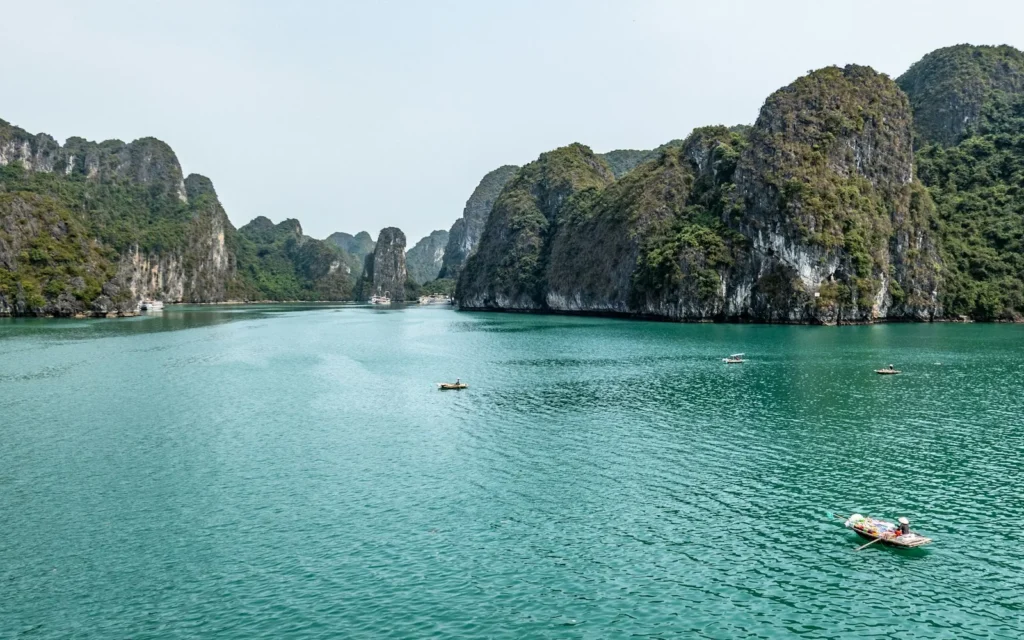
- Ha Long Bay and Cat Ba, on the water. Signal is patchy to absent once a boat is properly out among the islands. Overnight cruises frequently have no usable data, which is worth knowing before you plan to work from one.
- Phong Nha’s caves. Underground, obviously — but also several of the approach roads.
- Mekong Delta side-channels. The towns are covered; the small waterways between them are inconsistent.
- Long-distance sleeper trains and buses. Signal comes and goes with terrain for hours at a time. Download offline maps and tickets before boarding, not during.
None of this makes Vietnam a hard country to stay connected in. It makes it a country where you should download what you need in advance and not assume a live connection at the exact moment you need a boarding pass.
The registration rule that quietly favours eSIMs
Vietnam requires mobile SIMs to be registered against identity documents, and regulators have run repeated campaigns against unregistered and improperly registered “junk” SIMs. For a visitor buying a physical prepaid SIM, this means presenting your passport at the point of sale and having the SIM registered to you. It is not difficult, but it is a step, it needs a real shop or an official airport counter, and it is not something a street vendor can legitimately shortcut for you.
This is a genuine reason the eSIM route has become the path of least resistance in Vietnam specifically. A travel eSIM sold by a reseller rides on already-registered wholesale capacity, so the identity-registration burden sits with the provider rather than with you at a counter after a ten-hour flight.
Two honest caveats. First, this convenience is exactly why a data-only travel eSIM usually gives you no Vietnamese phone number — you are not a registered Vietnamese subscriber, and the trade is deliberate. Second, if you specifically need a local number, a properly registered physical SIM bought in-country from an official store remains the cleaner answer. Buying the passport-registered local SIM is not the outdated option; it is the option that comes with a number.
The Grab problem: why data-only can bite
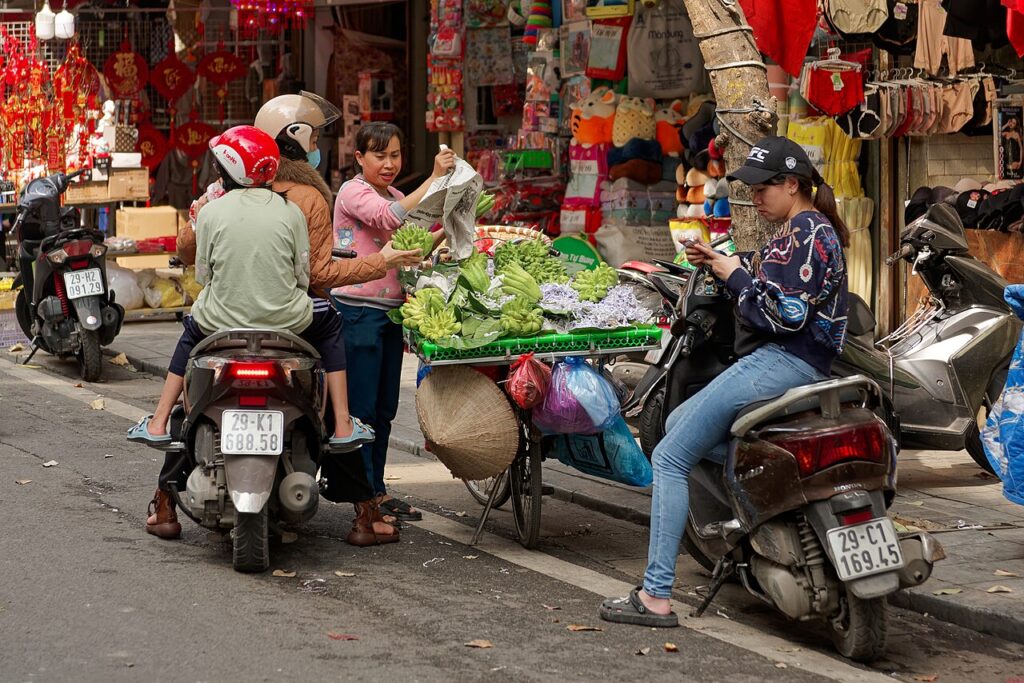
This is the failure mode most guides skip, and in Vietnam it matters more than usual because Grab is not optional. It is how you get taxis, how you get food, and increasingly how you pay for both.
A data-only eSIM gives you internet and no telephone identity. Consequences, in rough order of how likely they are to ruin an afternoon:
- Grab driver contact. Drivers call. Vietnamese addresses are frequently ambiguous, alley numbering is genuinely hard, and a driver who cannot reach you may simply cancel. Grab’s in-app chat and calling work over data, so keep the app in the foreground and notifications on — but a driver who defaults to a normal phone call will not get through.
- One-time passcodes. Bank and card verification SMS goes to your home number. If your home SIM is switched off or has no roaming, that code does not arrive, and a card payment or app login can hard-fail.
- App re-verification. Some services re-verify by SMS when they see a new country and a new IP address. This can happen mid-trip with no warning.
The fix is mundane and worth doing before you leave. On a dual-SIM phone, keep your home SIM installed and active for SMS only — data off, roaming data off, SMS receipt on — and put all data on the Vietnamese eSIM. You keep your number for codes and pay nothing for data. Check your home carrier’s charge for receiving SMS abroad; for most it is free or near-free, but confirm rather than assume. Also make sure your home number is the one on file for anything you might need to authenticate during the trip.
How much data a Vietnam trip actually uses
Plan sizing is where people overspend. The honest answer is that ordinary travel use is modest and the outliers are obvious. Treat the figures below as planning estimates rather than measurements — your own usage depends heavily on how much you stream.
- Light use — maps, messaging, Grab, occasional browsing, photos uploaded on hotel wi-fi: roughly 300–600 MB per day.
- Normal use — the above plus social media, some video, translation, uploading photos over cellular: roughly 700 MB–1.5 GB per day.
- Heavy use — video calls home, streaming on buses and trains, tethering a laptop: 2–4 GB per day and up.
For a two-week Vietnam trip, that puts most travellers comfortably inside 10–15 GB. Two specifics push it up: navigating by phone while riding a motorbike for hours, and tethering. Two things pull it down sharply — hotel and cafe wi-fi in Vietnam is widespread and generally good, and offline maps cost you nothing once downloaded.
Download offline map areas for Hanoi, Hoi An, Ho Chi Minh City and any loop you plan to ride before you go. It is the single highest-value five minutes of trip prep on this page.
Validity: the detail that costs people money
Read this before you buy anything. Travel eSIM validity is counted in one of two ways, and providers are not consistent:
- From first connection. The clock starts when the eSIM first attaches to a Vietnamese network. This is the traveller-friendly version — you can install it weeks early and it does not burn.
- From purchase or activation date. The clock starts whether you have landed or not. Install early on one of these and you can lose days before your flight.
Two practical rules. Buy a validity window longer than your trip, because a 14-day plan against a 14-day trip leaves no margin for a delayed flight. And install the profile at home but leave it switched off until you land — installation needs wi-fi and is the step most likely to go wrong, so you want it done somewhere calm, but you do not want it connecting until you are actually in Vietnam.
Airport counters versus buying in advance
Official carrier counters do exist in the arrivals areas at the major international airports — Noi Bai in Hanoi, Tan Son Nhat in Ho Chi Minh City, Da Nang. Buying there works, gets you a registered local SIM with a local number, and is a reasonable choice if a Vietnamese number matters to you.
The costs are queue time after a long flight, opening hours that may not match a 2 a.m. arrival, and pricing that is generally higher than in-city stores. There is also a well-documented pattern across Southeast Asian airports of resellers positioned before the official counters selling plans that are not what the buyer thought they were. Look for official carrier branding, and be sceptical of anyone approaching you.
An eSIM bought in advance sidesteps all of it. You clear immigration, toggle the profile on, and open Grab in the taxi queue. That is the entire pitch, and for most visitors it is enough.
Setting it up without drama
- Confirm your phone is eSIM-capable and carrier-unlocked before you buy. Most iPhones from the XS and XR generation onward support eSIM, as do Pixel 3 and later and Samsung Galaxy S20 and later — but there are regional exceptions, notably some handset variants sold in mainland China and Hong Kong. Our eSIM guide has the full compatibility detail.
- Install the profile at home, over wi-fi. Scan the QR code the provider sends. The profile downloads and appears as a second line.
- Leave it turned off. Label it something obvious like “Vietnam” so you are not guessing at the airport.
- On landing, enable the Vietnam line and set it as your data line. Turn mobile data off on your home line and confirm data roaming is off there too.
- Turn on data roaming for the Vietnam line. This sounds wrong and is correct — a travel eSIM is technically roaming, and it will not pass data without this. It is the most common activation failure.
- Check which network you attached to in your phone’s network settings. If you are on a weak one and your plan supports multiple, force a manual reselect.
If it does not work
- No data at all? Check data roaming on the eSIM line first. Then confirm the Vietnam line is set as the mobile data line, not merely enabled.
- Connected but nothing loads? Toggle airplane mode for ten seconds. If that fails, check the APN — most providers auto-configure, some need it entered manually and will tell you the value.
- Very slow speeds? Check whether you have hit a fair-use threshold after which the plan throttles. Many plans have one. Then try a manual network reselect.
- Nothing at all after landing? Free airport wi-fi is available at the major terminals, which is enough to reach your provider’s support. This is a reason to keep the confirmation email accessible offline.
Frequently asked questions
Do I need an eSIM for Vietnam, or is wi-fi enough?
Wi-fi is genuinely good and widespread in Vietnamese hotels and cafes, so a very low-key trip can survive on it. But Grab needs data at the roadside, not in your hotel lobby, and that is where wi-fi-only plans fail. For most visitors a small data plan is worth it purely for transport.
Which network has the widest coverage in Vietnam?
Viettel has the widest rural and mountain footprint, which is what matters if you are heading to Sapa, Ha Giang or Phong Nha. For a cities-and-coast itinerary, all three national networks are adequate.
Will a travel eSIM give me a Vietnamese phone number?
Usually not. Most travel eSIMs are data-only. If you need a local number for calls and SMS, buy a passport-registered physical SIM from an official carrier store or airport counter.
Can I use Grab with a data-only eSIM?
Yes — Grab’s booking, chat and in-app calling all work over data. The gap is a driver who calls your phone number directly rather than using the app. Keeping your home SIM active for SMS and calls solves it.
How much data do I need for two weeks in Vietnam?
For most travellers, 10–15 GB is comfortable. Go higher if you plan to tether a laptop, stream on long bus journeys, or navigate by phone for hours on a motorbike.
When should I install the eSIM?
Install it at home over wi-fi a day or two before flying, and leave it switched off until you land. Confirm first whether your plan’s validity starts on purchase or on first connection — if it starts on purchase, do not buy too early.
Does my phone need to be unlocked?
Yes. A carrier-locked handset may refuse a third-party eSIM profile. Check with your carrier before you buy a plan.
The short version
Vietnam does not punish you for arriving unconnected — airport wi-fi and cheap in-city SIMs mean you can always fix it. But the fix costs you the first hour of your trip, and the first hour is usually the one where you most need a map and a taxi. An eSIM installed at home, switched on after landing, with your home SIM kept alive for SMS, removes the entire problem for the price of a couple of coffees.
Next, if you are still building the trip: our 10-day Vietnam itinerary covers the route, visa requirements covers entry, and getting around Vietnam covers trains, buses and internal flights — all three of which you will be booking on the data plan you just sorted out.
You Might Also Love





Written by
John Morrison is the founder and lead travel writer at Packzup. Over the past decade he has explored destinations across Africa, the Americas, Asia, Europe, the Middle East, and Oceania — always self-funded, never on a press trip.
