
Morocco travel guide
Morocco travel guide: Marrakech, the desert, and the High Atlas
Morocco delivers one of Africa's most accessible cultural adventures - the sensory immersion of Marrakech medina, the cooling escape of the Atlas Mountains, and the Sahara that defines the trip for many travelers.
Destinations we cover in Morocco
Country overview
Morocco is hot-semi-arid inland, mediterranean on the northern coast, mountain-cold in the High Atlas. Visa-free for most Western travelers (90 days). Cash-based culture; ATMs widely available.
- Language
- Arabic + Berber (Tamazight); French universal as second language; English increasingly common in tourism but far less than French.
- Currency
- Moroccan Dirham (MAD). Cash is essential; cards accepted in upscale hotels and restaurants.
- Best time to visit
- October-April for comfortable Marrakech and Sahara temperatures. May-September is brutally hot inland (40C+). Atlas Mountains good year-round but snowy in winter.
- Trip highlights
- Marrakech medina + souks + riad rooftops + hammams + Atlas Mountains + Sahara desert extensions + Essaouira coast.
Morocco travel guide
Morocco is a feast for the senses — imperial cities, the Sahara, mountains and the coast.
- Marrakech — the famous medina, souks and Jemaa el-Fnaa.
- Fez — the world's largest car-free medieval medina.
- The Sahara — camel treks and desert camps near Merzouga.
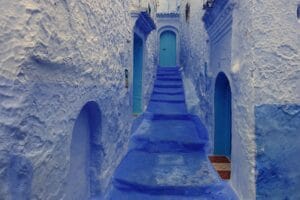
- Chefchaouen — the blue mountain town; plus the Atlas and the coast at Essaouira.
When to go & tips
Spring (March-May) and autumn (September-November) are ideal — summer is scorching inland. Stay in traditional riads, bargain in the souks, carry dirham cash, and dress modestly.
Ten days lets you loop Marrakech, Fez, the desert and the mountains.
Morocco Travel Guide FAQ
What's the best itinerary for Morocco?
Marrakech, Fez, the Sahara desert and Chefchaouen or the Atlas Mountains — about 10 days.
When is the best time to visit Morocco?
Spring (March-May) and autumn (September-November); summer is very hot inland.
Torn between destinations? See our honest comparisons: Morocco vs Portugal, Morocco vs South Africa, Morocco vs Egypt, Morocco vs Turkey.
Plan the practical side: Cost of 1 Week in Morocco Americans, Morocco Visa Guide.
Do you need a visa for Morocco, and how long can you stay?
British, Canadian and German passport holders travelling for tourism need no visa for Morocco and may stay up to 90 days. Each of those three governments publishes the rule in its own words, and all three pages were read on 5 September 2026. The UK Foreign, Commonwealth and Development Office states that you can visit Morocco without a visa for up to 90 days for tourism. The Government of Canada, whose page was modified on 1 September 2026, lists a tourist visa as not required for stays of less than 90 days. The German Federal Foreign Office, whose page carries the same day's date, says German nationals need no visa for tourism or business stays of up to 90 days.
The 90 days is extended inside Morocco, not at the border on your way out. You apply at a police station, and the Government of Canada is specific about the timing: contact the Service to Foreigners Section at your local police station at least 15 days before the 90-day limit expires. Canada's own words for what follows an overstay are that you will be forced to remain in Morocco until seen by a prosecutor, and fined. The German Federal Foreign Office is blunter still, treating a longer stay as a breach of residence law that is prosecuted criminally rather than as a paperwork slip. Leaving the extension to the final week is how a lawful stay becomes an offence.
- Passport validity: the three governments disagree, so use the longest. The FCDO says your passport must have an expiry date at least 3 months after the date you arrive. Canada says valid for at least 6 months beyond the date you expect to leave Morocco. Germany says travel documents must still be valid for at least six months at the moment of entry. Six months of remaining validity satisfies all three. Germany adds that entering Morocco on a national identity card is not possible.
- A damaged passport can end the trip at the desk. The FCDO records that Moroccan authorities have denied entry to some travellers with damaged passports. A peeling laminate or a water-stained page is worth replacing before you book, not after.
- Polio certificate, but only from certain countries. The FCDO states you must have a certificate to prove you have had a polio vaccine if you are coming from a polio-affected country. Arriving from Europe or North America, nothing is required.
- If you drive in, you must drive out. Canada states that if you enter Morocco with a vehicle you must exit with it or you will be denied exit. Germany states the same and adds that failure to re-export means departure is refused and substantial customs penalties follow. This is the rule that catches people who bring a hire car over on the Spanish ferry.
Every other nationality is a separate question and this page does not answer it. Morocco's Ministry of Foreign Affairs runs an electronic visa through its Accès Maroc platform at acces-maroc.ma, with the consular route at consulat.ma. Neither host would give up the list on 5 September 2026. The consular page that carries the visa-exempt nationalities returned the notice 'The requested URL was rejected', and acces-maroc.ma served only an unrendered application shell, a nationality form whose labels had not even been translated, with no list behind it. So no eligibility list, fee, validity or processing time is quoted here rather than quoted wrongly. Check your own nationality on acces-maroc.ma, and check it again within a fortnight of flying, because visa lists move without notice.
Why you cannot buy Moroccan dirhams before you fly
The dirham is a closed currency, so you cannot reliably buy it at home and you cannot legally carry much of it across the border in either direction. The FCDO puts it plainly: the Moroccan dirham is a closed non-convertible currency, which means it cannot easily be exchanged outside Morocco for other currencies. That is exchange-control law rather than a market quirk, and you feel it in the first hour and the last hour of the trip.
The banknote allowance is 2,000 dirhams each way, and it is the regulator's own figure. Morocco's exchange-control authority is the Office des Changes, and its rulebook is the Instruction Générale des Opérations de Change. Article 181 of that instruction, in the edition dated 16 November 2011 read for this page, authorises travellers to export and import an amount in banknotes not exceeding 2,000 dirhams, and states the reason in the text: so that they can meet certain expenses on their return to Morocco. Article numbering moves between editions of the instruction, so if you need to put this to an official, quote the wording rather than the number.
Above 100,000 dirhams of foreign currency, you declare in writing. Article 170 of the same instruction requires foreign currency brought in as banknotes or bearer negotiable instruments to be declared in writing to the frontier customs service on entry once the amount equals or exceeds the equivalent of 100,000 dirhams. Two details inside that article matter more to you than the threshold does. The declaration is valid once only, for a single stay, and for a period not exceeding six months, so a form kept from an earlier trip is worth nothing. And you may subscribe the declaration voluntarily for amounts below 100,000 dirhams, which is the sensible move if you are carrying a sum you will want to take out again. Article 169 sets the background rule that a non-resident may import payment means in foreign currency freely, without limitation of amount, so the duty is to declare rather than a ceiling on what you may bring. The FCDO gives the same threshold, glosses it as around 8,000 pounds, and says the declaration applies when you enter and when you leave. The German Federal Foreign Office gives the identical figure. Keep the form: the instruction states it is what justifies the origin of your currency to the customs service on the way out.
The Office des Changes site refused every connection on 5 September 2026, so its current edition could not be opened directly here. Both figures are the ones its own instrument sets out, and both are corroborated by the German Federal Foreign Office page of 5 September 2026, which gives a maximum of 2,000 MAD in cash for import or export and a declaration duty from an equivalent of 100,000 MAD. Confirm both with the Office des Changes before you move a serious sum, because it is the only body that can change them. The Government of Canada, for its part, states outright that it is illegal to take dirhams out of Morocco.
Two banknote offences carry prison sentences. The FCDO's money section for Morocco states that passing fraudulent banknotes carries significant prison sentences, and that defacing Moroccan banknotes is also illegal and punishable by imprisonment. The first is the one that can catch an honest visitor, because a bad note reaches you as change and it is you who passes it on. Look at large notes when you take them, not when you spend them.
Change what is left before you fly, and keep the receipts. Canada's advice is that unused dirhams can be converted at the airport exchange counter on departure, on production of proof of your original currency purchase. So keep every bureau slip and ATM receipt, and do the reconversion landside where the counters are rather than after security. Cards will not carry the trip either: Canada states that credit cards and travellers cheques are accepted in certain stores and restaurants in urban centres and in major hotels, which leaves medina stalls, petit taxis, shared grands taxis and small-town cafes on cash.
What is the taxe de sejour, and what does it add to a Moroccan hotel bill?
It is a tourist tax charged per person and per night, on top of the room price, and the legal range runs from 2 to 30 dirhams a night depending on the type of establishment. It comes from Law 47-06 on the taxation of local authorities, promulgated by dahir 1-07-195 of 30 November 2007, whose Chapter IX is the taxe de séjour. Article 70 says the tax is collected in tourist accommodation establishments and comes in addition to the price of the room, so a rate quoted without it is not wrong, it is incomplete. Article 72 makes it due per person and per night.
A riad is taxed as a maison d'hôtes, in the highest band. Article 73 contains no riad category at all. Its bands are: maisons d'hôtes, congress centres or palaces and luxury hotels at 15 to 30 DH; five-star hotels at 10 to 25 DH; four-star at 5 to 10 DH; three-star at 3 to 7 DH; one and two star at 2 to 5 DH; private clubs at 10 to 25 DH; holiday villages at 5 to 10 DH; tourist residences at 3 to 7 DH; and motels, gîtes, staging inns and other tourist establishments at 2 to 5 DH. A figure of 10 to 25 DH is widely repeated for riads and does not appear in the law. That band belongs to private clubs. Article 70 lists maisons d'hôtes among the taxable establishments, and that is the category a riad falls into.
Several kinds of stay are exempt outright. Article 71 exempts unclassified hotels, pensions, camping and caravanning sites, youth hostels, and children under twelve. If you are travelling cheaply or with young children, a real share of your nights carry no taxe de séjour at all, which is a bigger saving than the headline numbers suggest.
The exact figure inside each band is a municipal decision. Article 73 fixes the tariffs in the forms and conditions set by Article 168, which has the local authority's ordonnateur set them by order once the council has approved. The band is therefore a floor and a ceiling and the commune picks the number inside it. No communal order setting a current figure for any particular Moroccan town could be reached on 5 September 2026, so ask your accommodation what its town charges.
You are entitled to see it as its own line. Article 76 makes the operator responsible for collecting the tax from guests and requires that invoices show the amount of the tax distinctly. If a bill arrives with an unexplained supplement, that article is what to ask about. Law 47-06 was read here from its promulgated text on 5 September 2026; no consolidated text carrying later finance-law amendments could be reached, so treat the bands as the position under the promulgated law and check the invoice line for what your town actually charges.
Does Morocco's high-speed train reach Marrakech, and how else do you cross the country?
No. Al Boraq, Morocco's high-speed service, does not run to Marrakech, and the extension that will take it there is still being built. The African Development Bank approved 205 million euros on 8 July 2026 for the Rail Infrastructure Development Support Project, known as PADIF and announced the next day, whose stated purpose is extending the high-speed rail line and upgrading the existing railway infrastructure along the Kenitra to Marrakech corridor. The same release puts new rails and track components into the Casablanca rail hub as well, so the work is not only the missing southern leg. That the corridor needs extending is the point: as of 5 September 2026 a Marrakech leg is a conventional-rail or road journey, not a high-speed one. Anyone building an itinerary on the assumption of a fast train into Marrakech is planning around infrastructure that does not carry passengers yet.
Every Moroccan intercity operator's own website failed this check on 5 September 2026, so no fare, journey time or timetable is quoted anywhere here. ONCF, the national railway, refused every connection at oncf.ma and at its ticketing site oncf-voyages.ma. Supratours, its road coach arm, refused at supratours.ma. CTM, the other national coach operator, answered at ctm.ma with a TLS certificate issued for an unrelated hosting-panel hostname, which browsers reject. That is a statement about the websites and not about the services, which run normally. It does mean that any Moroccan fare or duration you find repeated on a third-party page today cannot be traced back to the operator, which is exactly when stale numbers survive longest.
- Buy from the operator, and read the figures attached to your specific service. ONCF sells rail and Supratours coach tickets through its own site and app; CTM sells through its own site and its agencies. Route-page averages are not what you are buying. ONCF keeps its Al Boraq fare rules under the prices and discounts area of its Al Boraq section rather than on a single tariff sheet, so that is the part of the site to open, and it is where a fare quoted anywhere else has to be checked against.
- Both coach operators are national, not regional. Between them CTM and Supratours are how the coast, the interior and the south connect where the railway does not run, which is most of the country south and east of Marrakech.
- Grands taxis fill the last gap. The shared long-distance taxi is the local answer where there is neither coach nor train, and the road-safety advisories apply to it in full.
What the official advisories do say about Moroccan roads is worth reading before you choose. The FCDO states that road accidents are a frequent occurrence in Morocco, that drivers of petits or grands taxis sometimes speed and do not follow other driving rules, particularly in big cities, and that poor lighting can make it dangerous to drive at night. It tells you to complete a constat amiable form signed by both parties if you are in an accident, and it says where to get one: blank forms come from insurance company booths in Tangier Port and from tobacconists in all cities, which is worth knowing before you need one. On taxis it is more specific than a general warning about unlicensed cars: many taxis booked through ride-sharing applications may be unregulated and unlicensed, the drivers may not be registered with the authorities, and the vehicles may not be insured to carry passengers. The German Federal Foreign Office goes further and simply advises avoiding night driving altogether, and says to undertake trekking in mountain regions and off-road tours in desert areas, naming Zagora and Merzouga, only in a group and with registered local guides, checking the current security assessment with the Moroccan police first.
Which parts of Morocco do official advisories tell you not to enter?
The land and sea borders with Algeria, which are closed. The FCDO's regional risks page states that the authorities have closed land and sea borders between Morocco and Algeria, that they patrol and closely monitor them, and that you should not attempt to cross because it is illegal to cross without authorisation. There is no overland route from Morocco into Algeria for a visitor, whatever a road map suggests, and this catches people trying to build a North African overland trip.
The same page adds instructions for anyone on the water near that border: know where the border is, stay within Moroccan waters, and carry enough fuel to return to shore. It notes that people entering Algerian waters illegally are likely to be intercepted and investigated. That applies to a rented jet ski as much as to a boat.
Western Sahara is a disputed territory. The FCDO says so in those words and records that the British Embassy in Rabat provides consular assistance for Western Sahara. It does not advise against travel there. It is a different consular and administrative situation from the rest of the country, and worth knowing before you plan a drive down the far southern Atlantic coast.
Beyond those, no official advisory consulted on 5 September 2026 restricted travel to any Moroccan region, including the High Atlas. Two natural hazards are flagged instead. The FCDO states that earthquakes are a risk in Morocco and that the last major earthquake, in 2023, killed almost 3,000 people, and that heavy rain can cause flash flooding in some areas, particularly in the mountains or near rivers during winter months. The German Federal Foreign Office is more specific about the mountains: in the rainy season, roughly November to March, the High Atlas in particular can see heavy snowfall and flooding and correspondingly serious traffic disruption. That is the sentence to plan a winter mountain route around.
Morocco has four climates running at once, and the desert is the cold one in winter
Choose your month by region, not by country. Morocco's Direction de la Météorologie Nationale supplies 1991 to 2020 normals to the World Meteorological Organization, and they show four separate climates on the same calendar day.
- The Atlantic coast is mild all year and never really hot. Casablanca's mean daily maximum is 26.1C in July and 26.7C in August. Agadir, far to the south, reaches only 26.7C in July. The ocean holds the whole coast in the mid twenties through high summer.
- The north is properly wet in winter. Tanger records 116.9 mm across 10 rain days in November and 114.3 mm across 11 days in December, against 1.3 mm on a single rain day in July.
- The interior swings hard in both directions. Fès runs to a 35.1C mean daily maximum in July and August, then down to a 3.7C mean daily minimum in January. Marrakech is hotter again in summer, at 37.7C in July and 37.4C in August.
- South of the Atlas is desert, and that includes the cold. Ouarzazate has a July mean daily maximum of 38.8C and a January mean daily minimum of 1.8C. Packing for the desert as though it were warm at night is the most common Moroccan clothing mistake, and it is a winter mistake, not a summer one.
The High Atlas is the honest gap in this dataset. No Moroccan mountain station appears in the WMO series, so no altitude normals are given here. Expect temperatures well below the valley figures, and use the German Federal Foreign Office position on the November to March rainy season, heavy snowfall and flooding in the High Atlas, in place of numbers nobody publishes. Get a local forecast for the specific valley you are entering rather than for Marrakech.
Read together, the normals point at two shoulder windows. April and May, and September into early October, give you the interior and the pre-Sahara at workable temperatures while the coast is still dry. July and August work on the Atlantic and punish you inland. From late October to February the north is in its rainy season and the south is in its cold one, which is also the only stretch when the mountains look like mountains.
When is Ramadan 2027 in Morocco, and what actually changes for a visitor?
Ramadan 2027 will start on 7 or 8 February, and nobody can narrow it further in advance. The astronomical new moon that opens the month falls on 6 February 2027 at 15:56 Universal Time, according to the Astronomical Applications Department of the US Naval Observatory. Morocco's Ministry of Habous and Islamic Affairs then announces the first day only after the crescent is actually sighted at the end of Sha'ban, which is why the date can land a day either side of any printed calendar. For a calculated comparison, Turkey's Diyanet, which publishes its religious calendar years ahead by calculation rather than by sighting, puts 1 Ramadan on 8 February 2027.
Eid al-Fitr follows the next new moon, which falls on 8 March 2027 at 09:29 Universal Time, so the holiday lands on or about 9 March. Diyanet's religious-days calendar puts 1 Shawwal 1448 on 9 March 2027. Confirm both Moroccan dates in the week before you fly, because the domestic travel peak is built around them rather than around the calculated dates.
What changes on the ground is more practical than most guides admit.
- Opening hours contract, and there is no single national rule. Museums, gardens and public offices commonly cut the afternoon. Individual sites publish their own Ramadan hours on their own pages, so check each one rather than assuming a blanket change.
- Daytime eating is the sensitive part, not the availability. Restaurants aimed at visitors keep going in the big cities, and riads and hotels serve throughout. Away from them, daytime food is harder to find, and eating, drinking or smoking in the street during fasting hours reads as deliberate rather than absent-minded.
- The day ends in a rush. Traffic peaks in the half hour before the fast breaks and then empties completely while everyone eats. Do not schedule an airport transfer or a coach connection across sunset.
- The final week is the busiest domestic travel week of the year. Movement builds towards Eid al-Fitr and coach seats on the main axes go first.
At a glance
| Station (Direction de la Météorologie Nationale, 1991-2020 normals) | January mean max / mean min | July mean max / mean min | Wettest month | Driest month |
|---|---|---|---|---|
| Tanger, north coast | 16.8C / 8.2C | 29.2C / 19.3C | November, 116.9 mm over 10 rain days | July, 1.3 mm over 1 rain day |
| Casablanca, central Atlantic coast | 17.6C / 8.9C | 26.1C / 20.5C | November, 82.5 mm over 9 rain days | August, 0.4 mm over 2 rain days |
| Agadir Inezganne, southern Atlantic coast | 21.1C / 8.4C | 26.7C / 19.2C | December, 47.4 mm over 6 rain days | July, 0.2 mm over 1 rain day |
| Fès, northern interior | 16.0C / 3.7C | 35.1C / 17.9C | November, 65.6 mm over 8 rain days | July, 1.1 mm over 2 rain days |
| Marrakech, southern interior | 19.1C / 5.9C | 37.7C / 20.6C | March, 35.3 mm over 6 rain days | July, 2.2 mm over 2 rain days |
| Ouarzazate, south of the High Atlas | 17.3C / 1.8C | 38.8C / 22.7C | March, 16.5 mm over 4 rain days | July, 3.8 mm over 3 rain days |
| Taxe de séjour band, Article 73 of Law 47-06 | Dirhams per person per night |
|---|---|
| Maisons d'hôtes, congress centres or palaces, luxury hotels | 15 to 30 DH |
| Hotels, 5 star | 10 to 25 DH |
| Private clubs | 10 to 25 DH |
| Hotels, 4 star | 5 to 10 DH |
| Holiday villages | 5 to 10 DH |
| Hotels, 3 star | 3 to 7 DH |
| Tourist residences | 3 to 7 DH |
| Hotels, 1 and 2 star | 2 to 5 DH |
| Motels, gîtes, staging inns, other tourist establishments | 2 to 5 DH |
| Unclassified hotels, pensions, camping and caravanning, youth hostels, children under 12 | Exempt under Article 71 |
Bands read from the promulgated text of Law 47-06, dahir 1-07-195 of 30 November 2007, on 5 September 2026. The commune sets the exact figure inside each band by order under Article 168, and Article 76 requires the invoice to show the tax amount distinctly.
Frequently asked questions
Can you take Moroccan dirhams out of Morocco?
Only 2,000 dirhams in banknotes. That is the Office des Changes figure, set in the article of the Instruction Generale des Operations de Change covering export and import of dirham banknotes, which authorises travellers to carry an amount not exceeding 2,000 dirhams so they can meet expenses on their return. The German Federal Foreign Office gives the same maximum on its Morocco page of 5 September 2026, and the Government of Canada states outright that it is illegal to take dirhams out of the country. Canada also says unused dirhams can be changed back at the airport exchange counter on departure if you can show proof of your original purchase, so keep your exchange slips and ATM receipts. Separately, foreign currency worth 100,000 dirhams or more must be declared in writing to frontier customs, per the same instruction and per the FCDO and the German Federal Foreign Office.
Do you need a visa to visit Morocco?
Not for tourism if you hold a British, Canadian or German ordinary passport: all three governments publish a visa-free stay of up to 90 days, checked on 5 September 2026. For any other nationality the authority is Morocco's Ministry of Foreign Affairs, which runs an electronic visa scheme through acces-maroc.ma and a consular route through consulat.ma. Both Moroccan hosts rejected every request when this was written, including the page listing visa-exempt nationalities, so no eligibility list or fee is repeated here. Check your own passport on acces-maroc.ma, and check again shortly before you travel.
How much is the tourist tax in Morocco?
Between 2 and 30 dirhams per person per night, depending on the establishment, under Article 73 of Law 47-06. Maisons d'hotes, which is the category a riad falls into, congress centres and luxury hotels sit in the top band of 15 to 30 DH; five-star hotels and private clubs at 10 to 25 DH; four-star hotels and holiday villages at 5 to 10 DH; three-star hotels and tourist residences at 3 to 7 DH; one and two star hotels, motels, gites and other tourist establishments at 2 to 5 DH. Unclassified hotels, pensions, campsites, youth hostels and children under twelve are exempt entirely under Article 71. The commune sets the exact figure inside each band, and Article 76 requires the invoice to show the tax separately.
Can you take the high-speed train from Casablanca to Marrakech?
Not as of 5 September 2026. The African Development Bank approved 205 million euros on 8 July 2026 for a project whose purpose is extending the high-speed line and upgrading the existing railway along the Kenitra to Marrakech corridor, which is the corridor Al Boraq does not yet cover. Plan a Marrakech leg on conventional rail or by road. No ONCF fare or timing is quoted on this page because oncf.ma and oncf-voyages.ma refused every connection when this was written, so confirm on ONCF's own site or app.
Is it safe to travel in the High Atlas after the 2023 earthquake?
No official advisory restricts travel to the High Atlas. The FCDO's Morocco advice mentions the 2023 earthquake only in a preparedness context, noting that it killed almost 3,000 people, and gives ordinary trekking guidance: research the trail, pack for it, hire a professional guide and check your insurance covers the activity. The German Federal Foreign Office advises trekking only in a group with registered local guides and warns that in the rainy season, roughly November to March, the High Atlas in particular can see heavy snowfall, flooding and serious traffic disruption. The FCDO separately warns that heavy rain can cause flash flooding, particularly in the mountains or near rivers in winter. What no official source publishes is the current open or closed status of individual mountain roads and villages, so confirm your specific route with your accommodation or operator within 48 hours of travelling.
What is the best month to visit Morocco?
April, May, September and early October, if you want the coast, the cities and the pre-Sahara to work on the same trip. National met service normals put Marrakech at a 37.7C mean daily maximum in July and Ouarzazate at 38.8C, while Casablanca only reaches 26.1C in the same month, so a July trip forces you to pick the coast. In winter the split reverses: Tanger averages 116.9 mm of rain across 10 days in November, and Ouarzazate drops to a 1.8C mean daily minimum in January.
Can you cross from Morocco into Algeria by land?
No. The FCDO states that the authorities have closed land and sea borders between Morocco and Algeria, that they patrol and closely monitor them, and that it is illegal to cross without authorisation. It also tells anyone on the water near the border to know where the border is, stay within Moroccan waters and carry enough fuel to return to shore, and notes that people entering Algerian waters illegally are likely to be intercepted and investigated.
Can you use a credit card everywhere in Morocco?
No. The Government of Canada's advice is that credit cards and travellers cheques are accepted in certain stores and restaurants in urban centres and in major hotels. Medina stalls, petit taxis, shared grands taxis, rural guesthouses and small-town cafes run on cash, and because the dirham is a closed currency you cannot bring that cash with you. Plan to withdraw dirhams after you land and to spend or reconvert them before you leave.
Best time to visit Morocco (real climate data)
Best months: March, April, November.
Morocco’s warmest month is July (avg 39°C / 103°F), the coolest is January (low 5°C / 42°F). The wettest is March (35 mm) and the driest is July.
Source: Open-Meteo / WMO climate normals (WMO 1991–2020, or ERA5 2019–2023 where unavailable). See the full month-by-month weather →
You Might Also Love
Before you go: see whether they speak English in Morocco and what to wear, check the tap water, sort your mobile data, and find out if it is a cash or card destination, and brush up on local etiquette.
