
Last updated September 17, 2026 · Editorial policy
- Cost comparison: what you will actually spend
- Food: one of these countries invented the world's favorite cuisine
- Beaches & nature: not a fair fight, but England surprises
- Cities & culture: free museums vs living museums
- Weather & when to go
- Getting around & safety: the practical stuff
- Nightlife & vibe: pints vs aperitivo
- England or Italy: the honest verdict
- FAQ
It is a World Cup summer, and you can feel it in both of these countries: England and Italy are two of the most football-obsessed nations on earth, and with the 2026 tournament unfolding across the USA, Canada and Mexico, every pub in Manchester and every piazza in Naples has a screen glowing late into the night. But that is where the football talk ends, because this is a travel comparison, and as vacation destinations, England and Italy could hardly be more different.
I have traveled both more than once, on a backpacker budget and with actual money, and I will tell you upfront: this is not the landslide you might expect. Italy wins the categories most people care about on vacation, meaning food, sunshine, coastline and cost, while England quietly wins the ones people forget to weigh: ease, museums, nightlife, and the comfort of traveling in your own language. Here is the honest breakdown, with real numbers.
| Category | England | Italy | Winner |
|---|---|---|---|
| Daily budget | $110–280 | $75–240 | Italy |
| Food | Better than its reputation | The best on earth | Italy |
| Beaches & nature | Pretty but cold | World-class variety | Italy |
| Cities & culture | London plus free museums | Rome, Florence, Venice | Tie |
| Weather | A daily coin flip | Reliable sun May–Sept | Italy |
| Ease of travel | No language barrier | Great trains, more friction | England |
| Nightlife | Pubs, clubs, live music | Aperitivo and late dinners | England |
| Value for money | Fair outside London | Strong almost everywhere | Italy |
Cost comparison: what you will actually spend
Let me kill the suspense: Italy is cheaper, and the gap is bigger than most people expect. Budget travelers in Italy can genuinely manage on $75–100 a day with a hostel bed or cheap guesthouse, pizza al taglio for lunch, a trattoria dinner with house wine, and regional trains between cities. In England, the same style of trip runs $90–120 a day outside London and $110–150 in the capital, where a hostel dorm bed alone can cost $45–60 in summer.

Mid-range is where the difference really shows. In Italy, $150–240 a day gets you a well-located three-star hotel, two proper sit-down meals, museum entries and high-speed trains. In England, plan on $180–280 for the equivalent, and London hotels will happily eat most of it: a forgettable double room near a Tube stop routinely runs $180–250 a night in July.
Luxury travelers can spend anything anywhere, but the honest floor is around $400 a day in Italy and $450 in England. The exceptions cut both ways. Venice, Capri and the Amalfi Coast in August charge London prices, while northern England, think York, the Peak District and Liverpool, feels almost cheap. If you are weighing Italy against its other famous neighbor, our France vs Italy comparison covers that matchup in the same detail.
Food: one of these countries invented the world’s favorite cuisine
Italy wins. You knew that. But let me add the nuance most comparisons skip. Italian food in Italy is regional to a degree that surprises people: ragu in Bologna, pizza in Naples, pesto in Liguria, cacio e pepe in Rome. Order the local specialty and you will eat better for $18 than you would for $60 back home. A full trattoria dinner with wine runs $20–35 per person in most of the country, an espresso at the bar costs about a dollar and a half, and gelato is basically a food group. It is the best eating-per-dollar country in Western Europe, a case I also made in our Italy vs Spain face-off, where food was the closest fight.

Now the England defense, because the bad-British-food joke is twenty years out of date. London is one of the great eating cities of the world. Its Indian, Turkish, Nigerian and Cantonese restaurants embarrass most of Europe, Borough Market is a legitimate destination, and a proper Sunday roast in a good country pub is worth planning a day around. The catch is price: a comparable sit-down meal costs $30–45, and the everyday baseline, the food you get when you do not research, is much weaker than Italy’s, where even the train station pizza is decent.
Beaches & nature: not a fair fight, but England surprises
Italy’s coastline is the whole highlight reel: turquoise coves in Sardinia, cliff towns on the Amalfi Coast, sandy stretches across Puglia, and the Cinque Terre villages stacked above the Ligurian Sea. The water is warm from June through September and beach culture is a way of life. If you tire of the sea, the Dolomites are among the most dramatic mountains in Europe, and the lakes, Como, Garda and Maggiore, add alpine scenery to the Mediterranean menu. One country covers beach, mountain and vineyard trips without a border crossing.

England’s nature is better than its billing. Cornwall’s beaches are legitimately beautiful, with golden sand, surfable waves and fishing villages, while the Lake District and the Yorkshire Dales deliver the green, stone-walled landscape that makes you want to buy a wax jacket. The honest problem is the sea temperature and the sky: even in August, swimming in England is an act of bravado, and a beach week can turn into a cream-tea-and-drizzle week without warning. If warm water is the core of your trip, Italy wins in a walk, or consider our Greece vs Portugal comparison, where both contenders are beach-first destinations.
Cities & culture: free museums vs living museums
This is the closest category, and I am calling it a tie for a specific reason. England’s case rests heavily on London, but what a case it is: the British Museum, the National Gallery, the Tate Modern and the Natural History Museum are all completely free, which is quietly one of the best travel deals in Europe. Add West End theatre, Bath’s Georgian crescents, York’s medieval walls, Oxford, Cambridge, and the music pilgrimage cities of Liverpool and Manchester, and England offers far more variety than the castles-and-rain stereotype suggests.

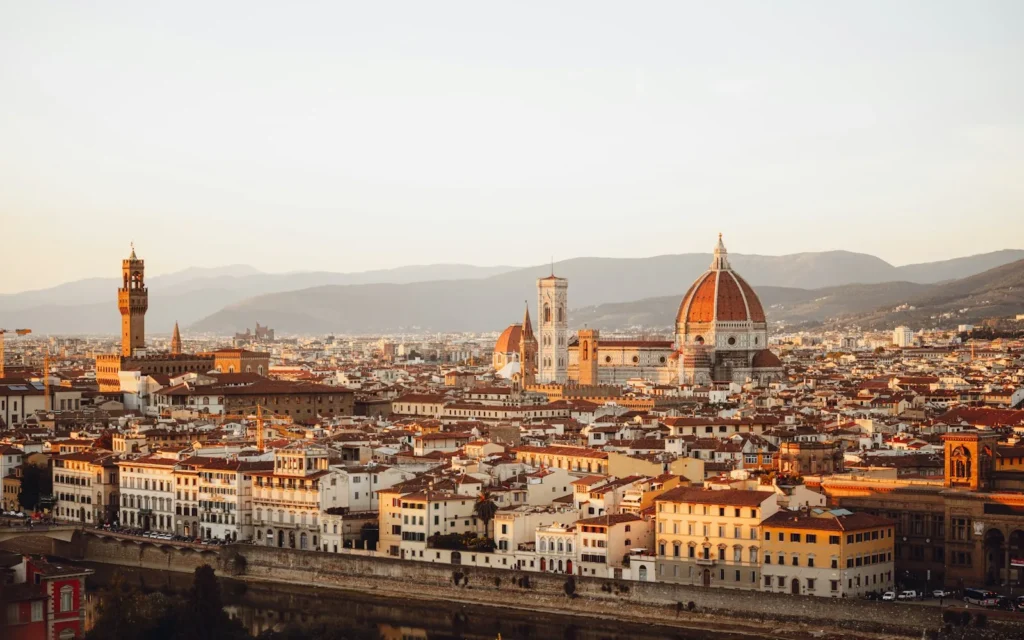
Italy’s counterargument is that the streets themselves are the museum. Rome is layered three thousand years deep in every direction, Florence packed the Renaissance into a city you can walk across in half an hour, and Venice should not exist yet somehow does. The catch is that Italy’s headline sights are ticketed, timed and crowded: the Colosseum, the Uffizi and the Vatican Museums all need advance booking in summer, and the queues without one are brutal. England for museum depth and zero admission fees; Italy for the feeling of walking through history on the way to dinner.
Weather & when to go
Italy is the easy winner here, with one big caveat. From May through September you can more or less bank on sunshine, and the south stays warm well into October. The caveat is July and August, when Rome and the south regularly push past 95°F, the cities empty of locals and fill with tour groups, and the coast hits peak pricing. May, June, September and early October are the sweet spot: warm sea, softer light, saner crowds.
England runs on weather roulette. Summer highs sit around 65–75°F, which is genuinely pleasant, and a sunny June day in the Cotswolds or along the Thames is as good as Europe gets. But rain is possible on any day of any month, and you have to pack and plan around that. The upside is that England never really cooks, so it is a smart choice for July and August if you hate heat, and December London, all lights and pub fires, is quietly magical.
Getting around & safety: the practical stuff
England is the easiest country in Europe for American travelers, full stop. Everyone speaks your language, contactless cards work on everything including the Tube, and the train network reaches nearly everywhere. The one warning: book long-distance train tickets weeks ahead, because walk-up fares are punishing. Driving is on the left, which sounds scarier than it is, but you will not need a car unless you are doing Cornwall or the Lakes.

Italy’s high-speed trains are one of Europe’s pleasant surprises: Rome to Florence in about ninety minutes, Florence to Venice in about two hours, often for less than an English intercity fare. Regional trains are slow but very cheap. The friction lives everywhere else. English is patchy outside tourist zones, ticket-validation rules trip up visitors, and driving into historic centers is a mistake, since ZTL restricted-traffic zones generate fines that arrive by mail months later. The honest safety note is petty theft: pickpockets work the crowds in Rome, Naples and on Milan transit, so keep your phone out of your back pocket. Violent crime against tourists is rare in both countries.
Entry paperwork for US passport holders is light for both, with two things to know in 2026. The UK now requires an ETA (Electronic Travel Authorisation), a quick online application with a small fee that you sort out before flying. For Italy, the EU’s long-delayed ETIAS travel authorization is not in operation yet and is now expected in 2027 at the earliest, so check the official EU site before your trip. Neither is a visa and both are formalities: US visitors get up to six months visa-free in the UK and 90 days in the Schengen area.
Nightlife & vibe: pints vs aperitivo
These countries go out in completely different ways. England means pubs, the best drinking culture in the world in my opinion, plus a serious live-music circuit in London, Manchester and Liverpool and proper club scenes for those who want them. The night starts early, since after-work pints at five are a national institution, and it can end whenever you want it to.
Italy means the evening more than the night. Aperitivo, a spritz with free snacks from roughly six to eight, flows into a nine o’clock dinner that lasts two hours, then a stroll and maybe a grappa. Clubs exist, mostly in Milan and along the summer coast, but they are not really the point. If your ideal night is a crawl of atmospheric pubs ending at a gig, England wins clearly, a big-city energy question much like the Berlin-versus-Paris debate in our France vs Germany comparison. If it is a golden-hour spritz in a piazza with no plans at all, Italy was never losing.
England or Italy: the honest verdict
No fence-sitting. Here is who should book what.
Budget travelers: Italy. Your dollars go roughly a quarter further, the cheap food is actually good, and regional trains cost pocket change. England on a tight budget means constant compromise, especially in London.
Foodies: Italy, unless your dream trip is eating across London’s global restaurant scene, which is a legitimate choice that simply costs more. For classic eat-your-way-through-a-country travel, Italy is the strongest destination in Europe.
Beach lovers: Italy, and it is not close. Warm sea, months of reliable sun, and coastline for every taste from glamorous to wild. England’s coast is for walking, not swimming.
First-time Europe travelers: England. This is my one contrarian pick. No language barrier, effortless transit, familiar norms and free world-class museums remove every source of first-trip anxiety, and London alone justifies the flight. Save Italy for trip two, when you will appreciate it even more.
Forced to pick just one for a classic summer vacation? Italy, because it delivers more of what most people actually want from a European holiday. But the margin is smaller than the stereotypes suggest, and nobody has ever regretted England in June.
FAQ
Which is cheaper to visit, England or Italy?
Which is better for a football-fan trip?
How many days do you need for each country?
Can I combine England and Italy in one trip?
Planning the trip? Go deeper with best time to visit England and our Italy Travel guide.
You Might Also Love
More side-by-side comparisons




Written by
John Morrison is the founder and lead travel writer at Packzup. Over the past decade he has explored destinations across Africa, the Americas, Asia, Europe, the Middle East, and Oceania — always self-funded, never on a press trip.
