
May is the best-value month in Iceland and the one most people skip. You get seventeen to twenty hours of daylight, the Ring Road fully open, puffins back on the cliffs, whale watching at its improving best and roughly half the visitors of July – at prices well below the summer. What you do not get is the highlands, which stay shut until mid-June, or the aurora, which needs a dark sky May does not have.
The daylight is already extraordinary
- 1 May 2027 – sunrise 05:03, sunset 21:50. 16 hours 47 minutes.
- 15 May – sunrise 04:16, sunset 22:35. 18 hours 20 minutes.
- 31 May – around twenty hours, and it never gets properly dark.
By the end of May Iceland is in effective midnight sun: the sun sets, but only into a long twilight that never becomes night. That is the practical gift of a May trip – you can drive at 22:00 in good light, photograph at midnight, and fit two days of sightseeing into one. It also means blackout curtains or an eye mask are not optional, and many Icelandic hotels do not have the former.
What is open and what is not
- The Ring Road is fully open and, weather permitting, straightforward. May is the first month a full circuit is comfortable rather than an undertaking.
- Puffins are back. The colonies – Latrabjarg in the Westfjords, Dyrholaey on the south coast, the Westman Islands, Borgarfjordur Eystri – are active from May to early August. May and June are the best months to see them.
- Whale watching from Husavik, Akureyri and Reykjavik is well into its season, with humpbacks and minke reliably around.
- Highland F-roads are still closed. They open between mid-June and early July depending on the road and the snow. Landmannalaugar, Askja and the interior are not May destinations.
- The Westfjords are partly seasonal: many roads, guesthouses and services open properly in June. Check before committing.
- Natural ice caves are closed until November. Katla and the manmade ice tunnels run year-round.
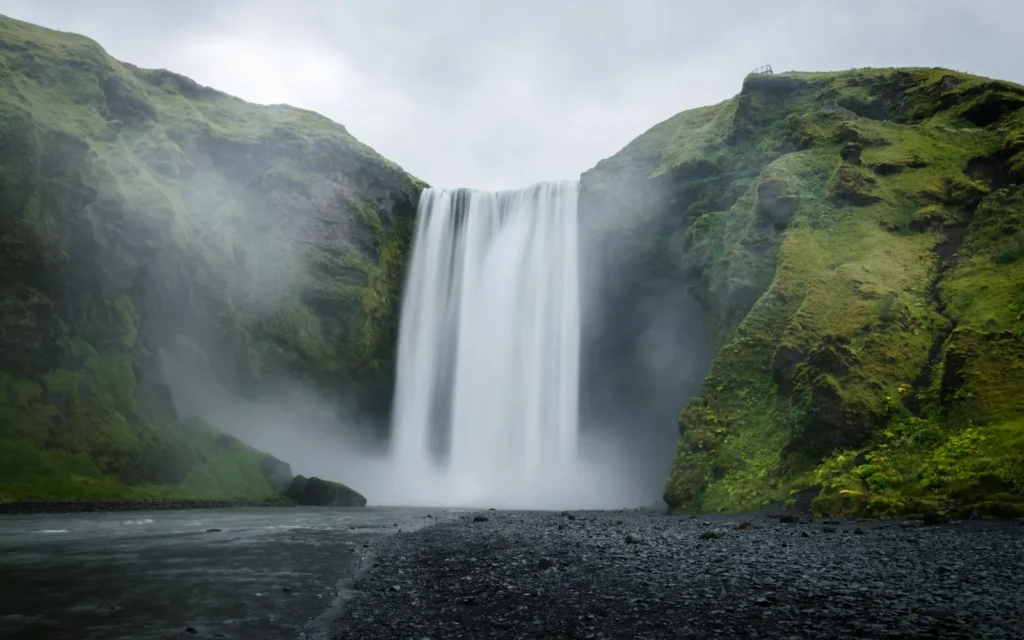
Waterfalls at their strongest
One underrated May advantage: snowmelt. The big waterfalls – Gullfoss, Skogafoss, Seljalandsfoss, Dettifoss – carry their heaviest flow of the year in late spring, and the landscape is green rather than the bleached tones of late summer. If waterfalls are what you came for, May and early June are the peak.
Weather
Reykjavik averages a high near 9°C and a low near 4°C, with precipitation on about 11 days – among the driest months of the year. It is still not warm, and the wind is still the main event, but May is genuinely more settled than anything before it.
Keep checking road.is, safetravel.is and vedur.is, particularly for the north and the mountain passes, which can still see snow into May. Studded tyres are no longer legal after 15 April, so your hire car will be on normal tyres.
Three public holidays
- Saturday 1 May – Labour Day, with marches in Reykjavik. On a Saturday in 2027, so no weekday lost.
- Thursday 6 May – Ascension Day, a public holiday.
- Monday 17 May – Whit Monday, following Whit Sunday on the 16th.
Each brings reduced hours and some domestic travel, but none of them produces the crush that Easter does. Book normally and check opening times for the specific days.
Prices and crowds
This is the argument for May. Iceland’s peak runs June to August and the difference is substantial: May accommodation and car hire sit well below July, tours have availability, and the headline sites – Gullfoss, Geysir, Seljalandsfoss, Jokulsarlon – are busy rather than overrun.
Iceland is expensive in absolute terms in every month. See how much a trip to Iceland costs and is Iceland expensive.
Volcanic activity
Reykjanes has erupted repeatedly in recent years, at times affecting Grindavik and the Blue Lagoon. The position changes constantly; check safetravel.is and the Icelandic Met Office before and during your trip rather than relying on any article.
What to wear
Layers, a waterproof and windproof shell, and boots you can walk wet ground in – May is melt season and the trails are soft. Sunglasses, because twenty hours of low sun is tiring. An eye mask for sleeping. And a swimsuit: the pools and lagoons are better in May than in the dark. See what to pack for Iceland.
The May 2027 calendar
- Saturday 1 May – Labour Day.
- Through May – puffins on the cliffs; whale-watching season building; waterfalls at peak flow.
- Thursday 6 May – Ascension Day, a public holiday.
- Sunday 16 and Monday 17 May – Whit Sunday and Whit Monday.
- Late May – effective midnight sun; the sky no longer goes properly dark.
- All month – highland F-roads closed; no aurora; no natural ice caves.
Read alongside
- Iceland in April – cheaper still, with the last aurora nights.
- Iceland in June – midnight sun and the highlands opening.
- Best time to visit Iceland – all twelve months compared.
- Iceland Ring Road itinerary – May is an excellent month for it.
- How much a trip to Iceland costs – shoulder-season numbers.
- What to pack for Iceland – the spring list.
- Things to know before visiting Iceland – driving and weather rules.
Frequently asked
Is May a good time to visit Iceland?
It is arguably the best value of the year: seventeen to twenty hours of daylight, the Ring Road open, puffins back, waterfalls at peak flow, and prices and crowds well below June to August. You give up the highlands, the aurora and the ice caves.
How much daylight does Iceland get in May?
16 hours 47 minutes on 1 May 2027 – sunrise 05:03, sunset 21:50 – rising to around twenty hours by the 31st, after which it never really gets dark. Bring an eye mask.
Can you see the northern lights in May?
No. The sky does not get dark enough. The aurora season runs roughly September to April.
Are the highland F-roads open in May?
No. They open between mid-June and early July depending on the road and the snow, so Landmannalaugar and the interior are out of reach in May.
Are there puffins in Iceland in May?
Yes. The colonies are active from May to early August, and May and June are the best months. Latrabjarg, Dyrholaey, the Westman Islands and Borgarfjordur Eystri are the main sites.
How warm is Iceland in May?
Reykjavik averages about 9°C by day and 4°C at night, with precipitation on roughly eleven days – one of the driest months. It is not warm, but it is settled by Icelandic standards.
Can you drive the Ring Road in May?
Yes, comfortably. May is the first month a full circuit is straightforward rather than a winter undertaking, though mountain passes in the north can still see snow, so keep checking road.is and vedur.is.
Is May cheaper than June in Iceland?
Yes, noticeably. Peak season runs June to August; May sits below it on accommodation, car hire and tours while giving you almost the same daylight.
You Might Also Love

Written by
John Morrison is the founder and lead travel writer at Packzup. Over the past decade he has explored destinations across Africa, the Americas, Asia, Europe, the Middle East, and Oceania — always self-funded, never on a press trip.
