
August is the wettest month of the year in Hanoi – around 420 mm across twenty-five days, which is nearly double July – and it is the last month of the domestic summer. The central coast is still dry and hot, the south is in steady rainy season, and the northern mountains are as green as they ever get. It is a month that rewards flexibility and punishes tight itineraries.
The rain in the north is real
Most Vietnamese wet-season rain is a heavy hour in the afternoon. In Hanoi in August it is more than that: rain falls on roughly twenty-five days of the month, and prolonged spells – a day and a half of steady rain – are normal rather than exceptional. Street flooding in the Old Quarter after a long downpour is routine and clears within hours.
Temperatures ease slightly from June and July: about 32°C by day and 26°C at night. It is marginally less oppressive than June, and considerably wetter.
Weather by region
- Hanoi and the north – the wettest month: about 420 mm over twenty-five days, 32°C by day and 26°C at night.
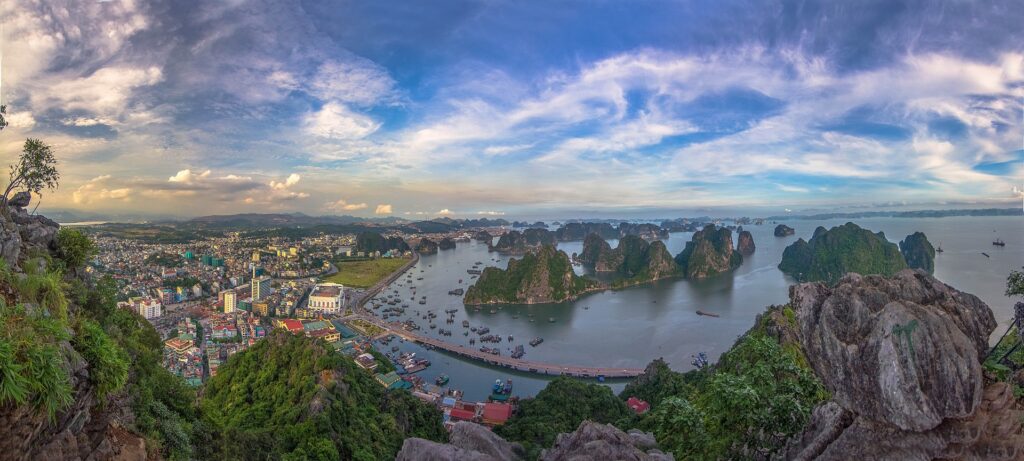
- Halong and the north-east coast – warm and swimmable, but weather cancellations are at their most likely of the summer.
- Sapa, Mu Cang Chai and Ha Giang – the wettest stretch of their year, with mountain roads occasionally blocked by landslides – and also the greenest, with the terraces just before harvest.
- Hue, Da Nang and Hoi An – still in the dry season: hot, sunny, calm sea. The central coast holds until about the end of the month.
- Ho Chi Minh City and the Mekong – rainy season, with a heavy hour most afternoons; the delta is at high water and at its most photogenic.
- Phu Quoc – wet and cheap; usable, not reliable.
The climate numbers on this page are Hanoi’s. Because Vietnam’s three climate zones are rarely in step, plan from the regional list rather than any single figure.
How to plan around it
August is the month to build slack into a Vietnamese itinerary:
- Do not put Halong on your last night before an international flight. If the cruise cancels, you want a spare day, not a crisis.
- Weight the trip towards the centre and the south. The central coast is the most reliable weather in the country in August.
- Take the train or fly rather than driving the far north in heavy rain. Landslides close mountain roads at short notice.
- Book refundable where you can. The flexibility is worth more than the discount in this month.
The end of the domestic summer
Vietnamese schools return towards the end of August, so the beach crowds thin in the last week and coastal rates come off their July peak. Combined with low foreign-visitor numbers, the final ten days of August are often the best-value window on the central coast all summer.
National Day, 2 September – and why it matters in August
Vietnam’s National Day falls on Thursday 2 September 2027, and the holiday period around it is a major domestic travel weekend. If your trip runs into the first days of September, book transport and coastal accommodation before the end of August – the same sell-out pattern as Tet and 30 April applies, on a smaller scale.
Prices and crowds
Cheap almost everywhere. Foreign arrivals are at their annual low, city hotels discount heavily, and coastal rates fall through the second half of the month. The cost of that is the weather risk, which is the highest of the year so far.
See how much a trip to Vietnam costs.
What to pack
A genuine rain layer rather than a token one, quick-drying clothing, sandals you do not mind soaking, a dry bag for electronics, and insect repellent – mosquito numbers peak in the wet season and dengue is present in Vietnam. See the Vietnam packing list.
The August 2027 calendar
- All month – the wettest month of the year in Hanoi and the northern plains.
- Through August – the central coast stays dry; the best weather in the country.
- Mid August – Vu Lan, the Wandering Souls festival, is observed at pagodas; the date moves with the lunar calendar.
- Wednesday 19 August – the anniversary of the August Revolution; commemorative rather than a day off.
- Last week of August – Vietnamese schools return; beach crowds thin and rates fall.
- Thursday 2 September – National Day; book transport before the end of August if your trip overlaps.
Read alongside
- Vietnam in July – drier in the north, busier on the coast.
- Vietnam in September – the rice harvest, and the start of the central storm season.
- Best time to visit Vietnam – all twelve months compared.
- Vietnam itinerary – and how to build slack into a wet-season trip.
- Getting around Vietnam – trains, flights and mountain roads in the rain.
- Is Vietnam safe for travel – weather, health and the practical risks.
- Vietnam packing list – the wet-season version.
Frequently asked
Is August a good time to visit Vietnam?
It is the cheapest and quietest month for foreign visitors, and the central coast around Da Nang and Hoi An has excellent weather. The north is the wettest it gets all year, so it suits a flexible itinerary rather than a fixed one.
How much does it rain in Hanoi in August?
Around 420 mm across roughly twenty-five days – the wettest month of the Hanoi year and nearly double July. Prolonged spells of rain are normal, not just short afternoon storms.
Is the central coast dry in August?
Yes. Hue, Da Nang and Hoi An are still in their dry season through August, with hot sunny days and a calm sea. Their wet season starts in September.
Will my Halong Bay cruise be cancelled?
It can be. August has the highest weather-cancellation rate of the summer, so do not schedule Halong for the night before an international flight, and keep a spare day in the plan.
Are the rice terraces green in August?
At their greenest. Sapa, Mu Cang Chai and Ha Giang are full and lush just before the harvest, which begins in September. The trade-off is that it is also their wettest month, with occasional landslides on mountain roads.
Is Vietnam cheap in August?
Yes, more or less everywhere. Foreign arrivals are at their annual low, city hotels discount, and coastal rates fall once Vietnamese schools return in the last week.
When is Vietnam’s National Day?
2 September – a Thursday in 2027. The days around it are a busy domestic travel period, so book transport and coastal rooms before the end of August if your trip overlaps.
Do I need mosquito protection in August?
Yes. Mosquito numbers peak in the wet season and dengue is present in Vietnam, so use repellent and cover up in the evenings, particularly in the Mekong Delta and the cities.
You Might Also Love



Written by
John Morrison is the founder and lead travel writer at Packzup. Over the past decade he has explored destinations across Africa, the Americas, Asia, Europe, the Middle East, and Oceania — always self-funded, never on a press trip.
