
Last updated September 4, 2026 · Editorial policy
- Where to stay in Rio de Janeiro: best areas
- Ipanema & Leblon: the premium beachfront
- Copacabana: the famous crescent
- Santa Teresa: bohemian hillside
- Botafogo & Flamengo: local-cool value
- Quick picks by traveler type
- The actual safety-to-price ladder, ranked
- FAQ
- Which metro station serves which beach, and where the line stops
- How Carnival and New Year change the arithmetic
- Safety by street and by hour, not by neighbourhood
- What a sea view actually costs you
Quick answer: Ipanema is the answer for most: beach-beautiful, safer-feeling, walkable to Leblon’s restaurants: Copacabana costs less for the same sand with more bustle. Santa Teresa trades beach for bohemian hillside charm: Botafogo is the local-cool budget play.
Where to stay in Rio de Janeiro: best areas
| Area | Best for | The vibe |
|---|---|---|
| Copacabana | First-timers, beach | Iconic, lively |
| Ipanema / Leblon | Upscale beach | Chic, trendy |
| Santa Teresa | Bohemian & views | Arty, hilltop |
| Botafogo / Flamengo | Local & value | Residential |
Ipanema & Leblon: the premium beachfront
Sunset at Arpoador, Sunday beach culture, leafy blocks of cafes: Rio at its most relaxed-glamorous. Leblon refines it further. Beach-block hotels run US$120–300: a street or two back saves real money.
Copacabana: the famous crescent
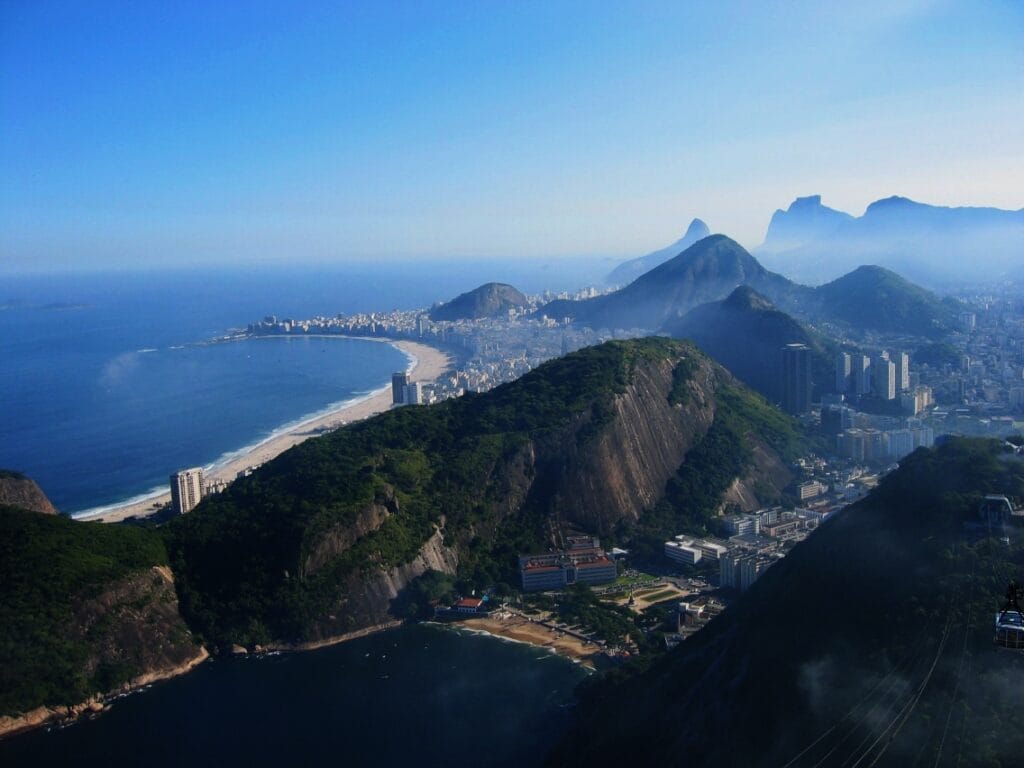
The world’s most famous beach is busier, cheaper and more mixed block-by-block: choose the Leme end or Ipanema-adjacent Posto 6 for calmer footing. Great metro links for Centro and Maracanã days.
Santa Teresa: bohemian hillside
Tram tracks, ateliers, mansion-guesthouses and viewpoints over the bay: romantic and artistic, with taxis bridging the hill at night. No beach: all character.

Botafogo & Flamengo: local-cool value
Craft bars, serious restaurants and Sugarloaf views at 60–70% of Zona Sul beach prices: metro-connected, young, real. Flamengo adds park-front runs.
Quick picks by traveler type
First visit: Ipanema. Budget: Botafogo or back-block Copacabana. Couples: Santa Teresa guesthouse + Ipanema finale. Carnival: anywhere on the metro: book half a year out.

The actual safety-to-price ladder, ranked
Rio’s neighborhoods sort into a fairly honest pecking order on safety, and it tracks price almost exactly. Roughly, calmest to edgiest: Leblon, Ipanema, Botafogo, Copacabana, then Santa Teresa. Leblon and Ipanema are where a first-time or solo traveler should default — quieter streets at night, and you can walk to Arpoador without crossing anything hairy. Expect $200–350 a night for a standard room at the nicer Ipanema and Leblon hotels, with suites pushing $400–600.
Drop to Botafogo and the math changes fast. Mid-range rooms run roughly $70–120, you get Sugarloaf views from the bay side, and the metro puts Ipanema 10 minutes away. It’s the value-with-safety sweet spot most guides undersell. Ipanema mid-range sits closer to $100–180.
Santa Teresa is the trade-off everyone romanticizes and few think through. The cobbled hilltop is genuinely charming, but it’s a hill — those winding lanes are isolated and poorly lit, so you’ll be calling taxis after dark every single night rather than strolling home. Budget for that, or you’ll resent it.
- Cheapest beds (hostels, basic guesthouses): roughly $30–60 across Copacabana, Botafogo and Santa Teresa.
- One block back from the sand in Ipanema typically shaves a real chunk off the beachfront rate.
FAQ
Is Copacabana safe?
Beach hotel or save money inland?
Where for nightlife?
How many nights?
Which metro station serves which beach, and where the line stops
Two lines serve the beach neighbourhoods, not one, and the difference decides how far you walk with luggage. Line 1 ends at General Osório in Ipanema, after Cardeal Arcoverde, Siqueira Campos and Cantagalo, which between them cover the length of Copacabana. Leblon is not on Line 1 at all. It sits on Line 4, which runs from General Osório through Nossa Senhora da Paz in Ipanema, then Jardim de Alah and Antero de Quental in Leblon, then São Conrado, and finally Jardim Oceânico in Barra da Tijuca. A Gávea station was planned for Line 4 and has never opened. Work on it restarted in 2025 and it is still unfinished, so there is no rail stop between Leblon and São Conrado.
Santa Teresa has no metro station. The connection is the tram from Estação Carioca in Centro, which costs R$20 for a return trip that lets you get off and reboard the same day. The Dois Irmãos line runs Monday to Friday from 08:00 to 18:30, and services drop to 09:00 to 17:00 on Saturdays, Sundays and public holidays. The shorter Paula Mattos line runs daily from 08:00 to 18:00. That is a daytime service, so an evening in Santa Teresa means a taxi app in both directions.
Opening hours cap the whole plan. MetrôRio runs Monday to Saturday 05:00 to midnight, and Sundays and public holidays 07:00 to 23:00, on Lines 1, 2 and 4 alike. Live music in Lapa is only warming up at that point, so budget for a ride home whichever neighbourhood you pick.
How Carnival and New Year change the arithmetic
Carnival 2027 runs from Friday 5 February to Ash Wednesday 10 February, with Carnival Tuesday on 9 February. Ash Wednesday is a public holiday across Brazil, so the working week restarts on Thursday 11 February. The Parade of Champions follows on Saturday 13 February, which is a second demand peak rather than an afterthought.
Choosing a quieter district does not get you out of Carnival pricing. The forecast HotéisRIO and ABIH-RJ published days before Carnival 2026 put occupancy at 96.91% from Glória to Botafogo, 96.19% in Ipanema and Leblon, 95.42% in Centro, 94.63% in Leme and Copacabana, and 86.97% across Barra, Recreio and São Conrado. Every district surveyed sat inside a ten point band. Those were projections, and the outcome beat all of them: HotéisRIO put final average occupancy in the city at 99.02%. On rates, hotel industry figures for the 2026 peak on Sunday 15 February show an average daily rate of R$2,657.38, and an average above R$1,000 on every day of the 13 to 21 February period.
What proximity buys you at Carnival is transport rather than a discount. In 2026 the metro ran around the clock for 139 consecutive hours, from 05:00 on the Friday to midnight on Ash Wednesday, plus a further 42 hours across the Parade of Champions weekend, and a similar scheme is announced each year. For the Sambadrome, even numbered sectors use Praça Onze and its Marquês de Sapucaí access, and odd numbered sectors use Central followed by a walk of about 700 metres.
New Year is a different problem. The city counted 2.6 million people on Copacabana at the 2026 turn. For that night MetrôRio ran a controlled operation from 19:00 on 31 December to 05:00 on 1 January in which boarding needed a paid Réveillon passport, sold in advance through the operator’s app and website and carrying a QR code and a return wristband. Cardeal Arcoverde took arrivals only, between 19:00 and midnight. Read that as a walking night: if you want Copacabana on 31 December, you need a bed you can reach on foot.
Safety by street and by hour, not by neighbourhood
The UK Foreign, Commonwealth and Development Office advice for Brazil is specific enough to act on. It says “Do not go on to city beaches after dark”, warns that “Thieves target mobile phones, particularly between 4pm and 9pm”, tells you not to hail taxis on the street, and says to avoid all favelas, including favela tours marketed to tourists and any accommodation, restaurants or bars advertised as being within a favela. That last clause is a booking filter, not just a walking rule.
Apply them to the walk rather than to the postcode. The beachfront avenues stay busy and lit late: Avenida Atlântica through Leme and Copacabana, and Avenida Vieira Souto in Ipanema, which continues without a break as Avenida Delfim Moreira in Leblon. The cross streets linking those avenues to the metro empty out much earlier, and it is that two block stretch between a station exit and a front door that decides how an 11pm return feels. When two rooms are priced the same, compare the route from the station, not the neighbourhood label.
Botafogo and Flamengo face Guanabara Bay, not the open Atlantic. INEA samples bathing water weekly and publishes a bulletin classifying each point as suitable or unsuitable, and advises avoiding sea bathing for 24 hours after rain and near storm drain outfalls. Treat a bay side base as a transport and eating decision, and check the bulletin before swimming.
What a sea view actually costs you
Copacabana’s entire seafront is a single road, Avenida Atlântica, running about 4 km. Front facing rooms are therefore a small fixed stock on one line of buildings, which is why they are sold as a separate product rather than as an upgrade. Listings normally distinguish a full frontal view from a lateral or partial one, and the lateral rooms can carry a very different rate for the same lift and the same breakfast.
The frontage has costs attached: traffic, event noise and the fireworks crowd. On Sundays and public holidays the city gives over a traffic lane on Avenida Atlântica, Vieira Souto and Delfim Moreira to a leisure area, and a 7.2 km leisure cycle lane runs along the South Zone seafront, so seafront traffic and kerbside drop offs are restricted for much of the day. If you are out from breakfast until dark, you are paying a premium for a window you will barely use.
You Might Also Love




Written by
John Morrison is the founder and lead travel writer at Packzup. Over the past decade he has explored destinations across Africa, the Americas, Asia, Europe, the Middle East, and Oceania — always self-funded, never on a press trip.
