
Last updated September 1, 2026 · Editorial policy
Quick answer: A well-paced 8-day Greece route pairing ancient Athens and clifftop Cape Sounion with two Cyclades gems — dramatic Santorini and greener, gentler Naxos — all linked by real high-speed ferries before you fly home from Naxos. Best months: May-June and September-October. July-August is brutally hot AND overcrowded. Best swimming late May-mid October. Total cost: US$1500-2400 per person mid-range / US$5000+ luxury. Excludes international flights.
Ten days lets you split Greece properly — 2 nights Athens, 3 nights Santorini, 3 nights Naxos or Milos, 1 buffer. This itinerary uses ferries (the right way to experience Greek islands) and skips Mykonos for a more authentic Cycladic experience. Built across 3 personal Greek island trips.
Still deciding? Compare: Greece vs Portugal · Greece vs Italy
Day-by-day breakdown
Day 1 — Arrival & the Acropolis
Land at Athens International Airport and ride Metro Line 3 straight into the centre — a single airport ticket runs about €9 (roughly $10), a fraction of a taxi fare. Base yourself in Plaka or Monastiraki, the walkable old quarters spread below the sacred rock. Book your Acropolis entry online in advance for a fixed time slot; in peak summer the 20,000 daily tickets sell out days ahead, so reserve before you fly. A standard adult ticket is about €30 (roughly $33). Aim for the late-afternoon slot when the marble glows amber and the crowds finally thin. Climb past the Theatre of Dionysus to the Parthenon, then wander down into Anafiotika, the tiny Cycladic-white hamlet built by island stonemasons on the north slope. Order grilled octopus and a carafe of house white; jet lag melts fastest with a sunset view over the sprawling city below.
Day 2 — Ancient Athens on Foot
Give the morning to the sprawling Ancient Agora, where Socrates once argued philosophy beneath the astonishingly intact Temple of Hephaestus. The multi-site combined ticket, about €30 (roughly $33) in summer, covers seven monuments over several days and quickly pays for itself. Explore the reconstructed Stoa of Attalos museum, then cross to Hadrian’s Library and the Roman Agora with its octagonal Tower of the Winds. For lunch, dive into the Varvakios Central Market on Athinas Street, where surrounding tavernas ladle out hearty bowls of chickpea revithada. Afterward browse the flea-market stalls fanning out from Monastiraki Square. Planning note: skip the tourist-strip cafes and climb Lycabettus Hill at dusk (a funicular runs to the summit for about €10, roughly $11) for a 360-degree panorama with the Acropolis floodlit below. End the evening over mezze in bohemian Psyrri.
Day 3 — Museum & Cape Sounion
Start early at the National Archaeological Museum, home to the gold Mask of Agamemnon and the extraordinary bronze Antikythera Mechanism — the world’s finest hoard of Greek antiquities. Take the metro toward Victoria station; entry is about €12 (roughly $13) in summer, and two to three unhurried hours is ideal. In the afternoon escape the city on a coastal drive down the Athens Riviera to Cape Sounion, about 70 km (43 miles) south. The gleaming marble Temple of Poseidon perches on a cliff above the Aegean, and its sunset is arguably the finest on the mainland. KTEL buses leave central Athens for roughly €7 (about $8) each way, or split a taxi. Look for Lord Byron’s name carved into a column — the poet scratched it here in 1810. Return to Athens for a farewell dinner before tomorrow’s island crossing.
Day 4 — Ferry to Santorini
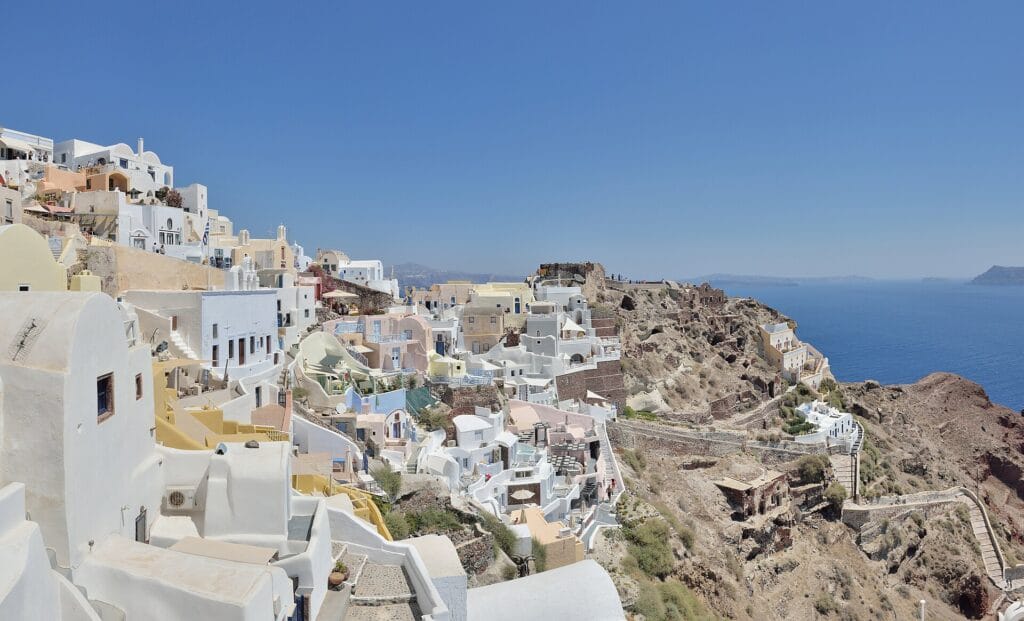
Transfer to Piraeus, Athens’s vast main port, for the crossing to Santorini. High-speed catamarans and larger Blue Star ferries make the run in roughly five to eight hours depending on stops, so leave on an early sailing; fares vary widely by season and vessel, but budget about €60–90 (roughly $65–100) and book well ahead for July and August. The ferry docks at Athinios port beneath the towering caldera cliffs, where a pre-arranged transfer or the local bus (about €3, roughly $3.50) hauls you up the switchbacks to the rim. Settle into Fira, Firostefani or Imerovigli and spend what’s left of the day simply absorbing the view over the flooded volcanic crater. Stroll the cliff path toward Skaros Rock for a quieter vantage. Planning note: try fava, Santorini’s velvety yellow split-pea puree, and the island’s intensely sweet cherry tomatoes.
Day 5 — Caldera Rim to Oia
Set out early to walk the celebrated caldera-rim hike from Fira to Oia, about 10.5 km (6.5 miles) of clifftop path threading through Firostefani and Imerovigli before descending toward Oia. Allow three to five hours with photo stops, wear proper shoes for the loose volcanic gravel, and start before the heat builds — there is almost no shade. If the full route feels ambitious, hop the local bus (roughly €3, about $3.50) between towns and walk only the prettiest stretches. Reward yourself with lunch among the blue-domed churches of Oia, then descend the 300-odd steps to Ammoudi Bay for grilled fish at the water’s edge. Oia’s sunset is world-famous, so claim a spot near the Byzantine Castle ruins at least an hour early. Planning note: for an equally spectacular but far less crowded sunset, watch from Imerovigli instead.
Day 6 — Akrotiri & the Volcano
Delve into Santorini’s deeper history at Akrotiri, sometimes called the Aegean’s Pompeii — a Bronze Age town buried under volcanic ash some 3,600 years ago, sheltered today beneath a modern roof so you can walk among multi-storey houses in any weather. It is generally open daily except Tuesday; budget about €12 (roughly $13). Pair it with the Museum of Prehistoric Thira in Fira, which displays the site’s exquisite frescoes. In the afternoon, join a caldera boat trip out to the still-steaming Nea Kameni volcanic islet, where a short hike reaches the crater rim, followed by a swim in the warm sulphur springs off Palea Kameni; half-day tours run about €30–45 (roughly $33–50). Planning note: cool off afterward at the dramatic red cliffs of Red Beach, and reserve any caldera-view dinner a day ahead in summer.
Days 7-8
Island time: Naxos = town walk + Portara sunset + Plaka Beach + Tragea villages. Or Milos = Sarakiniko + Kleftiko (boat tour required) + Apollonia ferry stop.
Day 9
Optional day trip from main island to nearby (Antiparos from Paros, Folegandros from Milos, Iraklia from Naxos).
Day 10
Ferry back to Athens (Piraeus). Last shopping in Plaka. Departure from Athens airport.
What to book ahead
- Acropolis tickets: Skip-the-line online 1+ months ahead for peak season. Combined ticket includes Roman Agora + Ancient Agora + others.
- Greek island ferries: Book online 1-2 months ahead for July-September peak. Use Ferryscanner or DirectFerries. Sea Jets and Blue Star are reliable.
- Santorini sunset dinner: Book 4-8 weeks ahead in season. Lauda, La Maison, or Pelekanos all have premium sunset views.
- Milos Kleftiko boat tour: Book 1-2 weeks ahead — boats limited and Kleftiko is the must-see. Various operators from Adamantas.
A local planning note
Skip Mykonos. Greek island newcomers think Mykonos is essential — it’s not. Mykonos is the loudest, most expensive, and least authentic of the Cyclades. Visit Sifnos for the food, Naxos for variety, Milos for landscapes, Folegandros for solitude. All deliver 10x the Cyclades experience at 1/3 the cost.
Best time for this trip
May-June and September-October. July-August is brutally hot AND overcrowded. Best swimming late May-mid October.
The Backtracking Mistake and the Buffer Day You Need
The routing error that costs Greece travelers a full day is treating Athens as a hub you return to between islands. You do not. The Cyclades connect directly to each other in season, so Naxos works as a central pivot with multiple daily ferries onward to Paros, Ios, and Santorini. Plan an open-jaw style loop that ends near your flight home rather than sailing back to Piraeus mid-trip just to catch another boat out.
Speed is not always the smart pick either. From Piraeus, the Seajets high-speed vessels reach Naxos in about 3 hours 20 minutes, while the large Blue Star ferries take 5 to 6 hours but ride far steadier in rough water and cost less. In August the meltemi winds regularly cancel the fast catamarans first, since they are lightest. That is why the most important fix is structural: never schedule an island-to-airport ferry on the same day as your international flight. Build at least one buffer night in Athens at the end, because a wind cancellation with no slack means a missed flight, not just a delay.
Frequently asked questions
Is 10 days enough for Greece?
Yes for Athens + 2 islands. 14 days for Athens + 3-4 islands. 21 days for mainland Greece + multi-island circuit including Crete.
How much does a 10-day Greece trip cost?
Backpacker: US$800-1200. Mid-range: US$1500-2400. Luxury Santorini: US$6000+. Greek islands more expensive than mainland.
Best time to visit Greek islands?
Late May-June and September-October are peak weather without peak crowds. Avoid August (40°C + crowds). Mid-October last good swimming.
Santorini or Naxos?
Santorini for sunset views + the famous photos. Naxos for everything else (food, beaches, villages, value). Both worth visiting.
Is Greece expensive?
Mid-range: US$80-150/day. Santorini significantly more expensive than other islands. Mainland (Athens, Peloponnese) cheaper.
Plan your Greece trip
Best time to visit Greece (real climate data)
Best months: April, May, June, September, October, November.
Greece’s warmest month is July (avg 34°C / 92°F), the coolest is January (low 5°C / 42°F). The wettest is December (110 mm) and the driest is July.
Source: Open-Meteo / WMO climate normals (WMO 1991–2020, or ERA5 2019–2023 where unavailable). See the full month-by-month weather →
You Might Also Love


Written by
John Morrison is the founder and lead travel writer at Packzup. Over the past decade he has explored destinations across Africa, the Americas, Asia, Europe, the Middle East, and Oceania — always self-funded, never on a press trip.
Trip prep: before you travel, plan what to wear, check the tap water, sort your mobile data, and see if it is a cash or card country, and skim local etiquette.
