
Last updated August 22, 2026 · Editorial policy
Costa Rica’s food is humble, fresh, and built around rice, beans, and whatever was harvested or caught that morning. Tico cuisine does not compete for Michelin stars, but it delivers deeply satisfying meals rooted in honest ingredients. Gallo pinto at breakfast, a casado at lunch, and fresh ceviche at the beach — this is the rhythm of eating in Costa Rica. The Pacific and Caribbean coasts cook completely differently, with Caribbean flavours leaning on coconut milk, scotch bonnet peppers, and Afro-Caribbean spice. Tropical fruit is extraordinary here, and the coffee is among the best on earth.
More: When to visit Costa Rica · Costa Rica travel guide
Gallo Pinto
The national breakfast — rice and black beans stir-fried together with Salsa Lizano (a sweet, tangy sauce unique to Costa Rica), served with scrambled eggs, fried plantains, sour cream, and a corn tortilla. Every soda (local restaurant) serves it, and the quality is remarkably consistent. Soda Tapia in San Jose is a beloved classic. About 2,500-4,500 CRC. It sounds simple because it is — and it is perfect every time.
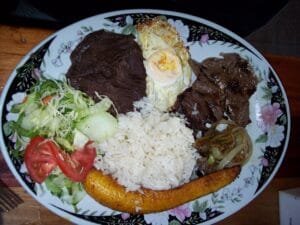
Casado
The set lunch that fuels the country — rice, black beans, salad, fried plantains, and your choice of protein (grilled chicken, fish, pork chop, or beef). The name means ‘married’ because everything is joined on one plate. Every soda in the country serves casados at lunch. About 3,500-6,000 CRC. The fish casado near the coast is always the best choice.
Ceviche
Continue planning your Costa Rica trip
Fresh white fish (usually corvina or sea bass) cured in lime juice with diced onion, cilantro, sweet peppers, and a splash of the beloved Salsa Lizano. Costa Rican ceviche is milder and chunkier than Peruvian versions. Beach towns like Manuel Antonio and Tamarindo serve it fresh from the morning catch. About 3,000-5,500 CRC. Eat it with patacones (fried green plantain discs).
Chifrijo
A bar snack that became a phenomenon — crispy chicharron (fried pork) and red beans over rice, topped with pico de gallo, avocado, and lime. Invented at a bar called Cordero’s in Tibas, San Jose in the 1990s. Now found at every bar and many restaurants. About 3,000-5,000 CRC. Order it with an Imperial beer and you have the perfect Costa Rican evening.
Caribbean Rice and Beans (Rice ‘n’ Beans)
Completely different from gallo pinto — rice and red beans cooked together in coconut milk with thyme, scotch bonnet pepper, and garlic. A staple of the Caribbean coast around Puerto Viejo and Cahuita, showing the Afro-Caribbean influence. Served with jerk chicken or Caribbean-style fish. About 4,000-7,000 CRC at sodas in Puerto Viejo. Soda Lidia and Miss Edith’s are legendary.
Patacones
Thick discs of green plantain, fried twice — once to cook, then smashed flat and fried again until golden and crispy. Served as a side with ceviche, beans, or topped with black bean dip and curtido (pickled cabbage). Found everywhere for about 1,500-3,000 CRC. The crunch and mild sweetness make them addictive.
Olla de Carne
A big, rustic beef soup loaded with corn on the cob, yuca, plantain, chayote squash, potatoes, and carrots simmered for hours. This is Costa Rican home cooking at its most comforting — the kind of pot every grandmother has on the stove on Sundays. Found at traditional sodas. About 3,500-5,500 CRC. A complete meal in a single bowl.
Costa Rican Coffee
Costa Rica grows exceptional arabica coffee in the Central Valley highlands around Tarrazú, Naranjo, and the slopes of Poas and Irazu volcanoes. A cortado or cafe negro at any local cafe is excellent, but visit a coffee farm in the Central Valley for the full experience. Cafe Britt and Doka Estate offer tours. A cup costs about 1,000-2,500 CRC. By law, only arabica beans can be grown here.
Eating Tips for Costa Rica
Sodas are the backbone of Costa Rican eating — small, family-run restaurants serving casados and gallo pinto at incredible prices. Lunch (casado) is the biggest and cheapest meal. Salsa Lizano is the secret weapon — buy a bottle at any supermarket. The Caribbean coast (Puerto Viejo, Cahuita) has completely different food from the Pacific side. Tip 10% at restaurants if service charge is not included. Fresh fruit batidos (smoothies) are available everywhere for about 1,500-2,500 CRC — try cas (sour guava), guanabana, and maracuya.
Frequently Asked Questions
What is the must-try food in Costa Rica?
The absolute must-try is Gallo Pinto. Beyond that, Casado and Ceviche are essential for understanding Costa Rica’s food culture.
Is street food safe in Costa Rica?
Yes, street food in Costa Rica is generally safe. Look for stalls with high turnover (long queues mean fresh food), eat where locals eat, and choose stalls where food is cooked to order. Stay hydrated and ease into spicier dishes gradually.
How much should I budget for food in Costa Rica?
Budget travelers can eat well for $10-20 per day at street stalls and local restaurants. Mid-range budgets of $30-50 allow a mix of street food and sit-down meals. Fine dining starts around $50-100 per person.
You Might Also Love




Written by
John Morrison is the founder and lead travel writer at Packzup. Over the past decade he has explored destinations across Africa, the Americas, Asia, Europe, the Middle East, and Oceania — always self-funded, never on a press trip.
