
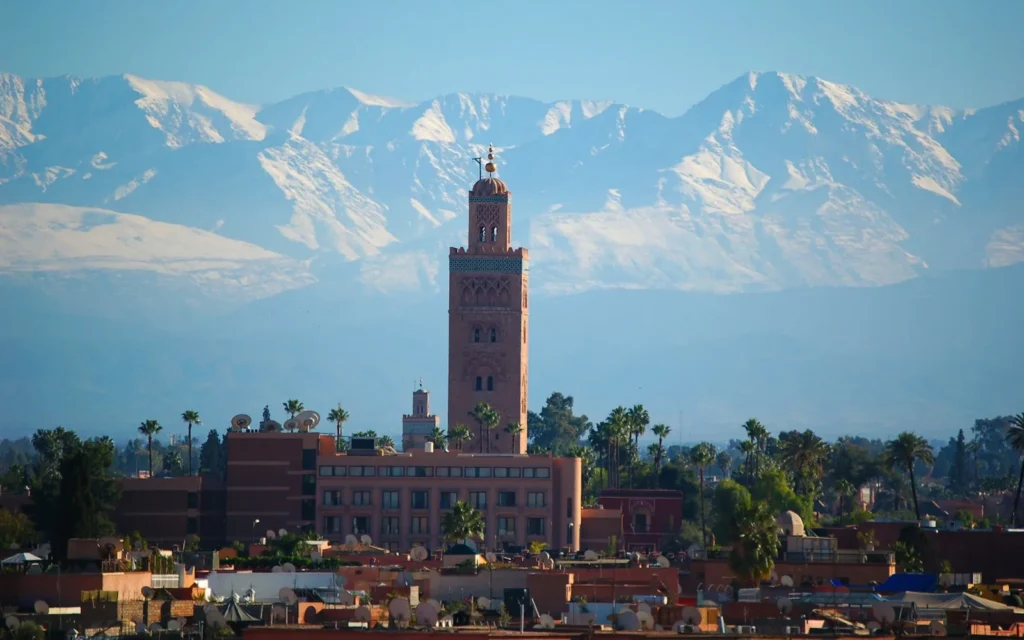
January is the coldest month in Marrakech and the one where the setting makes most sense. The city sits at about 18°C by day and 6°C at night, the High Atlas is snow-capped and visible from the rooftops, the orange trees lining the avenues are in fruit, and the hammams stop being a novelty and start being the obvious thing to do. It is low season, and the nights are colder than almost anyone expects.
The cold nobody packs for
This is the single most useful thing to know about a Moroccan winter. Marrakech is a desert-edge city: the days are pleasant, in the high teens, and the nights drop to around 6°C. Riads are built for summer – thick walls, open courtyards, tiled floors, minimal heating – and an unheated riad room at 6°C is genuinely cold.
Two practical consequences: check that your riad has heating rather than assuming, and pack a warm layer and something for the evenings. Rooftop dinners in January need a coat.
The Atlas in winter
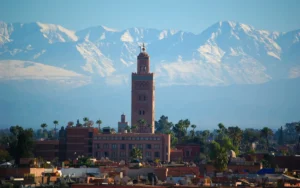
January is when the mountains behind the city are at their most dramatic. The High Atlas is snow-covered and on a clear morning the peaks are visible from any Marrakech rooftop – the classic view is the Koutoubia minaret with white mountains behind it.
- Oukaïmeden, about 75 km from the city, is North Africa’s best-known ski area and operates when snowfall allows. Conditions vary enormously year to year, so treat it as a day trip to check rather than a ski holiday to book.
- The Ourika Valley and Imlil are both easy day trips and spectacular under snow.
- Toubkal, North Africa’s highest peak, is a serious winter mountaineering objective in January – crampons and ice axe, with a qualified guide. It is not the summer trek.
Yennayer, the Amazigh New Year
Thursday 14 January 2027 is Yennayer, the Amazigh (Berber) New Year, which became an official paid public holiday in Morocco from January 2024. Banks, government offices and schools close.
It marks the start of the agricultural calendar and is celebrated with family meals – tagula and couscous with seven vegetables are traditional – and cultural events, particularly in Amazigh regions. In Marrakech it is a quieter, domestic occasion rather than a street festival, but it is a recent and meaningful piece of national recognition.
Weather
January averages about 18°C by day and 6°C at night, with roughly 30 mm of rain – one of the wetter months in a very dry city, which still means only a handful of rainy days. Skies are usually clear and the light is excellent.
What January is for
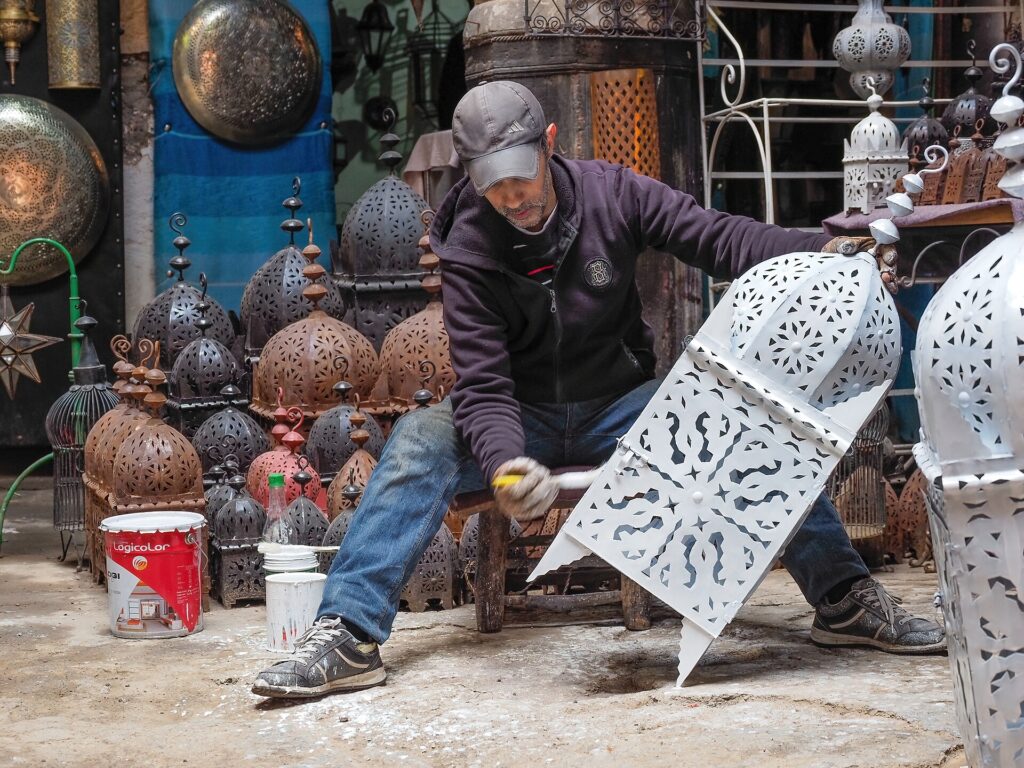
- The souks and the medina, which are covered, sheltered and far more pleasant without summer heat.
- Hammams – the traditional bath is genuinely restorative in cold weather rather than an ordeal.
- The gardens – the Jardin Majorelle, Le Jardin Secret and the Menara are all comfortable to walk in January.
- Orange season. The streets are lined with bitter orange trees in fruit, and the fresh juice stalls at Jemaa el-Fna are at their best.
- Day trips – the Atlas, the Ourika Valley, Essaouira on the coast.
Jemaa el-Fna, and the hassle question
The main square is UNESCO-listed as intangible cultural heritage and it is the centre of the city’s evening life – food stalls, musicians, storytellers. It is also where visitors most often feel pressured.
The practical rules: anything offered to you has a price, including a photograph with a snake or a monkey, a henna design applied to your hand uninvited, or directions from a stranger who then walks you somewhere. Agree a price before anything begins, or decline clearly and keep walking. A firm, polite “la, shukran” and no eye contact is the local answer, and it is not rude.
None of this is dangerous; it is commercial. Knowing it in advance removes most of the friction.
Prices and crowds
Low season after the first week. The New Year period is busy and expensive; from about 8 January, riad rates fall and the medina is noticeably quieter.
See the Marrakech travel budget.
What to pack
Layers, and more warmth than the daytime forecast suggests – a proper jacket for evenings and unheated riads. Modest clothing is appropriate, particularly for women, and comfortable shoes for uneven medina paving. See the Morocco packing list.
The January 2027 calendar
- Friday 1 January – New Year’s Day, a public holiday; the first week is peak.
- Monday 11 January – Independence Manifesto Day, a public holiday.
- Thursday 14 January – Yennayer, the Amazigh New Year, an official public holiday since 2024.
- January – the Marrakech Marathon; the date is announced annually.
- Through January – the Atlas is snow-covered; Oukaïmeden operates when snow allows.
- Through January – orange season; the coldest nights of the year.
- Around 8 February – Ramadan is expected to begin, so January falls entirely outside it.
Read alongside
- Marrakech in February – almond blossom and the start of Ramadan.
- Best time to visit Marrakech – all twelve months compared.
- Marrakech travel guide – the medina, Gueliz and how to use them.
- Day trips from Marrakech – the Atlas, Ourika and Essaouira.
- Marrakech travel budget – low-season numbers.
- Where to stay in Marrakech – and why heating matters in January.
- Morocco packing list – the winter version.
Frequently asked
Is January a good time to visit Marrakech?
Yes, for the medina, the souks, the hammams and the snow-capped Atlas behind the city – all at low-season prices after the first week. The catch is the nights, which drop to around 6°C.
How cold does Marrakech get at night?
Around 6°C in January, which surprises most visitors. Riads are built for summer with thick walls, open courtyards and minimal heating, so check your accommodation actually has heating rather than assuming it does.
Can you see snow from Marrakech?
Yes – the High Atlas is snow-covered in January and visible from almost any rooftop on a clear morning. The classic view is the Koutoubia minaret with white mountains behind.
Can you ski near Marrakech?
At Oukaïmeden, about 75 km away, when snowfall allows. Conditions vary enormously from year to year, so treat it as a day trip to check on arrival rather than a ski holiday to book in advance.
What is Yennayer?
The Amazigh (Berber) New Year on 14 January, marking the start of the agricultural calendar. It became an official paid public holiday in Morocco from January 2024, so banks, offices and schools close.
How do I handle the hassle at Jemaa el-Fna?
Assume anything offered has a price – a photo with a snake or monkey, henna applied uninvited, directions from a stranger who then walks you somewhere. Agree a price first or decline clearly. A polite “la, shukran” without eye contact is the normal local response and is not considered rude.
Is Marrakech cheap in January?
After the first week, yes – it is low season, riad rates fall and the medina is quieter. The New Year period itself is peak.
Does it rain in Marrakech in January?
About 30 mm, which is one of the wetter months in a very dry city – in practice that means a handful of rainy days and otherwise clear skies.
You Might Also Love

Written by
John Morrison is the founder and lead travel writer at Packzup. Over the past decade he has explored destinations across Africa, the Americas, Asia, Europe, the Middle East, and Oceania — always self-funded, never on a press trip.
