
Last updated August 31, 2026 · Editorial policy
Quick answer: Vietnam is long and varied, so most travelers base in several spots. Start in Hanoi (north) for culture and Ha Long Bay, stop in Hoi An / Da Nang (centre) for old-town charm and beaches, and end in Ho Chi Minh City (south) for energy and the Mekong.
The country stretches over 1,600 km north to south, so think in regions and hop between them by short domestic flights or the train.
Where to stay in Vietnam: best areas
| Area | Best for | The vibe |
|---|---|---|
| Hanoi | History & the north | Capital, atmospheric |
| Ho Chi Minh City | Energy & food | Modern, buzzy |
| Hoi An | Charm & tailors | Lantern town |
| Da Nang | Beaches | Coastal, modern |
Best regions to base in Vietnam
Hanoi (North)
The atmospheric capital — the Old Quarter, street food, and the gateway to Ha Long Bay and Sapa. The classic northern base.
Ha Long Bay / Cat Ba
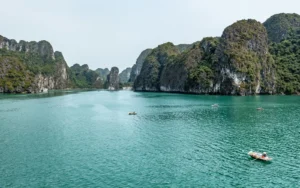
The karst-island seascape, usually done as an overnight cruise from Hanoi.
Hoi An & Da Nang (Centre)
Hoi An’s lantern-lit old town and tailors, with Da Nang’s beaches and airport next door. The charm stop.
Hue (Centre)
The imperial citadel and royal tombs, between Hoi An and the north.
Ho Chi Minh City (South)
Fast, modern Saigon — District 1, war history, rooftop bars, and the gateway to the Mekong Delta.
Sapa (Far North)
Terraced rice mountains and hill-tribe trekking, a night train or drive from Hanoi.
Quick picks by trip type
- First trip: Hanoi + Hoi An + Ho Chi Minh City
- Scenery: Ha Long Bay + Sapa
- Beach: Da Nang / Hoi An
- Nightlife: Ho Chi Minh City
Getting around
Cheap domestic flights link the three hubs; the Reunification train is scenic (the Da Nang–Hue leg especially). Use Grab in the cities.
See more in our Asia travel guide.
Where to stay in Vietnam: the best areas
- Hanoi (Old Quarter) — the atmospheric northern capital base.
- Halong Bay — an overnight cruise among the limestone karsts.
- Hoi An — the lantern-lit old town and nearby beaches.
- Ho Chi Minh City (District 1) — the buzzing southern hub.
- Da Nang — beaches and a modern coastal base.
Vietnam is a touring trip — base-hop north to south rather than picking one place.
Which Vietnam Neighborhood Fits Your Trip
The city you pick matters less than the district inside it. Here is where each type of traveler actually sleeps well.
- First-timers: Ho Chi Minh City’s District 1 around Dong Khoi puts the War Remnants Museum, restaurants, and airport taxis within a short walk. In Hanoi, the Old Quarter is the classic landing spot but motorbikes and food-stall noise run late, so light sleepers should book a room on a quieter side lane. Mid-range doubles in both sit around 30 to 60 USD a night.
- Nightlife: Bui Vien Street in HCMC’s Pham Ngu Lao is the bar strip, loud past midnight, with dorm beds from roughly 7 to 12 USD. Treat it as a base for going out, not for sleeping.
- Families: Skip Hoi An’s Old Town and stay near An Bang Beach instead, about 4 km out (a 3 to 5 USD taxi). Family-run homestays there are calmer and often cheaper than central boutiques. Da Nang near My Khe Beach works too, with clean hostels from around 14 USD.
Overrated pick: staying more than two or three nights in Hanoi’s Old Quarter. Overcharging is common and the horns never stop. West Lake (Tay Ho) gives you green space and better value at around 9 to 27 USD a night.
Where To Stay In Vietnam FAQ
Where should I stay in Vietnam?
Base-hop north to south: Hanoi, Halong Bay, Hoi An and Ho Chi Minh City.
Is Vietnam a single-base or touring destination?
Touring — the highlights stretch the length of the country, so plan to move between them.
Comparing the two? Bangkok vs Ho Chi Minh City
Best time to visit Vietnam (real climate data)
Best months: January, February, November, December.
Vietnam’s warmest month is June (avg 34°C / 93°F), the coolest is January (low 14°C / 57°F). The wettest is August (423 mm) and the driest is December.
Source: Open-Meteo / WMO climate normals (WMO 1991–2020, or ERA5 2019–2023 where unavailable). See the full month-by-month weather →
You Might Also Love


Written by
John Morrison is the founder and lead travel writer at Packzup. Over the past decade he has explored destinations across Africa, the Americas, Asia, Europe, the Middle East, and Oceania — always self-funded, never on a press trip.
