
October is Kyoto at its most comfortable and, for one night, at its most extraordinary. The city settles to about 23°C by day and 14°C at night, dry and clear after the typhoon season, and on Friday 22 October 2027 two things happen at once: the Jidai Matsuri parades twelve centuries of Japanese costume through the city, and the Kurama Fire Festival carries giant flaming torches through a mountain village north of it.
22 October: two festivals, one night
A genuine scheduling problem, and worth understanding before you plan.
Jidai Matsuri, the Festival of the Ages, is the youngest of Kyoto’s three great festivals, founded in 1895 to mark the city’s 1,100th anniversary. Around two thousand people in meticulously researched costume walk in reverse chronological order – Meiji back to Heian – from the Imperial Palace to Heian Shrine, starting at noon. It is effectively a moving museum of Japanese dress.
Kurama no Himatsuri, the same night, is the opposite in every respect. In the mountain village of Kurama, half an hour north by train, residents carry enormous burning pine torches through narrow streets to the shrine, from around 18:00 until late. It is loud, hot, extremely crowded and unforgettable.
You can do both – parade at midday, train to Kurama in the late afternoon – but the Eizan line to Kurama is severely congested that night and the return is worse. Expect long queues and a very late finish, and check whether access restrictions apply that year.
The autumn colour question
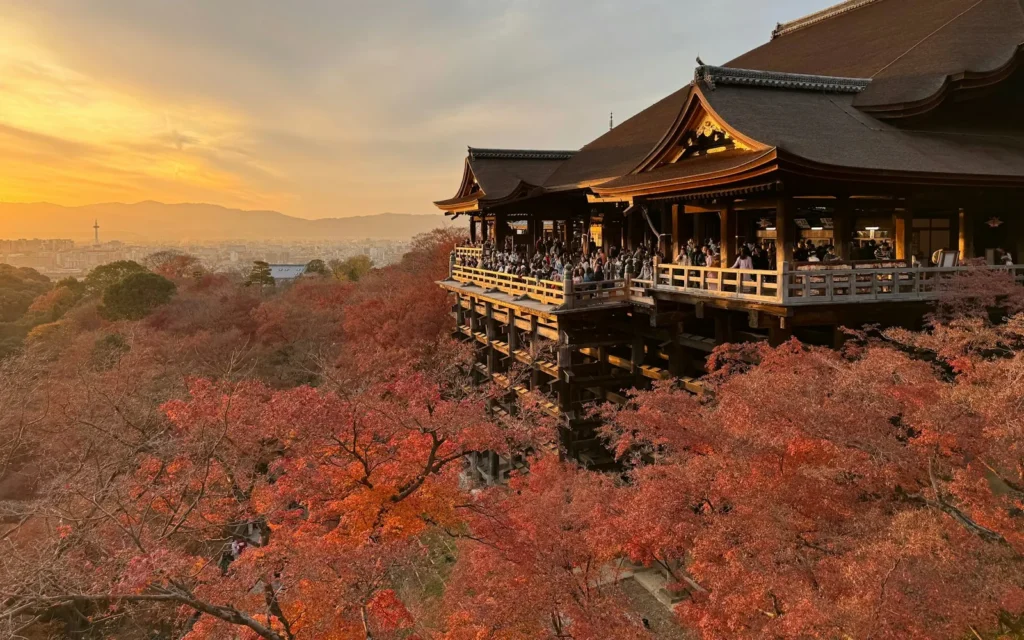
The most common mistake visitors make about Kyoto. The maples do not turn in October. Kyoto’s koyo peaks from about mid-to-late November into early December, and an October trip booked for autumn colour will find green trees.
What October does give you is the best walking weather of the year, dry clear air, and the last month before the maple season doubles accommodation rates. If you want colour in October, you have to go high and north – the Kurama and Ohara valleys begin turning earlier than the city, and the Japan Alps are well ahead.
Weather
October averages about 23°C by day and 14°C at night, with roughly 143 mm of rain, mostly early in the month as the last typhoons pass. From mid-October it is dry, clear and close to ideal for temples and long walks.
What October is for
- Walking. The Philosopher’s Path, the Higashiyama lanes, the full Fushimi Inari loop and Arashiyama are all comfortable now in a way they are not in summer.
- Jidai Matsuri and Kurama, on the 22nd.
- Value. The last month before November pricing.
- The markets – Toji on the 21st, Kitano Tenmangu on the 25th.
- Autumn food – matsutake mushrooms, chestnuts, new-crop rice and the start of the kaiseki autumn menus.
Prices and crowds
Rising through the month and sharply higher at the very end as the maple season approaches. October is busy but not November-busy, and rates are meaningfully lower. Sports Day falls on Monday 11 October 2027, creating a three-day domestic weekend.
See how many days Kyoto needs.
What to pack
Layers – warm afternoons and cool evenings – plus a light rain shell for the first half of the month and comfortable walking shoes. If you are going to Kurama, wear something you do not mind smelling of woodsmoke. See the Japan packing list.
The October 2027 calendar
- Monday 11 October – Sports Day, a public holiday; a three-day domestic weekend.
- Mid October – the last typhoons pass; the weather settles into its best of the year.
- Thursday 21 October – the Toji temple market.
- Friday 22 October, noon – Jidai Matsuri, from the Imperial Palace to Heian Shrine.
- Friday 22 October, evening – the Kurama Fire Festival; the Eizan line is severely congested.
- Monday 25 October – the Kitano Tenmangu market.
- Late October – rates climb sharply towards the November maple season.
Read alongside
- Kyoto in September – typhoon season and the heat breaking.
- Kyoto in November – peak autumn colour and peak prices.
- Japan in October – the country-level view.
- Best time to visit Japan – all twelve months compared.
- Day trips from Kyoto – Kurama and Ohara turn before the city.
- Things to do in Kyoto – the walking list.
- Best photo spots in Kyoto – and when the light is best.
Frequently asked
Is there autumn colour in Kyoto in October?
No, and this is the most common planning error. Kyoto’s maples turn from about mid-to-late November into early December. In October the trees are still green in the city; only the higher Kurama and Ohara valleys begin turning.
What is the Jidai Matsuri?
The Festival of the Ages on 22 October, founded in 1895, when around two thousand people in historically researched costume walk in reverse chronological order from the Imperial Palace to Heian Shrine, starting at noon. It is effectively a moving museum of Japanese dress.
What is the Kurama Fire Festival?
On the same night as Jidai Matsuri, in the mountain village of Kurama half an hour north, residents carry enormous burning pine torches through the streets to the shrine from about 18:00. It is loud, hot and extremely crowded, and the Eizan line is severely congested.
Can you do both festivals on 22 October?
Yes – the parade at midday and Kurama in the evening – but expect long queues for the Eizan line and a very late return. Check whether access restrictions apply in the year you travel.
How warm is Kyoto in October?
About 23°C by day and 14°C at night with roughly 143 mm of rain, mostly early in the month. From mid-October it is dry, clear and close to ideal.
Is October cheaper than November in Kyoto?
Meaningfully, yes. The maple season roughly doubles Kyoto accommodation rates from mid-November, so October – with better walking weather and no crowds at the colour spots – is a strong trade.
Is October a good time to visit Kyoto?
It is the best walking month of the year: dry, clear, comfortable, with two great festivals and prices still below November. The only thing it lacks is the colour.
When should I book for the November maples?
Well before October. By the time the colour forecasts are published, the well-placed Kyoto accommodation for mid-to-late November has gone and rates have already climbed.
You Might Also Love

Written by
John Morrison is the founder and lead travel writer at Packzup. Over the past decade he has explored destinations across Africa, the Americas, Asia, Europe, the Middle East, and Oceania — always self-funded, never on a press trip.
