
December splits Kyoto in two. The first week still carries the tail of the autumn maples at the lower temples; the rest of the month is cold, clear and among the cheapest of the year – about 11°C by day and 3°C at night – until New Year arrives and the city fills again. It is the best month to have the great temples largely to yourself.
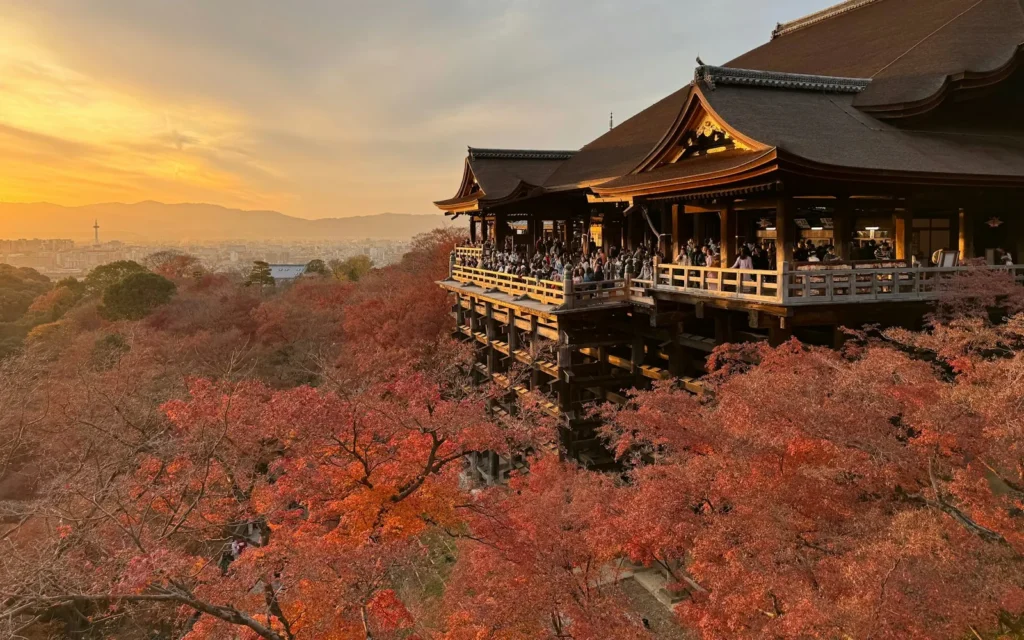
The last of the maples
Kyoto’s koyo peaks in mid-to-late November, but the tail usually runs into the first week of December at the lower-altitude temples. Tofuku-ji, Eikan-do and the Arashiyama temples often still have colour when the hillside sites are bare.
It is a genuine window: the colour is past its best, and so are the November crowds and the November rates. If you cannot travel in peak season, the first days of December are the compromise worth making.
Weather
December averages about 11°C by day and 3°C at night, with roughly 57 mm of precipitation – one of the driest months. Kyoto’s basin cold is damp and gets into unheated temple buildings, so it feels sharper than the numbers. Snow is possible late in the month but uncommon this early.
The compensation is the light. December gives the clearest air of the year, and the low winter sun on raked gravel and bare maple branches is a specific pleasure.
New Year, and what closes
From about 28 December the city turns to shogatsu. Roughly 29 December to 3 January, most restaurants, many shops and some temples close, and prices and occupancy climb sharply.
- Friday 31 December – Omisoka. Temple bells are rung 108 times at midnight – joya no kane – at Chion-in, whose bell is one of the largest in Japan and needs seventeen monks to ring it, and at Kiyomizu-dera and Zojo-ji. People queue to ring smaller bells themselves at many temples.
- Yasaka Shrine’s okera-mairi on the same night: a sacred flame carried home on a lit rope to start the new year’s first fire.
- Toshikoshi soba is eaten on the 31st – buckwheat noodles, for a clean break with the year.
25 December is an ordinary working day in Japan. There is no Christmas public holiday, and December has no public holiday at all since the Emperor’s Birthday moved to February in 2020.
What December is for
- Empty temples, from about 8 December to Christmas – the quietest and cheapest stretch of the year alongside late January.
- Dry gardens. Ryoan-ji and Daitoku-ji read best in cold clear light with nobody else there.
- The year’s biggest markets – the Toji market on 21 December is Shimai-Kobo, the last and largest of the year, and Kitano Tenmangu on the 25th is Shimai-Tenjin.
- Winter food – yudofu below Nanzen-ji, kaiseki at its most seasonal, and the start of the crab season.
- Joya no kane on New Year’s Eve.
Prices and crowds
Three phases. The first week carries a little of the autumn tail; 8 to about 27 December is the value window, with the temples quiet and rates near their annual floor; and from the 28th, New Year pricing and full occupancy take over through to about 3 January.
See how many days Kyoto needs.
What to pack
A warm coat, layers and warm socks – you remove your shoes constantly and temple floors are genuinely cold. Kyoto’s damp basin cold is sharper than the temperature suggests. See the Japan packing list.
The December 2027 calendar
- First week – the tail of the autumn colour at Tofuku-ji, Eikan-do and Arashiyama.
- 8–27 December – the value window; empty temples and rates near the annual floor.
- Tuesday 21 December – Shimai-Kobo, the last and largest Toji market of the year.
- Saturday 25 December – an ordinary working day in Japan; also Shimai-Tenjin at Kitano Tenmangu.
- From about 28 December – the New Year shutdown begins; prices and occupancy climb.
- Friday 31 December – Omisoka; joya no kane at Chion-in and Kiyomizu-dera, okera-mairi at Yasaka.
- 29 December – 3 January – most restaurants, many shops and some temples closed.
Read alongside
- Kyoto in November – peak autumn colour and peak prices.
- Kyoto in January – New Year and the emptiest weeks.
- Japan in December – the country-level view.
- Best time to visit Japan – all twelve months compared.
- Things to do in Kyoto – the winter list.
- Kyoto food guide – yudofu and the crab season.
- Kyoto travel guide – districts and how to plan them.
Frequently asked
Can you still see autumn colour in Kyoto in December?
Usually into the first week, at the lower-altitude temples – Tofuku-ji, Eikan-do and the Arashiyama sites often hold colour when the hillside temples are bare. The colour is past its best, and so are the November crowds and rates.
Is Christmas a holiday in Japan?
No. 25 December is an ordinary working day, and December has no public holiday at all since the Emperor’s Birthday moved to February in 2020.
What is joya no kane?
The ringing of temple bells 108 times at midnight on New Year’s Eve. Chion-in has one of the largest bells in Japan, needing seventeen monks to ring it; many temples let visitors ring smaller bells themselves.
How cold is Kyoto in December?
About 11°C by day and 3°C at night, with roughly 57 mm of precipitation – one of the driest months. The damp basin cold is sharper than the numbers, especially in unheated temple buildings.
When is the cheapest time in December?
Roughly 8 to 27 December. The autumn crowds have gone, the temples are quiet, rates are near the annual floor, and the New Year premium has not started.
What closes over New Year in Kyoto?
Most restaurants, many shops and some temples from about 29 December to 3 January. Shrines are the exception and become the busiest places in the city for hatsumode.
Are the December temple markets worth it?
Very. The Toji market on 21 December is Shimai-Kobo, the last and largest of the year, and Kitano Tenmangu on the 25th is Shimai-Tenjin. Both are free and start early.
Does it snow in Kyoto in December?
Occasionally, late in the month, but January and February are far more likely. December is cold, dry and clear rather than snowy.
You Might Also Love

Written by
John Morrison is the founder and lead travel writer at Packzup. Over the past decade he has explored destinations across Africa, the Americas, Asia, Europe, the Middle East, and Oceania — always self-funded, never on a press trip.
