

January is deep winter and peak ski season, and it contains the single most expensive week of the Swiss year followed by one of the cheapest. It also contains the fact that surprises most first-time winter visitors: the mountains are often in brilliant sunshine while Zurich and Bern sit under grey cloud all day.
The numbers
The fog on the plateau, the sun above it
Through the winter the Swiss Plateau – the belt holding Zurich, Bern, Lucerne and Basel – regularly sits under a temperature inversion. Cold air pools in the lowlands under a lid of low stratus known locally as Hochnebel, while the mountains above about 1,000–1,500 m are in clear sun, looking down on what the Swiss call a Nebelmeer, a sea of fog.
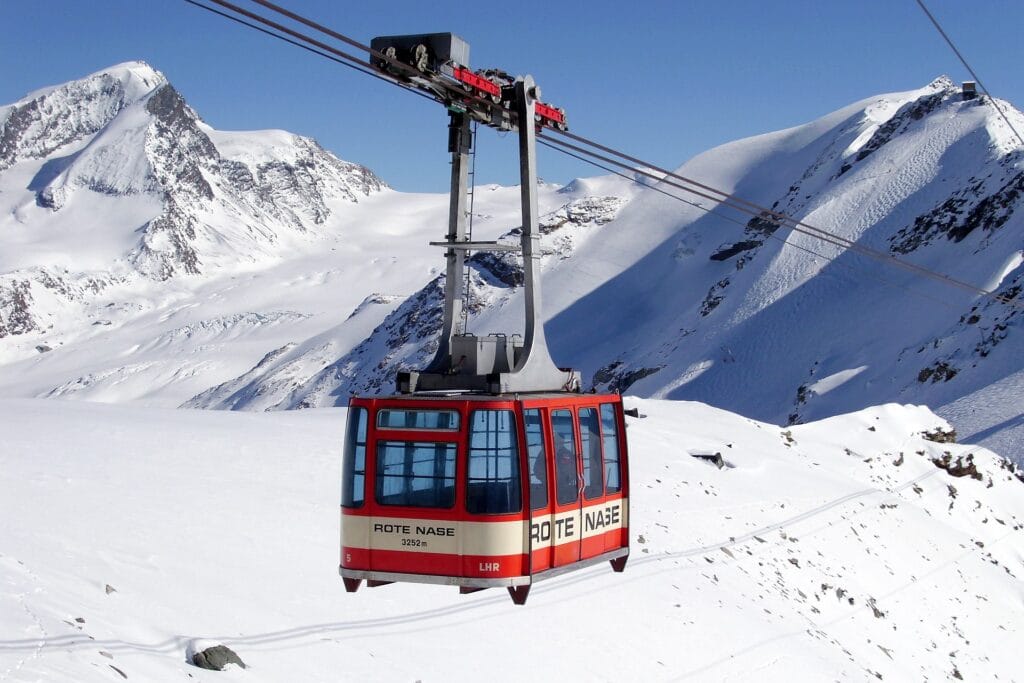
The practical consequence is large. A week in Zurich in January can be grey from start to finish; a cable car up Rigi, Pilatus, Stanserhorn or the Schilthorn can put you above the cloud in twenty minutes. If your forecast for the lowlands looks bleak, go up rather than waiting it out.
Skiing in January
- Snow conditions are usually at their most reliable, with cold temperatures holding the base.
- The New Year week is the most expensive of the year, followed by a genuine lull in the middle of January before the February half-term rush.
- The World Cup races come to Adelboden and Wengen in January. Wengen’s Lauberhorn is the longest downhill on the circuit, and race weekends fill the Jungfrau region.
- Check the avalanche bulletin from the SLF institute in Davos before any off-piste plan. It is published daily and is the standard reference.
- Trains and buses run through snow. Swiss public transport is the most winter-proof in Europe, and a rail pass is usually a better bet than a hire car in January.
What else January is for
- Sledging. Switzerland has hundreds of marked toboggan runs, many floodlit for evening use, and they cost a fraction of a lift pass.
- Winter hiking. Prepared and signposted winter walking trails run through most resort areas – no equipment needed beyond boots and grips.
- Thermal baths. Leukerbad, Vals, Bad Ragaz and Scuol are at their best with snow outside.
- Ticino. South of the Alps, Lugano and Locarno stay several degrees milder and noticeably sunnier than the north all winter.
- The scenic rail routes. The Glacier Express and Bernina Express run through the winter, and the Bernina line in snow is arguably better than in summer.
Where to go in January
- Zermatt, Verbier, Davos, St Moritz and the Jungfrau region – the big lift networks, running at full capacity.
- Above the fog – Rigi, Pilatus, Stanserhorn, Schilthorn and Stoos for a half-day escape from a grey Zurich or Lucerne.
- Lugano and Locarno for the mildest, sunniest corner of the country.
- Leukerbad, Vals and Scuol for thermal water without a ski pass.
- The Bernina line between Chur, St Moritz and Tirano, which crosses the Alps without a tunnel and is spectacular under snow.
Prices and crowds
The last week of December and the first days of January are the most expensive of the Swiss year. From roughly the second week the resorts quieten and rates fall sharply until the February school holidays. The lowland cities are in low season all month and are the cheapest they get. See what travelling Switzerland costs and how much a trip adds up to.
What to pack
Proper winter clothing: insulated jacket, hat, gloves and waterproof boots with grip. Sunglasses and high-factor sunscreen – altitude plus snow reflection burns even at freezing point. Layers, because the difference between a foggy 1°C in Zurich and a sunny −8°C at 2,500 m is not the one most people expect. A refillable bottle; Swiss tap and fountain water is excellent.
The January 2027 calendar
- Friday 1 January – New Year’s Day, a public holiday nationwide.
- Saturday 2 January – Berchtoldstag, a holiday in many German-speaking cantons.
- First week of January – the peak of the ski season on price and occupancy.
- Mid-January – the quietest and best-value stretch of the whole winter.
- January – Alpine Ski World Cup racing at Adelboden and at Wengen, where the Lauberhorn is the longest downhill on the circuit.
- Through January – persistent Hochnebel on the plateau; the mountains are frequently in sun above it.
Read alongside
- Switzerland in February – carnival and half-term.
- Switzerland in March – spring skiing.
- Switzerland in December – markets and the season opening.
- Best time to visit Switzerland – all twelve months compared.
- Switzerland travel guide – regions, trains and how it fits together.
- Switzerland in 7 days – a first-visit route.
- Switzerland in 10 days – the longer version.
- Best things to do in Switzerland – the year-round list.
Frequently asked
How cold is Switzerland in January?
Zurich averages about 4°C by day and −1°C overnight, and Lugano south of the Alps is a few degrees milder at about 7°C. In the mountains it is far colder – temperature falls roughly 0.6°C for every 100 m you climb.
Why is it grey in Zurich but sunny in the mountains?
A winter temperature inversion traps cold air and low cloud over the Swiss Plateau. Above about 1,000 to 1,500 m you are usually in clear sun looking down on the fog. Taking a cable car up is the standard response.
Is January a good time to ski in Switzerland?
Yes – snow reliability is at its best. Avoid the New Year week if you can; mid-January is markedly quieter and cheaper before the February half-term.
When are the Swiss public holidays in January 2027?
New Year’s Day on Friday 1 January nationwide, and Berchtoldstag on Saturday 2 January in many German-speaking cantons.
Do Swiss trains run in the snow?
Yes. Swiss public transport is built for winter and keeps running through conditions that would stop traffic elsewhere. In January a rail pass is usually more practical than a hire car.
Can you visit Switzerland in January without skiing?
Easily. Sledging, prepared winter walking trails, thermal baths, the scenic rail routes and the Ticino lakes all work without a lift pass, and the cities are in low season.
Do I need sunscreen in a Swiss winter?
On the mountain, yes. Altitude and snow reflection together burn quickly even when the air is below freezing.
Where can I check avalanche risk in Switzerland?
The SLF institute in Davos publishes a daily national avalanche bulletin. Consult it before any off-piste or backcountry plan, and hire a guide if you are not equipped to read it.
Switzerland month by month
- January – deep winter, peak ski, and fog on the plateau (this page).
- February – the coldest weeks, carnival, and half-term crowds.
- March – spring skiing and the first valleys thawing.
- April – snowmelt, closed passes, and a country in two seasons.
- May – waterfalls at full volume and the passes reopening.
- June – alpine flowers and the first full hiking month.
- July – peak summer, festivals and long days in the mountains.
- August – warm lakes, National Day and the busiest trails.
- September – the best hiking month and the cattle coming down.
- October – autumn colour, clear air and the passes closing.
- November – the quietest and cheapest month of the year.
- December – Christmas markets and the season opening.
You Might Also Love



Written by
John Morrison is the founder and lead travel writer at Packzup. Over the past decade he has explored destinations across Africa, the Americas, Asia, Europe, the Middle East, and Oceania — always self-funded, never on a press trip.
