
June is the month most guides tell you to skip, and the month experienced visitors quietly book. Tsuyu, the rainy season, reaches most of Japan around the first week of June and runs to about mid-July – but Tokyo still only averages 168 mm across twelve days, which is fewer wet days than a London autumn. In exchange you get hydrangeas, green moss gardens, the emptiest temples of the year and the lowest prices before the summer.
What tsuyu actually means
The Japan Meteorological Agency’s long-run average has the rainy season running from about 7 June to about 19 July across most of the country. What that looks like on the ground:
- Grey, humid days with intermittent rain rather than continuous downpours. A typical day has rain for part of it and not the rest.
- Tokyo gets around 168 mm over twelve days – more than May, but far from a washout. Kyoto is wetter at around 200 mm.
- Humidity is the real cost. 26°C at high humidity is more tiring than the number suggests.
- Hokkaido has no proper rainy season – the island largely escapes tsuyu, and June there is cool, bright and one of its best months.
The single most useful adjustment: build indoor options into every day. Japan is extraordinarily good at this – museums, covered shopping streets, department-store basements, cafes, onsen and the entire underground city beneath most stations.
Weather by region
- Tokyo – about 26°C by day and 19°C at night, with roughly 168 mm of rain across twelve days. Warm, grey and humid.
- Kyoto and Osaka – around 27°C and wetter, near 200 mm. Kyoto’s moss gardens are at their best in exactly this weather.
- Hokkaido – no real rainy season; cool, clear and green, with the Furano lavender beginning late in the month.
- Okinawa – its rainy season, which started in mid-May, usually ends around late June, after which the islands are hot and excellent.
- The Japan Alps – green and walkable between showers; Kamikochi opens fully for the season.
Hydrangeas, and the aesthetic case for June
June is ajisai season. Hydrangeas are planted deliberately at temples across the country for this month, and the combination of wet stone, moss and blue-purple flowers is a specifically Japanese pleasure rather than a consolation prize. Meigetsu-in and Hase-dera in Kamakura, Mimuroto-ji near Kyoto and Hakusan Shrine in Tokyo are the best known, and all of them are better in light rain.
The same is true of Kyoto’s moss temples – Saiho-ji, Gio-ji, Sanzen-in – which look faded in dry weather and extraordinary in June.
What June is genuinely good for
- Empty temples. Kyoto without Golden Week or autumn crowds is a different city, and mid-June weekdays are as quiet as it gets.
- Price. It is the cheapest month of the first half of the year after January, with no domestic holiday rush at all.
- Hokkaido. Escaping tsuyu entirely while the rest of the country is grey is the strongest single argument for a June trip.
- Onsen. Hot-spring towns like Kinosaki, Kusatsu and Ginzan are at their least crowded and rain suits them.
What to avoid in June
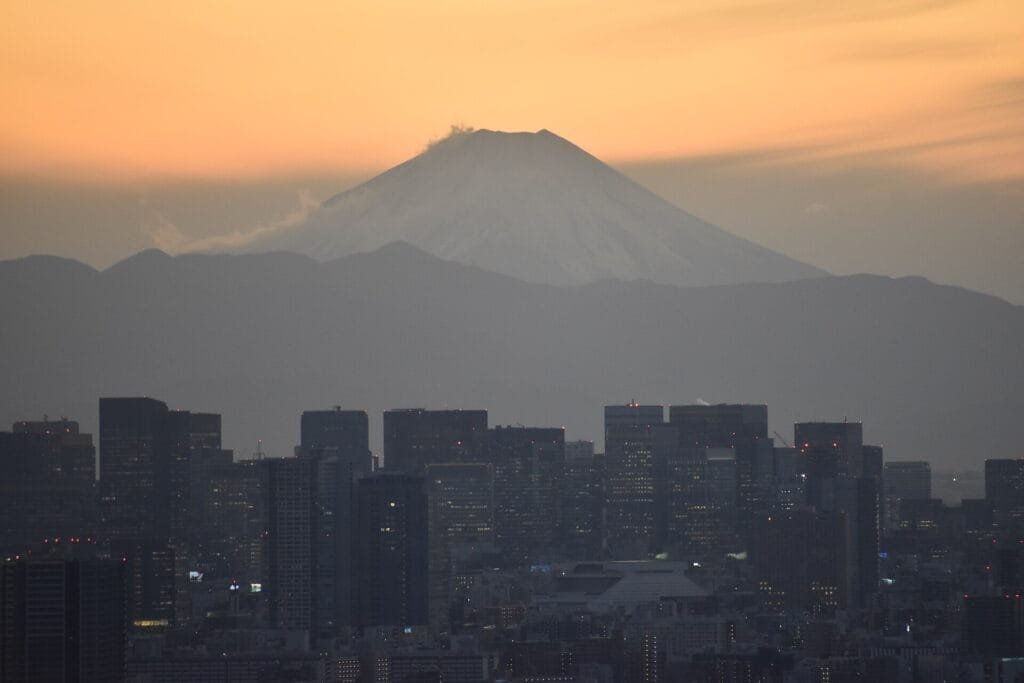
Fixed multi-day hiking plans, and anything that depends on a view. Fuji is rarely visible, mountain trails are slippery, and the official Mount Fuji climbing season does not open until the start of July – June attempts are outside the season, with huts closed and trails officially discouraged.
Prices and crowds
Low on both counts. There is no Japanese public holiday in June at all – the only month of the year with none – so domestic travel is flat and foreign arrivals dip between the cherry-blossom and summer peaks. Hotel rates in Tokyo and Kyoto are among the year’s best.
See the best time to visit Japan for the full comparison.
What to pack
A compact umbrella – Japan is an umbrella country, not a raincoat one, and every station and convenience store sells them – quick-drying clothing, shoes that cope with wet pavement, and something for aggressive indoor air conditioning. A small towel is standard Japanese equipment in humid months. See the Japan packing list.
The June 2027 calendar
- About 7 June – the rainy season typically begins across most of the country.
- All month – no public holidays; the only such month in the Japanese year.
- Through June – hydrangea season at Kamakura, Mimuroto-ji and temple gardens nationwide.
- Mid June – Kyoto’s moss gardens at their best.
- Late June – Okinawa’s rainy season usually ends; Furano’s lavender begins in Hokkaido.
- 30 June – Nagoshi no Harae, the summer purification rite, at shrines nationwide.
- Early July – the official Mount Fuji climbing season opens; huts take June bookings.
Read alongside
- Japan in May – Golden Week, and the last dry month.
- Japan in July – Gion Matsuri, fireworks and the end of the rains.
- Best time to visit Japan – all twelve months compared.
- Tokyo in June – the city-level version of this month.
- Kyoto vs Hokkaido – the decision June makes easiest.
- Japan travel guide – regions, rail and how to combine them.
- Japan packing list – the rainy-season version.
Frequently asked
Is June a bad time to visit Japan?
No, but it is a specific one. It is the rainy season on the mainland, with grey humid days and intermittent rain – and in exchange you get the emptiest temples, the lowest prices of the first half of the year, hydrangea season and Hokkaido at its best.
When is Japan’s rainy season?
On long-run averages it runs from about 7 June to about 19 July across most of the country. Okinawa starts about a month earlier, in mid-May, and Hokkaido largely escapes it.
How much does it rain in Tokyo in June?
Around 168 mm across roughly twelve days – more than May, but fewer wet days than many people expect. Kyoto is wetter, at about 200 mm.
Is there a public holiday in Japan in June?
No. June is the only month of the Japanese year with no national holiday, which is part of why domestic travel and hotel prices are so flat.
Where should I go in Japan in June?
Hokkaido, which has no real rainy season and is cool and bright, and Kyoto, whose moss and hydrangea gardens are at their best in exactly this weather. Both are unusually quiet.
Can you climb Mount Fuji in June?
Not within the official season, which opens at the start of July. In June the huts are closed and the trails are officially discouraged, so June is for booking rather than climbing.
Is Japan cheap in June?
Yes – after January it is the cheapest month of the first half of the year, with no domestic holiday rush and foreign arrivals dipping between the spring and summer peaks.
Do I need a raincoat in Japan in June?
An umbrella is more useful. Japan is an umbrella culture, every station and convenience store sells them cheaply, and most buildings have umbrella stands. Add quick-drying clothing and something light for heavy indoor air conditioning.
You Might Also Love


Written by
John Morrison is the founder and lead travel writer at Packzup. Over the past decade he has explored destinations across Africa, the Americas, Asia, Europe, the Middle East, and Oceania — always self-funded, never on a press trip.
