
July belongs to Gion Matsuri, the biggest festival in Japan, which takes over central Kyoto for the entire month. The two great float parades fall on Saturday 17 and Saturday 24 July 2027 – both on weekends, which will make them busier than usual – and the Yoiyama evenings before each are arguably better than the parades themselves. It is also brutally hot: Kyoto reaches about 32°C and the basin holds it.
Gion Matsuri: the dates that matter
The festival runs all July, but the schedule is fixed and only a handful of dates are the event:
- Yoiyama evenings, 14–16 July – central Kyoto closed to traffic, the yamaboko floats lit and standing in the streets, food and drink stalls everywhere, roughly 18:00 to 23:00. Many old machiya open their street-facing rooms to display family heirlooms.
- Saturday 17 July – Saki Matsuri Yamaboko Junko, the first and larger parade, from about 09:00. The floats are hauled by teams, and the turns at the junctions – wheels dragged across wet bamboo – are the moment everyone waits for.
- Yoiyama again, 21–23 July, ahead of the second parade.
- Saturday 24 July – Ato Matsuri Yamaboko Junko, smaller, calmer and for many people the better of the two.
Book Kyoto accommodation for 14–17 and 21–24 July many months ahead. Paid grandstand seating is sold for the parades; the route itself is free but you will stand in serious heat for hours. The Ato Matsuri is the one to choose if you want to see it without the crush.
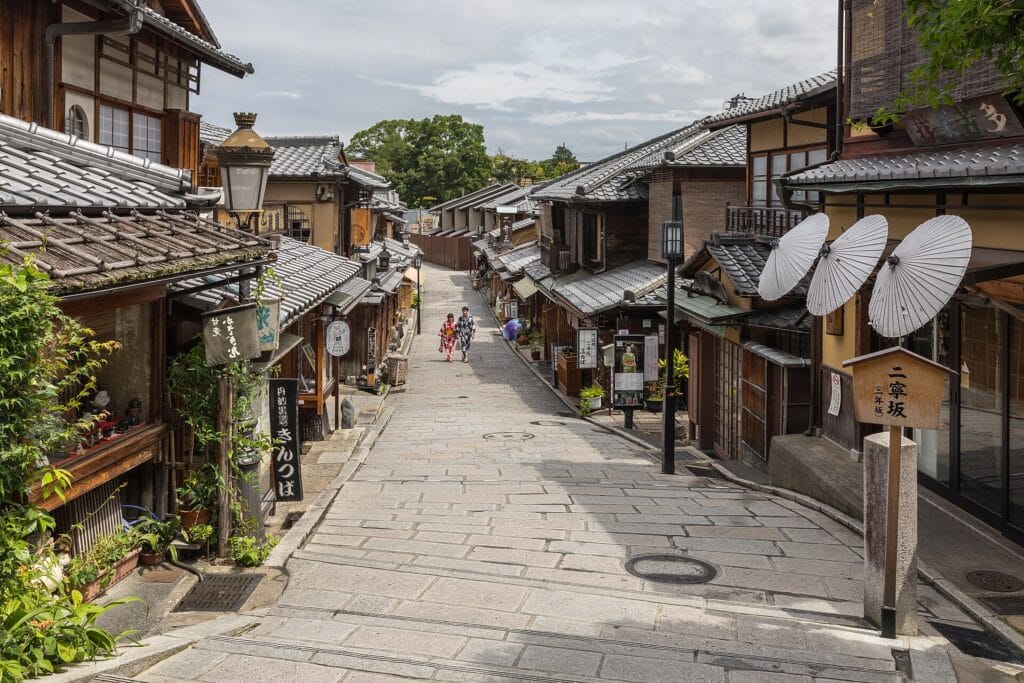
The heat is the other story
Kyoto sits in a basin ringed by mountains, and in July that means about 32°C by day and 22°C at night with high humidity and roughly 224 mm of rain, most of it early in the month before the rainy season lifts around the 19th. It is consistently one of the hottest cities in Japan.
The workable structure: temples at opening, indoors or on a river from late morning, out again after five. The Kyoto solutions are good ones:
- Kawadoko – dining platforms over the water at Kibune, several degrees cooler than the city, and along the Kamo at Pontocho.
- Kurama and Ohara, both north and higher.
- The Hozugawa river boat ride down to Arashiyama.
- Museums and covered arcades – Nishiki market, the Kyoto National Museum, the Manga Museum.
Prices and crowds
The Gion Matsuri weeks are among the most expensive of the Kyoto year, and 2027 is worse than usual because both parades fall on Saturdays. Outside those two blocks, July is otherwise a moderate month – the heat suppresses ordinary tourism, and the first ten days in particular are reasonably priced.
See how many days Kyoto needs.
What to pack
The lightest clothing you own, a hand towel, a fan, sunscreen and a refillable bottle. Add an umbrella for the first half of the month. If you are going to Yoiyama, wear something you can stand in a dense crowd in for hours – and consider renting a yukata, which is what most people wear and is genuinely cooler. See the Japan packing list.
The July 2027 calendar
- 1 July onwards – Gion Matsuri opening rituals; the floats begin to be assembled by hand, without nails.
- 14–16 July – Yoiyama evenings; central Kyoto closed to traffic.
- Saturday 17 July – Saki Matsuri Yamaboko Junko, the first great parade.
- About 19 July – the rainy season typically lifts and the real heat arrives.
- 21–23 July – the second run of Yoiyama evenings.
- Saturday 24 July – Ato Matsuri Yamaboko Junko, the quieter and often better parade.
- Wednesday 21 and Sunday 25 July – the Toji and Kitano Tenmangu markets.
Read alongside
- Kyoto in June – the rainy season and the moss gardens.
- Kyoto in August – the hottest month and the Daimonji fires.
- Japan in July – the country-level view.
- Best time to visit Japan – all twelve months compared.
- Things to do in Kyoto – and how to time them in the heat.
- Kyoto food guide – kawadoko season.
- Day trips from Kyoto – Kibune and Kurama for the cool.
Frequently asked
When is Gion Matsuri in 2027?
Throughout July, with fixed key dates: Yoiyama evenings on 14–16 and 21–23 July, and the two Yamaboko Junko float parades on Saturday 17 and Saturday 24 July 2027. Both parades fall on a weekend, so expect heavier crowds than usual.
Which Gion Matsuri parade should I see?
The Ato Matsuri on 24 July if you want to see it properly – it is smaller, calmer and far less crushed. The Saki Matsuri on the 17th is larger and more spectacular, and correspondingly harder to watch.
Are the Yoiyama evenings worth it?
For many people they are better than the parades. Central Kyoto closes to traffic, the floats stand lit in the streets, and old machiya open their street-facing rooms to display family heirlooms – which is the part you cannot see at any other time.
How hot is Kyoto in July?
About 32°C by day and 22°C at night with high humidity. Kyoto sits in a mountain basin that traps the heat, making it consistently one of the hottest cities in Japan.
How far ahead should I book for Gion Matsuri?
Many months. Accommodation for 14–17 and 21–24 July is the most sought-after of the Kyoto year, and 2027 is worse because both parades are on Saturdays.
What is kawadoko?
Dining platforms built out over the water – at Kibune directly above the stream, and along the Kamo at Pontocho. Kibune runs several degrees cooler than the city and is the standard local escape from a Kyoto July.
When does the rainy season end?
Around 19 July on long-run averages. The change is abrupt: grey and humid becomes hot and bright within a couple of days, and the cicadas start.
Is July expensive in Kyoto?
During the two Gion Matsuri blocks, very. Outside them the heat suppresses ordinary tourism and July is moderate – the first ten days in particular are reasonably priced.
You Might Also Love


Written by
John Morrison is the founder and lead travel writer at Packzup. Over the past decade he has explored destinations across Africa, the Americas, Asia, Europe, the Middle East, and Oceania — always self-funded, never on a press trip.
