
June is Kyoto’s rainy season and the month that rewards knowing what you are looking at. Tsuyu arrives in early June, the city sits at about 28°C and humid with roughly 200 mm of rain – and the moss gardens, which look faded in dry weather, become the best version of themselves. The hydrangeas open, the temples are empty, and it is the cheapest month between sakura and autumn.
What the rain actually does for Kyoto
This is the argument for June, and it is a real one. Kyoto’s most celebrated gardens are moss gardens, and moss needs rain to look like anything. In June it is saturated, luminous and exactly as the gardens were designed to be seen.
- Saiho-ji (Kokedera) – the moss temple, over a hundred varieties. Visits are by advance application only and involve copying a sutra before you enter the garden; check the current booking procedure well ahead.
- Gio-ji in Arashiyama – small, thatched and carpeted in moss. One of the loveliest places in the city and rarely crowded.
- Sanzen-in at Ohara, north of the city, with its moss slope and small stone figures.
- Ginkaku-ji, whose moss garden is the underrated half of the site.
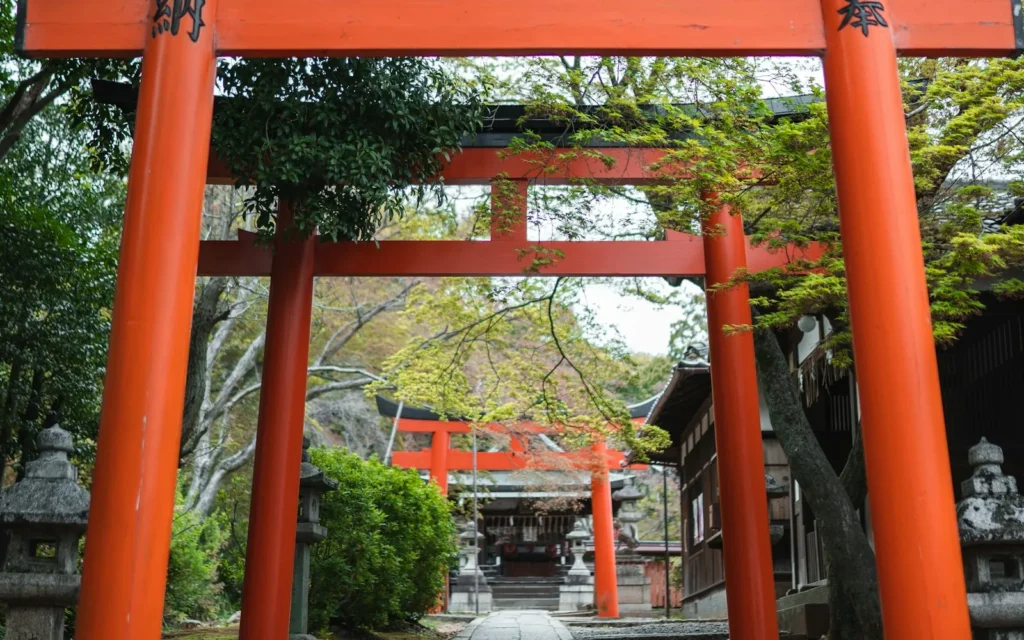
Hydrangeas
Ajisai season runs through June, and several Kyoto temples plant for it deliberately:
- Mimuroto-ji at Uji – around ten thousand hydrangeas on a hillside, the best in the region.
- Fujinomori Shrine, close to Fushimi Inari, which holds a hydrangea festival.
- Sanzen-in and Yanagidani Kannon, both quieter.
Weather
June averages about 28°C by day and 19°C at night, with roughly 200 mm of rain. Tsuyu normally reaches the Kyoto area in the first week and runs into mid-July. It is not continuous rain – grey humid days with intermittent showers is the pattern – but the humidity in a mountain basin is the real cost.
What else June offers
- Empty temples. Kiyomizu-dera, Ginkaku-ji and Arashiyama at a fraction of their spring numbers.
- Kawadoko – the riverside dining platforms built out over the water at Kibune and along the Kamo in Pontocho, which run through the summer and are the Kyoto answer to the heat.
- 30 June – Nagoshi no Harae, the summer purification rite, when visitors walk through a large grass ring at shrines across the city to shed the first half of the year.
- Price. The cheapest month between the two peak seasons.
Prices and crowds
Low. Foreign visitors thin out, there are no Japanese holidays in June at all – the only month of the year with none – and Kyoto accommodation, which is the main cost of any trip here, drops accordingly.
See how many days Kyoto needs.
What to pack
A compact umbrella rather than a raincoat – Japan is an umbrella country and every convenience store sells them – quick-drying clothes, shoes that cope with wet stone, and a small towel, which is standard Japanese equipment in humid months. See the Japan packing list.
The June 2027 calendar
- Early June – tsuyu, the rainy season, normally reaches Kyoto.
- Through June – moss gardens at their best; hydrangeas at Mimuroto-ji and Fujinomori.
- Through June – no public holidays anywhere in Japan; the only such month.
- Through June – kawadoko riverside platforms open at Kibune and Pontocho.
- Monday 21 June – the Toji temple market.
- Friday 25 June – the Kitano Tenmangu market.
- Wednesday 30 June – Nagoshi no Harae; grass-ring purification at shrines across the city.
Read alongside
- Kyoto in May – green maples and the best weather.
- Kyoto in July – Gion Matsuri and the heat.
- Japan in June – the country-level view of the rainy season.
- Best time to visit Japan – all twelve months compared.
- Things to do in Kyoto – the wet-weather list.
- Day trips from Kyoto – Uji and Ohara for hydrangeas and moss.
- Kyoto food guide – kawadoko dining season.
Frequently asked
Is June a bad time to visit Kyoto?
It is the rainy season, and it is also when the moss gardens look their best, the hydrangeas are out, the temples are empty and prices are at their lowest between the two peak seasons. For a certain kind of trip it is the ideal month.
How much does it rain in Kyoto in June?
Around 200 mm, arriving as grey humid days with intermittent showers rather than continuous downpours. Tsuyu normally reaches the area in the first week and runs into mid-July.
Where are the best moss gardens?
Saiho-ji, the moss temple, which requires advance application and a sutra-copying session before entry; Gio-ji in Arashiyama; Sanzen-in at Ohara; and the often-overlooked moss garden at Ginkaku-ji.
When are hydrangeas in Kyoto?
Through June. Mimuroto-ji at Uji has around ten thousand of them on a hillside and is the best in the region; Fujinomori Shrine near Fushimi Inari holds a hydrangea festival.
How hot is Kyoto in June?
About 28°C by day and 19°C at night. The humidity in a mountain basin is the real issue rather than the temperature, and it gets worse through July and August.
What is kawadoko?
Riverside dining platforms built out over the water at Kibune and along the Kamo at Pontocho, open through the summer. At Kibune the platforms sit directly above the stream and it is several degrees cooler than the city.
Is Kyoto cheap in June?
It is the cheapest month between sakura and autumn. There are no Japanese public holidays in June at all, foreign numbers are down, and accommodation – the main cost of a Kyoto trip – falls with them.
Do I need an umbrella or a raincoat?
An umbrella. Japan is an umbrella culture, every convenience store sells them cheaply and every building has a stand for them. Add a small towel, which is what locals carry in humid months.
You Might Also Love



Written by
John Morrison is the founder and lead travel writer at Packzup. Over the past decade he has explored destinations across Africa, the Americas, Asia, Europe, the Middle East, and Oceania — always self-funded, never on a press trip.
